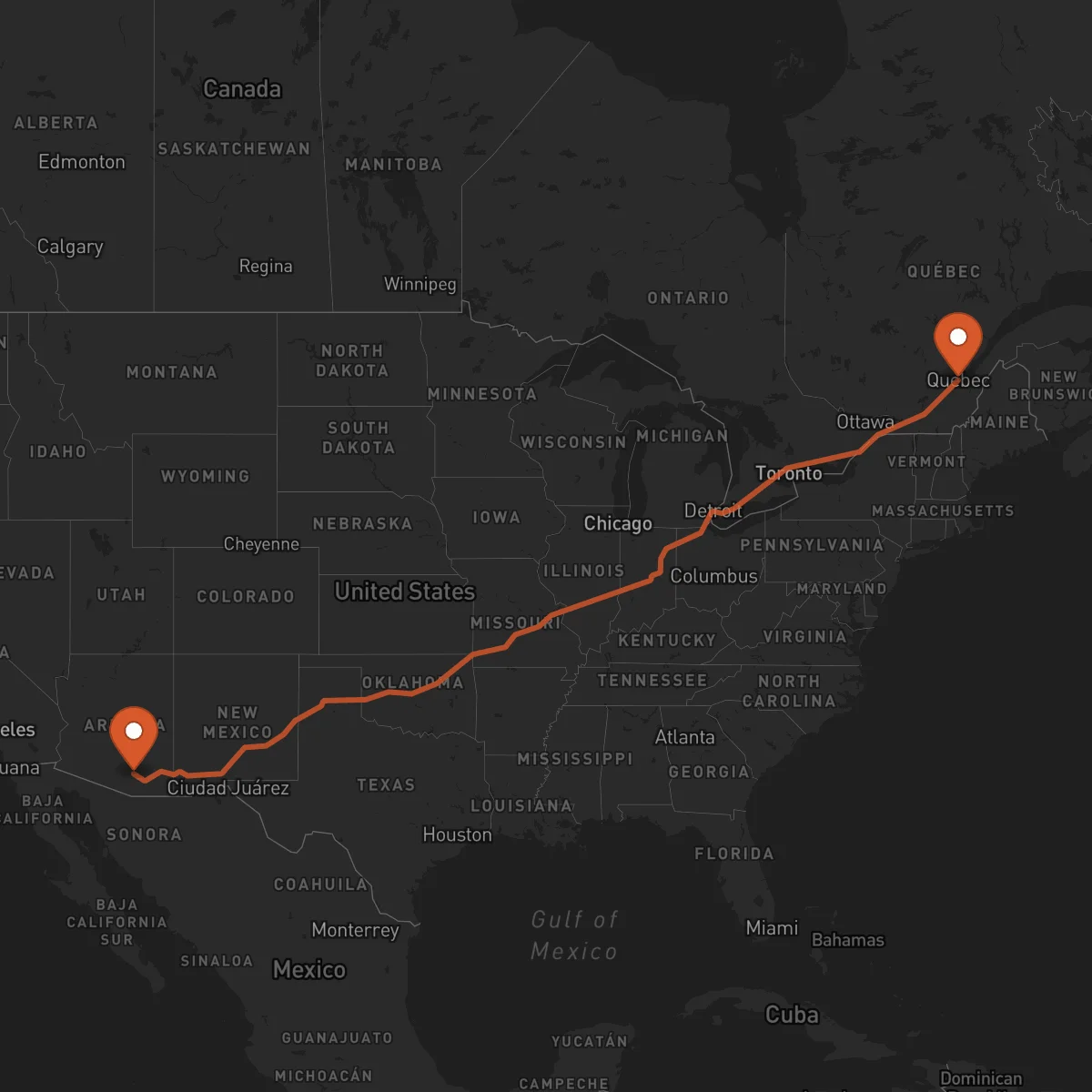
Tucson to Quebec City
Quebec City → TucsonFTL freight transportation service between Tucson and Quebec City. Reliable logistics solutions for your business.
Route Description
Everything you need to know about the corridor Tucson - Quebec City
The Tucson-Quebec City corridor is a vital logistics artery connecting the industrial heart of Arizona with the economic hub of Quebec. This 3,724 km cross-border route traverses diverse landscapes and industrial zones, facilitating the movement of goods between the United States and Canada. The corridor's strategic importance lies in its ability to link the manufacturing and agricultural sectors of the southwestern United States with the automotive, aerospace, and technology industries of Quebec. Control Terrestre leverages this route to provide efficient FTL transportation solutions, ensuring seamless cross-border operations. The corridor primarily utilizes Interstate 19, I-17, and I-40 in the U.S., transitioning to Autoroutes 20 and 40 in Canada. Key border crossings include Nogales-Mariposa and Lacolle, where our C-TPAT and FAST certifications expedite customs clearance. Our extensive network of certified carriers and deep understanding of cross-border regulations enable us to navigate the complexities of this international route, offering our clients reliable and timely transportation services. The Tucson-Quebec City corridor is particularly crucial for industries such as automotive parts, electronics, and agricultural products, which rely on our specialized equipment and temperature-controlled transportation options to maintain product integrity throughout the journey.
Services for this Route
Available services for the corridor Tucson - Quebec City
 Origin
Tucson
Tucson, Arizona, serves as a strategic gateway for logistics operations in the southwestern United States. Located just 100 km from the Mexican border, Tucson offers unparalleled access to both domestic and international markets. The city's economy is driven by diverse sectors, including aerospace and defense, optics and photonics, and advanced manufacturing. Tucson's transportation infrastructure is robust, featuring the Tucson International Airport, Union Pacific and Burlington Northern Santa Fe rail lines, and extensive highway networks including I-10 and I-19. The Port of Tucson Inland Port further enhances the city's logistics capabilities, providing efficient intermodal connections. Control Terrestre capitalizes on Tucson's strategic location and infrastructure to offer seamless FTL transportation solutions, connecting local industries with markets across North America.
 Destination
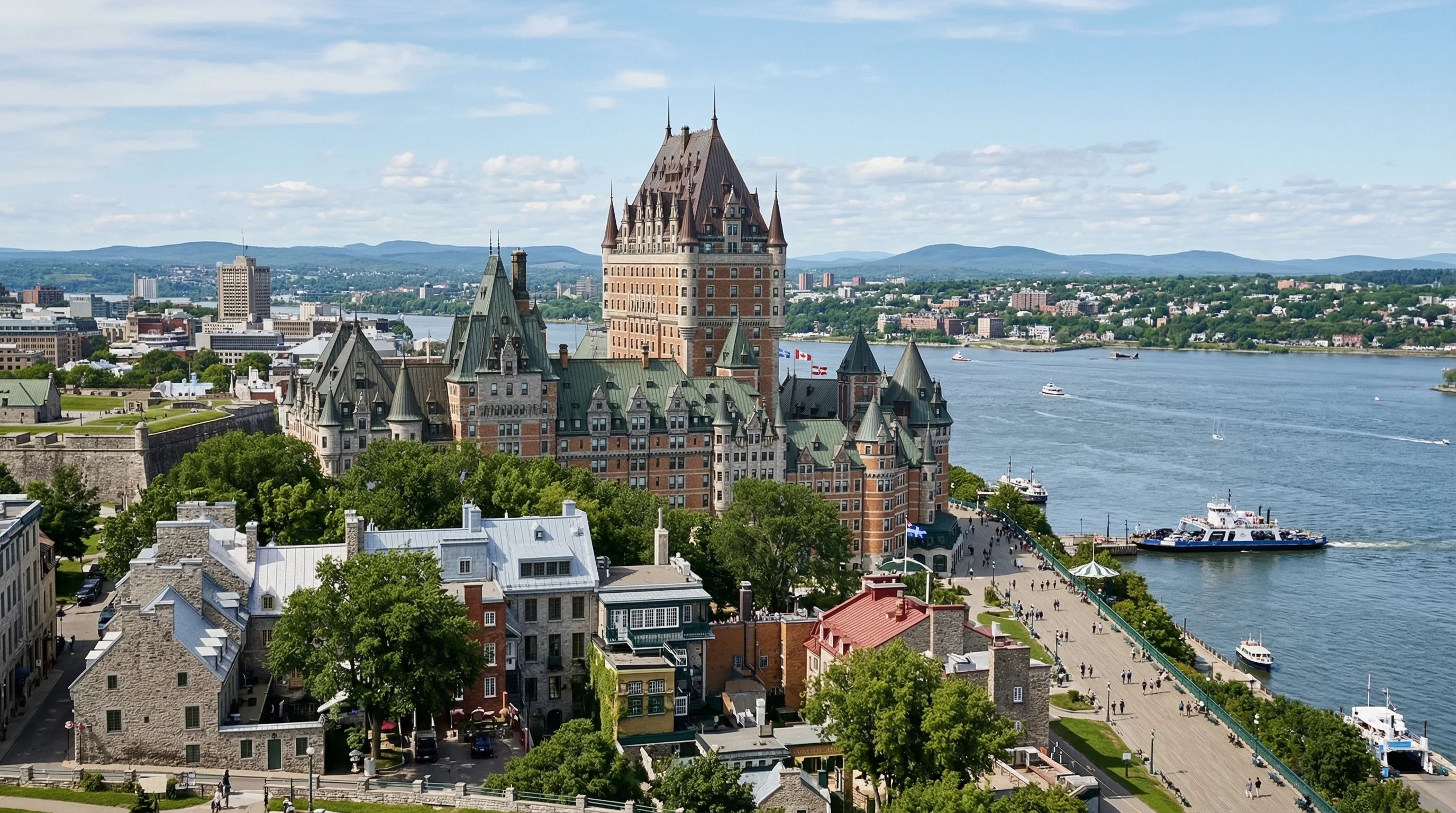
Quebec City, the capital of Quebec province, stands as a major economic and logistics hub in eastern Canada. Its strategic location at the confluence of the St. Lawrence River and its proximity to major urban centers like Montreal and Toronto make it a crucial node in Canada's supply chain network. Quebec City's economy is diverse, with key sectors including aerospace, biotechnology, information technology, and tourism. The city boasts excellent transportation infrastructure, including Jean Lesage International Airport, extensive rail connections via CN and CP rail lines, and a comprehensive highway system anchored by Autoroutes 20, 40, and 73. The Port of Quebec, one of Canada's largest inland ports, further enhances the city's logistics capabilities. Control Terrestre leverages Quebec City's strategic position and infrastructure to provide efficient FTL transportation services, connecting local industries with markets throughout North America and beyond.










