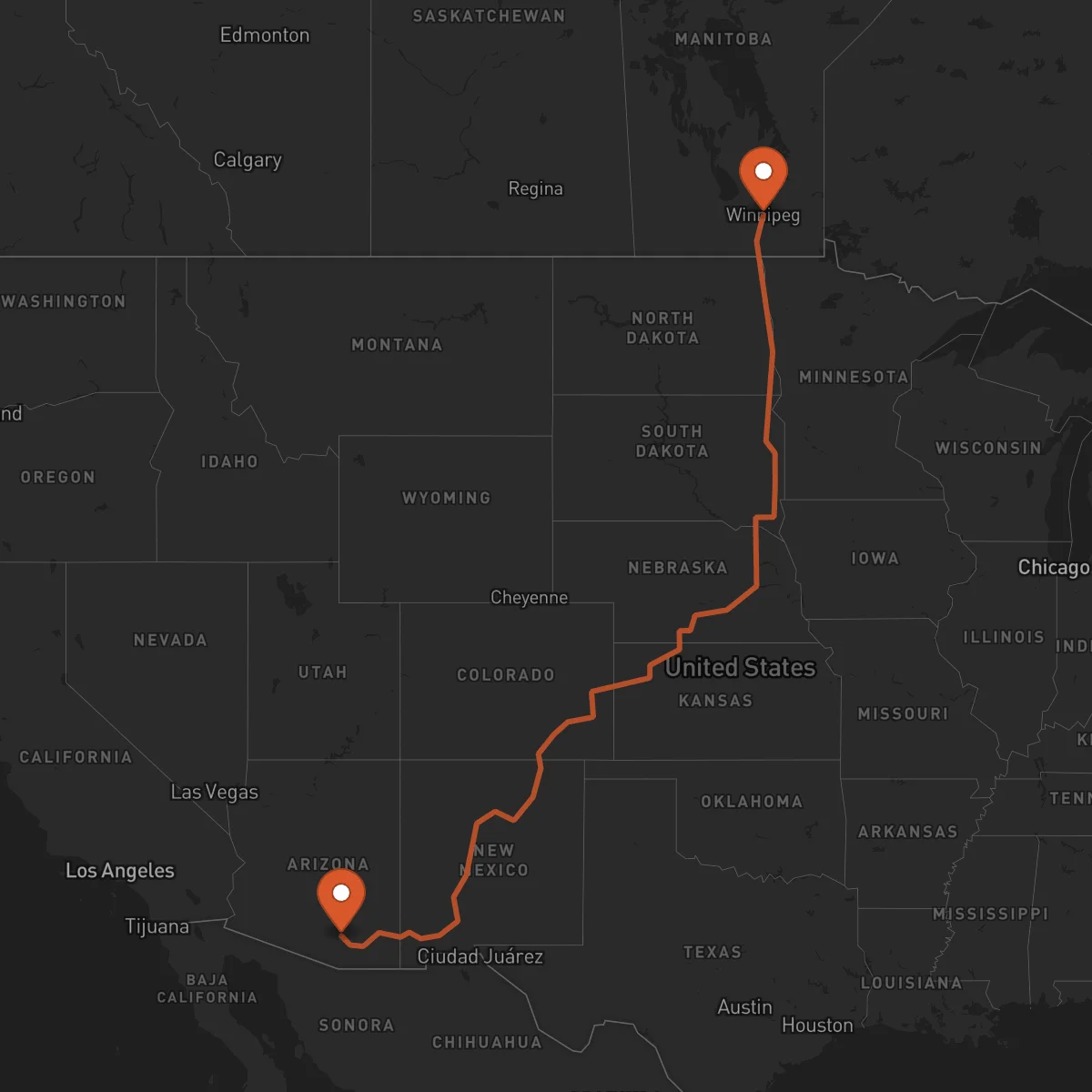
Tucson to Winnipeg
Winnipeg → TucsonFTL freight transportation service between Tucson and Winnipeg. Reliable logistics solutions for your business.
Route Description
Everything you need to know about the corridor Tucson - Winnipeg
The Tucson to Winnipeg corridor represents a vital cross-border freight transportation route connecting the southwestern United States with central Canada. This 2,271 km journey traverses diverse terrains and crosses multiple states and provinces, creating a critical link in North American supply chains. The corridor facilitates the movement of goods between major industrial centers, supporting economic integration across the continent.
The route primarily follows Interstate 10 and Interstate 29, connecting through key cities including Phoenix, Denver, and Fargo. This infrastructure provides reliable transportation options for freight moving between the two countries. The corridor serves as a strategic pathway for industries requiring efficient cross-border logistics solutions, particularly those operating between the manufacturing and agricultural sectors of the United States and Canada.
Major industries utilizing this corridor include automotive manufacturing, agricultural products, industrial equipment, and consumer goods. The route particularly benefits companies engaged in cross-border trade between Arizona's technology and mining sectors and Manitoba's agricultural and manufacturing industries. Control Terrestre leverages this corridor to provide seamless full truckload (FTL) transportation services, ensuring efficient customs clearance and reliable delivery across international borders.
The corridor's significance is enhanced by its connection to major border crossings and customs facilities, allowing for streamlined freight processing. Control Terrestre's expertise in cross-border operations ensures that shipments move efficiently through these checkpoints, minimizing delays and maintaining supply chain integrity. Our comprehensive understanding of customs requirements and documentation for both US and Canadian regulations makes us an ideal partner for companies operating along this important trade route.
Services for this Route
Available services for the corridor Tucson - Winnipeg
 Origin
Tucson
Tucson, located in southern Arizona, serves as a strategic logistics hub with its proximity to major transportation corridors and the Mexican border. The city's location provides excellent access to Interstate 10, facilitating connections to both coastal and inland markets. Tucson's infrastructure includes multiple industrial parks, warehousing facilities, and a modern international airport, supporting diverse freight transportation needs.
The region's economy is anchored by aerospace and defense industries, mining operations, and technology manufacturing. Tucson's proximity to the U.S.-Mexico border creates unique cross-border trade opportunities, while its desert location makes it ideal for specialized cargo handling. The city's transportation infrastructure includes rail connections through Union Pacific and BNSF, complementing its highway network and supporting efficient freight movement.
 Destination
Winnipeg, the capital of Manitoba, stands as a crucial logistics center in central Canada due to its strategic location at the confluence of the Red and Assiniboine rivers. The city serves as a transportation nexus, connecting eastern and western Canada through major highways including the Trans-Canada Highway and Provincial Highway 75. Winnipeg's infrastructure features extensive rail networks operated by Canadian National and Canadian Pacific, supporting both domestic and international freight movement.
The city's economy is diverse, with strong sectors in agriculture, manufacturing, and transportation. Winnipeg's central location makes it a natural distribution point for goods moving throughout Canada and into the northern United States. The city's industrial areas and warehousing facilities are well-equipped to handle various types of freight, while its cold climate has fostered expertise in temperature-controlled logistics and specialized handling requirements.










