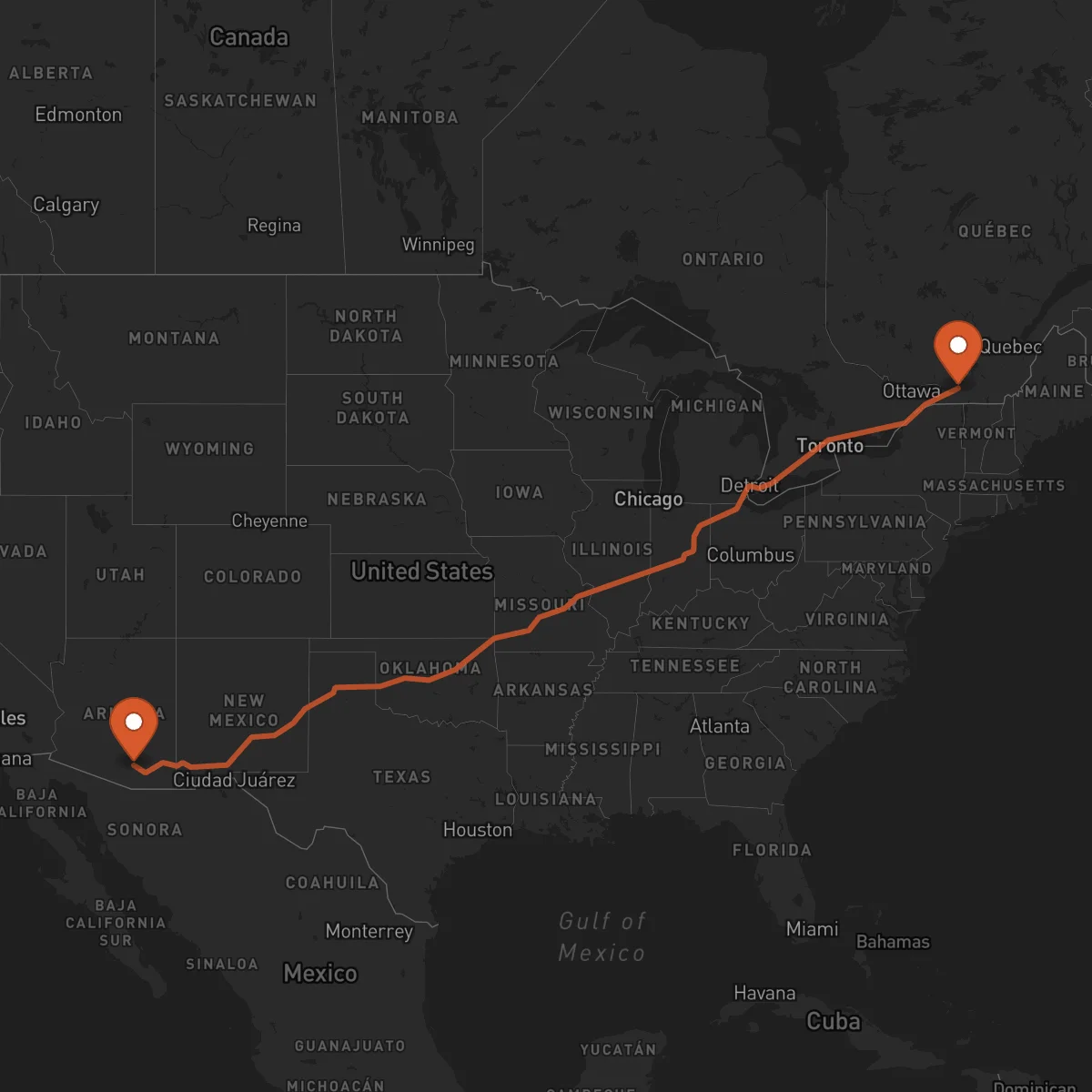
Tucson to Montreal
Montreal → TucsonFTL freight transportation service between Tucson and Montreal. Reliable logistics solutions for your business.
Route Description
Everything you need to know about the corridor Tucson - Montreal
The Tucson-Montreal corridor represents a vital logistics connection between the southwestern United States and Canada's largest economic center. This 3,517 km route traverses diverse terrain and crosses multiple jurisdictions, connecting Arizona's industrial base with Quebec's manufacturing and distribution hubs. The corridor serves as a critical link in North American supply chains, facilitating the movement of goods between major economic regions.
This cross-border route passes through key economic zones including the Phoenix metropolitan area, the Denver industrial corridor, the Great Lakes manufacturing region, and finally reaches Montreal's port and logistics infrastructure. The route benefits from well-developed transportation networks including Interstate 10, Interstate 25, Interstate 70, and Interstate 80 before transitioning to Canadian highways. Major border crossings at locations like Detroit-Windsor and Champlain-Rouses Point facilitate smooth cargo movement between countries.
Control Terrestre specializes in managing the complexities of this corridor, offering dedicated FTL services that ensure cargo moves efficiently across the entire route. Our expertise in cross-border documentation, customs clearance, and regulatory compliance helps shippers navigate the requirements of both US and Canadian authorities. We coordinate with trusted carriers who understand the specific needs of temperature-sensitive, time-critical, and specialized freight moving along this corridor.
Services for this Route
Available services for the corridor Tucson - Montreal
 Origin
Tucson
Tucson serves as a strategic logistics hub in southern Arizona, positioned near major transportation arteries and international borders. The city's location provides access to Interstate 10, connecting to both the Pacific coast and the southwestern United States. Tucson's economy features strong sectors in aerospace and defense, electronics manufacturing, and agricultural products, creating consistent freight movement. The region benefits from multiple transportation options including Tucson International Airport, Union Pacific rail connections, and extensive trucking infrastructure. The city's proximity to the Mexican border also positions it as a key point for cross-border trade operations.
 Destination
Montreal stands as Canada's premier logistics and distribution center, offering unparalleled connectivity to North American and global markets. The city's strategic location provides access to the St. Lawrence Seaway, major rail networks, and extensive highway systems including Autoroutes 20 and 40. Montreal's economy thrives on advanced manufacturing, aerospace, pharmaceuticals, and technology sectors, generating substantial freight volumes. The Port of Montreal, one of North America's largest inland ports, combined with Pierre Elliott Trudeau International Airport and extensive rail connections, creates a multimodal logistics ecosystem. The city's position near the US-Canada border facilitates efficient cross-border operations.










