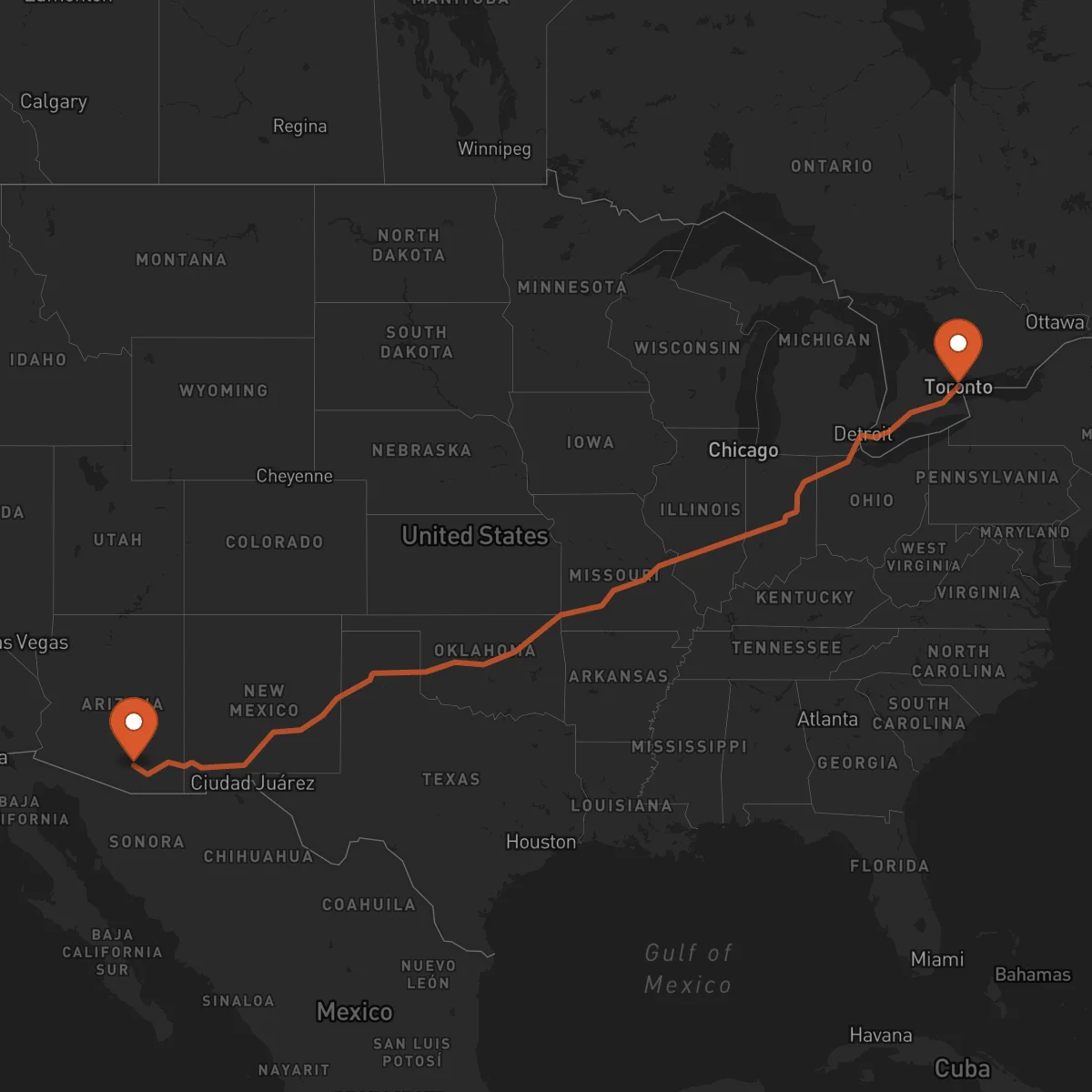
Tucson to Toronto
Toronto → TucsonFTL freight transportation service between Tucson and Toronto. Reliable logistics solutions for your business.
Route Description
Everything you need to know about the corridor Tucson - Toronto
The Tucson-Toronto corridor represents a vital cross-border freight transportation route connecting the southwestern United States with Canada's largest economic hub. This 3,022 km logistics corridor traverses diverse terrain and crosses multiple jurisdictions, making it essential for North American supply chain operations. The route facilitates the movement of goods between Mexico, the United States, and Canada, serving as a critical link in the trinational trade network.
This corridor benefits from the strategic positioning of Tucson as a logistics gateway and Toronto's status as Canada's financial and industrial capital. The region's economic activity spans manufacturing, automotive, technology, and agricultural sectors, with significant cross-border trade flows. Major transportation infrastructure includes Interstate 10, I-25, I-35, and I-29 in the United States, connecting to Canadian highways through key border crossings such as Detroit-Windsor and Buffalo-Niagara Falls.
Control Terrestre facilitates seamless operations along this corridor through our extensive network of certified transportation providers. Our C-TPAT and FAST-certified partners ensure expedited customs clearance and secure cargo handling throughout the journey. We provide dedicated FTL services with specialized equipment options, including refrigerated units for temperature-sensitive cargo and flatbeds for oversized shipments. Our expertise in cross-border documentation and compliance helps customers navigate the complexities of international freight transportation between the United States and Canada.
Services for this Route
Available services for the corridor Tucson - Toronto
 Origin
Tucson
Tucson serves as a strategic logistics hub in the southwestern United States, offering excellent connectivity to major markets in the western region. The city's location provides direct access to Interstate 10, facilitating efficient transportation to Phoenix, Los Angeles, and other key destinations. Tucson's economy is diverse, with strong presence in aerospace and defense, technology, healthcare, and tourism sectors. The region also benefits from proximity to the US-Mexico border, making it an ideal gateway for cross-border trade operations. Tucson International Airport and multiple rail connections complement the robust ground transportation infrastructure, supporting various freight transportation needs.
 Destination
Toronto stands as Canada's premier logistics and economic center, strategically positioned in the heart of the Great Lakes region. The city serves as a major distribution point for goods throughout eastern Canada and the northeastern United States. Toronto's economy is dominated by finance, technology, manufacturing, and healthcare sectors, with a significant automotive industry presence. The city benefits from excellent transportation infrastructure, including Pearson International Airport, extensive rail networks, and major highways such as the 401 and QEW. Toronto's port facilities on Lake Ontario provide additional multimodal transportation options, enhancing its role as a critical logistics hub in North America.










