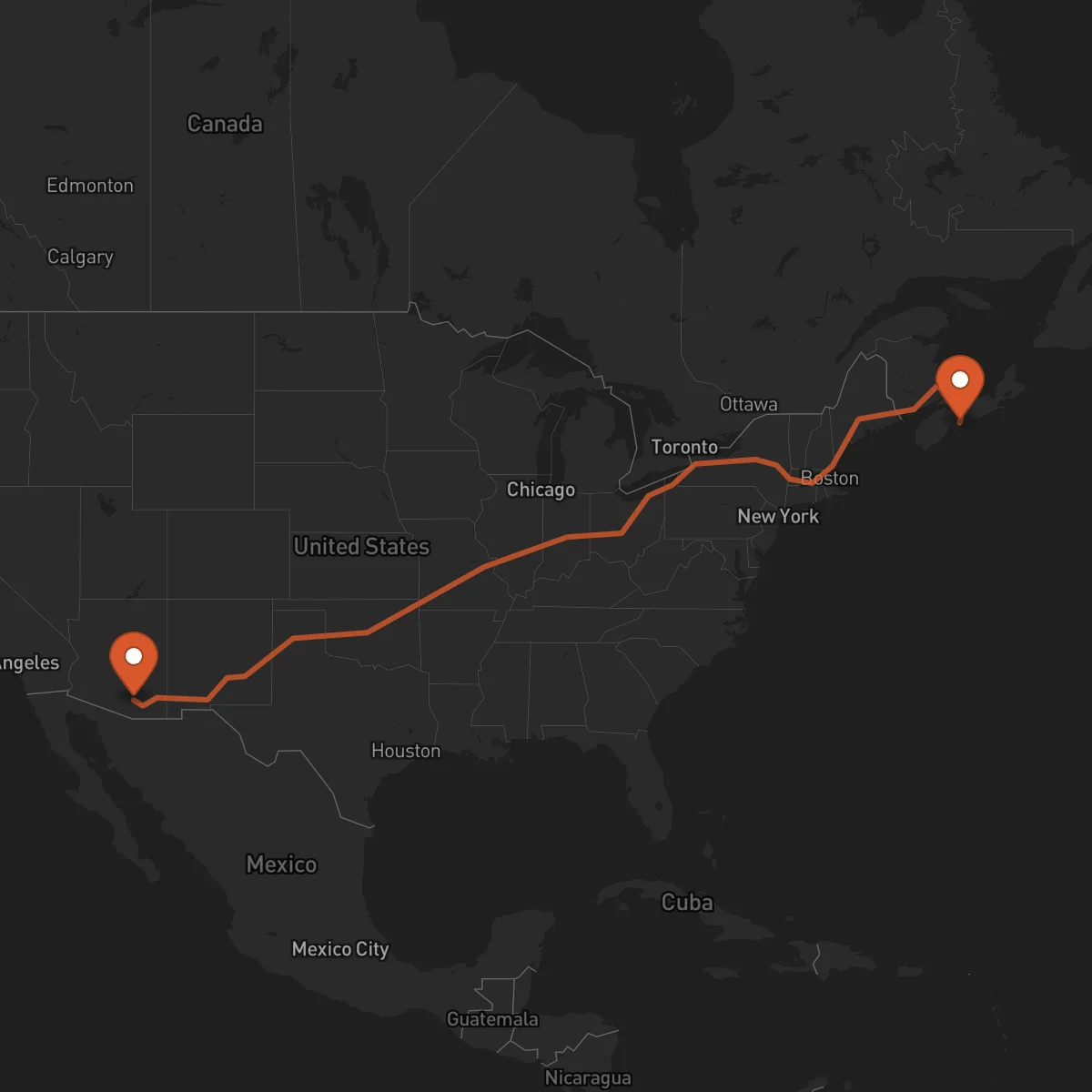
Tucson to Halifax
Halifax → TucsonFTL freight transportation service between Tucson and Halifax. Reliable logistics solutions for your business.
Route Description
Everything you need to know about the corridor Tucson - Halifax
The Tucson to Halifax corridor represents one of North America's most significant cross-border freight routes, spanning approximately 4,283 kilometers through diverse terrain and economic zones. This strategic artery connects the industrial heartland of Arizona with the Atlantic port of Nova Scotia, facilitating the movement of goods between the United States and Canada. The corridor traverses multiple states and provinces, including Arizona, New Mexico, Colorado, Nebraska, Iowa, Illinois, Indiana, Ohio, Pennsylvania, New York, Vermont, New Hampshire, and finally into Nova Scotia, Canada.
The economic significance of this corridor cannot be overstated. Tucson serves as a crucial gateway for goods entering and exiting the southwestern United States, while Halifax functions as Canada's primary Atlantic port, handling millions of containers annually. This route supports vital industries including automotive manufacturing, agricultural products, industrial equipment, and consumer goods. The corridor particularly benefits from the complementary economic cycles of the southwestern and northeastern regions of North America.
Transportation infrastructure along this route includes major interstate highways such as I-10, I-25, I-80, I-90, and various Canadian provincial routes. Key border crossings include those at Niagara Falls and other strategic points between the U.S. and Canada. Control Terrestre specializes in managing the complexities of cross-border operations, ensuring seamless customs clearance and compliance with both U.S. and Canadian regulations. Our expertise in handling full truckload (FTL) shipments makes us the ideal partner for companies requiring reliable, efficient transportation along this critical corridor.
Services for this Route
Available services for the corridor Tucson - Halifax
 Origin
Tucson
Tucson, Arizona serves as a strategic logistics hub in the southwestern United States, offering excellent connectivity to major markets across North America. The city's location provides direct access to Interstate 10, which runs coast-to-coast from California to Florida, making it an ideal departure point for cross-country freight movements. Tucson's economy is diverse, with strong sectors in aerospace and defense, technology, optics and photonics, and mining. The region also serves as a major distribution center for agricultural products, particularly winter vegetables and citrus fruits. Tucson's transportation infrastructure includes the Tucson International Airport, extensive rail connections through Union Pacific and BNSF railways, and modern highway systems that facilitate efficient freight movement in all directions.
 Destination
Halifax
Halifax, Nova Scotia stands as Canada's premier Atlantic port city and a crucial gateway for international trade. Located on the eastern seaboard, Halifax provides strategic access to European and global markets through its deep-water port facilities. The city's economy is anchored by the port operations, defense, aerospace, and information technology sectors. Halifax Port is one of North America's busiest container ports, handling over 1.5 million TEUs annually. The region's transportation infrastructure includes the Halifax Stanfield International Airport, extensive rail connections via CN Rail, and a comprehensive highway network that connects to the rest of Canada and the United States. The port's ice-free status year-round makes it particularly valuable for time-sensitive shipments.










