A massive cleanup is happening in Mexico's Importer Registry right now. And the most interesting part isn't how many companies are being suspended — it's why.
What's happening
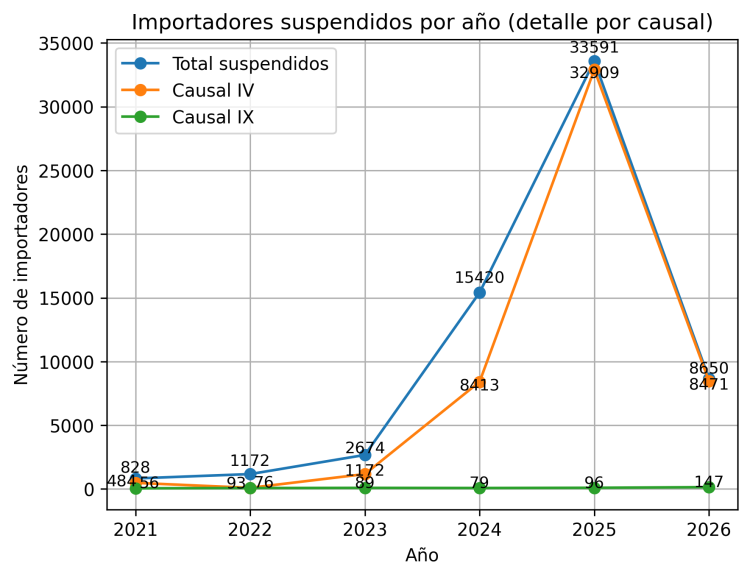
The SAT is purging the Importer Registry at an accelerated pace. As of the end of February 2026, the registry had 103,231 active records in the general registry and 37,028 in the Specific Sectors Importer Registry. But the figure that draws attention isn't the total — it's the reason behind the suspensions.
When cross-referencing the database of suspended taxpayers with the grounds listed in Rule 1.3.3. of the General Foreign Trade Rules, the dominant cause by a wide margin is IV: companies that did not conduct foreign trade operations for more than 12 months.
In other words: the registry is not being purged primarily due to fraud, evasion, or tax noncompliance. It is being purged due to inactivity.
Why that changes everything
A superficial reading of the phenomenon would be alarming: thousands of suspensions, a shrinking registry, risk signals in Mexican foreign trade. But the structural data tells a different story.
Mexican foreign trade is not slowing down. In 2025, more than 10.9 million customs entries were recorded — just 4% below 2024 — of which more than 8.1 million corresponded to imports, according to the Agencia Nacional de Aduanas de México (ANAM). At the same time, foreign trade–related tax collection maintained double-digit real growth in several categories, with VAT accounting for more than 68% of the total collected.
What is happening is not a contraction of trade. It is a concentration: fewer companies in the registry, but more active ones, generating more operations and more tax revenue. Trade is consolidating among players with real operational continuity.
The signal that should actually concern you
Within this dominant trend, there is a nuance that deserves attention. In the first three months of 2026, 147 incidents associated with ground IX were already recorded — when the authority cannot locate the taxpayer at their registered fiscal address or the address does not meet the requirements of the Tax Code. In previous years, this cause did not exceed 100 annual records.
This is not inactivity. It is traceability. And that distinction matters because it points to something different: companies that stopped operating, but rather companies that the authority cannot find. That is a direct risk signal in the customs compliance chain.
What this means for your operation
If you are a company that imports regularly, this purge probably does not affect you directly — as long as you maintain constant activity and your tax situation is in order.
But there are scenarios where you should pay attention:
Your company had a period of inactivity in imports. If you have gone more than 12 months without foreign trade operations, you fall under ground IV. Before reactivating imports, verify that your registry entry is still active. Discovering it at the border crossing is the worst possible moment.
You work with suppliers or agents in Mexico that you don't review frequently. The purge under ground IX — untraceable fiscal address — can affect your customs broker, your supplier, or any link in your chain that has tax obligations in Mexico. A suspension at any of those points can halt your operation even if you are in full compliance.
You are planning to start importing from Mexico. The registry enrollment process has timelines — normally between 5 and 15 business days under normal conditions — and can be extended if there are observations. Planning ahead is not optional.
Your import volume varies significantly between periods. If there are months or quarters where you don't import anything, it is good practice to maintain some activity or at least periodically check the status of your registration so you don't encounter a suspension when you resume operations.
The underlying question this phenomenon raises
If the registry is being purged primarily due to inactivity, the problem is not just about compliance. It is about permanence. Importing in Mexico requires fiscal continuity, financial capacity, and operational discipline. Prolonged inactivity is not just an administrative condition — it is a silent exit mechanism from the system.
What the SAT data is showing, at its core, is the real barometer of business dynamism in Mexican foreign trade. Many companies that at some point had import activity were unable to sustain it. And the registry is finally removing them.
The relevant question for any company operating in the Mexico–U.S. corridor is not whether the purge affects them today. It is whether they have the internal controls to detect it before it affects them tomorrow.
At Control Terrestre, we work with active operators, verified documentation, and up-to-date knowledge of the customs regulatory environment — because a solid foreign trade operation doesn't just depend on transportation. It depends on every link being in compliance. Request a quote or subscribe to our newsletter to receive practical logistics and foreign trade content every week.