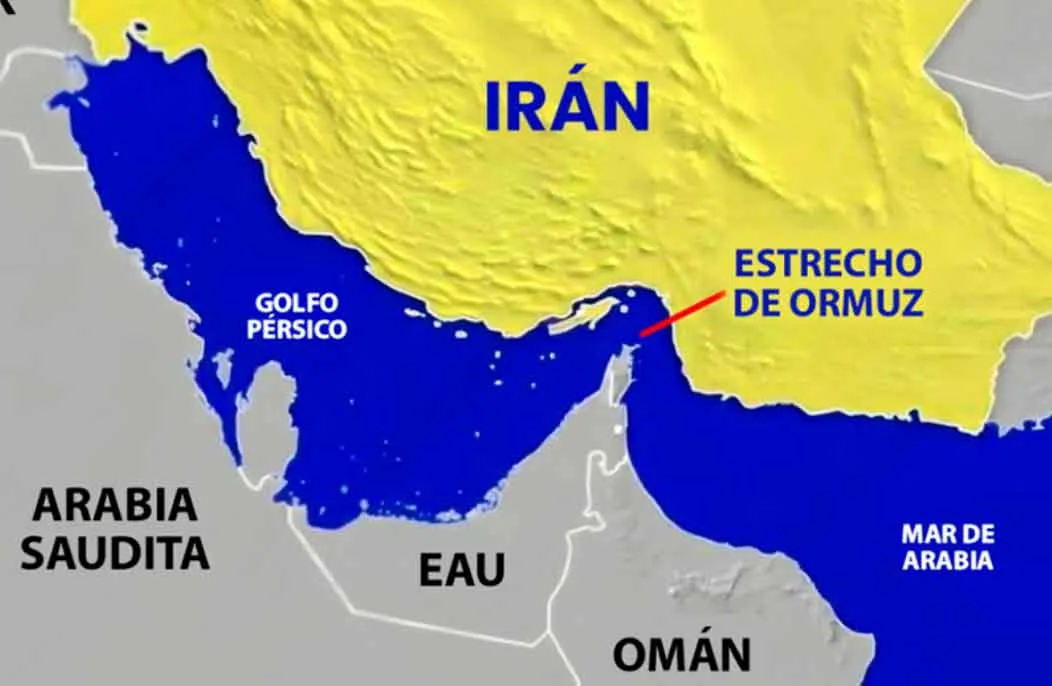
Since February 28, 2026, the world of maritime trade has changed. The Strait of Hormuz — through which 20% of the world's oil and massive volumes of global cargo pass — has been in crisis for months. And although Mexico does not border the Persian Gulf, the consequences are already reaching supply chains operating in the Mexico–U.S. corridor.
What happened and where we stand today
On March 2, 2026, an officer of Iran's Islamic Revolutionary Guard declared that "the strait is closed." As of March 4, Iranian forces declared the Strait closed, threatening and carrying out attacks against ships attempting to transit it. Inmobiliare
On February 28, 2026, U.S. and Israeli forces attacked Iran. In less than 48 hours, the Strait of Hormuz — the most critical commercial chokepoint in the world — had effectively closed. Maersk, MSC, CMA CGM, and Hapag-Lloyd suspended all transits. Agenciaaduanal
A temporary ceasefire between the U.S. and Iran has been extended, opening a window for diplomacy — but persistent tensions in the Strait of Hormuz continue to amplify trade disruptions. Milenio
DHL forecasts 4 to 6 months for normalization: Tobias Maier, CEO of DHL Global Forwarding for the Middle East and Africa, indicated to clients that transport through the Strait of Hormuz will take at least four to six months to normalize. Agenciaaduanal
In practical terms: we are not facing a one-off event that resolves in days. We are facing a structural disruption that will continue to affect global supply chains for months — and that is already having concrete effects on the cost and availability of inputs arriving in Mexico.
Why it matters to Mexico even though it's not on the Persian Gulf
Oil and petrochemicals
The Strait of Hormuz is one of the most critical maritime chokepoints in the world, carrying roughly one-quarter of global seaborne oil trade and significant volumes of liquefied natural gas and fertilizers. YouTube
Substantial quantities of petrochemicals and plastic raw materials flow through Hormuz. Around 85% of Middle Eastern polyethylene exports pass through this route. Shortages and delays will drive up the price of packaging, automotive components, and consumer goods. The Logistics World
For Mexican manufacturing — automotive, electronics, plastics — this translates into pressure on the cost of raw materials and components imported from Asia or the Middle East. Rising prices for resins, polyethylene, and petrochemicals have a direct impact on production costs at many plants in Mexico.
Asia shipping routes are taking longer
The Cape of Good Hope route goes around the southern tip of Africa instead of passing through the Suez Canal or the Strait of Hormuz. It adds approximately 3,500 to 4,000 nautical miles and 10 to 14 days to travel times on Asia-to-Europe and Asia-to-Middle East routes. Agenciaaduanal
Mexican companies that import components or inputs from Asia — electronics, textiles, machinery — are seeing longer transit times and higher costs. This puts pressure on inventories, affects production cycles, and forces a reassessment of safety stock levels.
More expensive diesel
Brent crude prices are now above $90 per barrel. For many industries built on predictability and freedom of navigation, the uncertainty weighing on supply chains has quickly become the most disruptive maritime risk in the world. The Logistics World
The impact on diesel prices is already happening. For ground transportation in Mexico — where fuel represents between 30% and 40% of a unit's operating cost — this is a factor that is pressuring freight rates in the Mexico–U.S. corridor precisely when demand in that corridor is at historically high levels.
What is happening with global supply chains
Even if a peace agreement restores safe passage through Hormuz, the disruption will persist. Weeks of suspended voyages, diverted cargo, and stressed feeder networks have created backlogs that could take months to resolve. MexicoIndustry
Fertilizers and agricultural flows, rubber, electronics, batteries, pharmaceuticals, Asia-based garment manufacturing, and sugar are among other potentially disrupted supply chains. The Logistics World
For Mexican companies participating in global chains — especially in the automotive, electronics, and pharmaceutical sectors — the question is no longer whether they will feel the impact. It is when and how intensely.
Why the Mexico–U.S. corridor becomes more strategic in this context
China now accounts for 6.4% of U.S. trade, down from 13% in 2016, with Mexico and Canada now positioned as the top two trading partners in the Americas. Transporte.mx
In an environment where global shipping routes are under pressure, overland trade within North America gains strategic relevance. What cannot arrive by sea from Asia has to come from somewhere — and Mexico is the primary alternative supplier for manufacturing that the American market needs.
That means more cargo volume in the Mexico–U.S. corridor, more demand for ground transportation, and more pressure on available capacity — precisely when that capacity was already tight due to the factors we have been covering in previous blogs.
What companies should be doing today
Review the origin of your critical inputs. If part of your chain depends on raw materials or components coming from Asia or the Middle East — resins, electronic components, pharmaceuticals, packaging materials — you need to understand how much of that flow is affected and how much safety stock you have.
Anticipate higher ground freight costs. Diesel prices and increased demand in the Mexico–U.S. corridor will continue to pressure rates. Companies that secured capacity in advance have protection. Those operating on the spot market will feel the pressure more directly.
Diversify suppliers toward North America. The Hormuz crisis is accelerating an already existing trend — the replacement of Asian suppliers with sources within North America. For Mexican companies, this is an opportunity to position themselves as alternative suppliers for American buyers looking to reduce their exposure to long maritime routes.
Monitor petrochemical input prices. If your industry uses resins, plastics, or petroleum-derived packaging, the coming months will bring price volatility. Having contracts with price bands or buying in advance can reduce that exposure.
The bigger picture
What is happening in the Strait of Hormuz is not just a distant geopolitical crisis. It is a reminder that global supply chains are interdependent — and that a disruption at one point in the system propagates to all others.
For Mexico and for companies operating in the Mexico–U.S. corridor, the combination of higher structural demand in the corridor, higher diesel costs, and disruptions on alternative routes creates an environment where well-managed logistics is more valuable than ever.
At Control Terrestre, we continue to closely monitor the global landscape because what happens on the oceans eventually reaches the highways. Request a quote or subscribe to our newsletter to receive practical content on logistics and foreign trade every week.