Every time a truck returns empty, your company is paying for a trip that generates no revenue. Backhaul is one of the most overlooked costs in ground logistics — and one of the easiest to optimize if you know how to approach it.
In this article, we explain what backhaul is, why it directly impacts the price you pay for freight, and what you can do to reduce it.
What is backhaul?
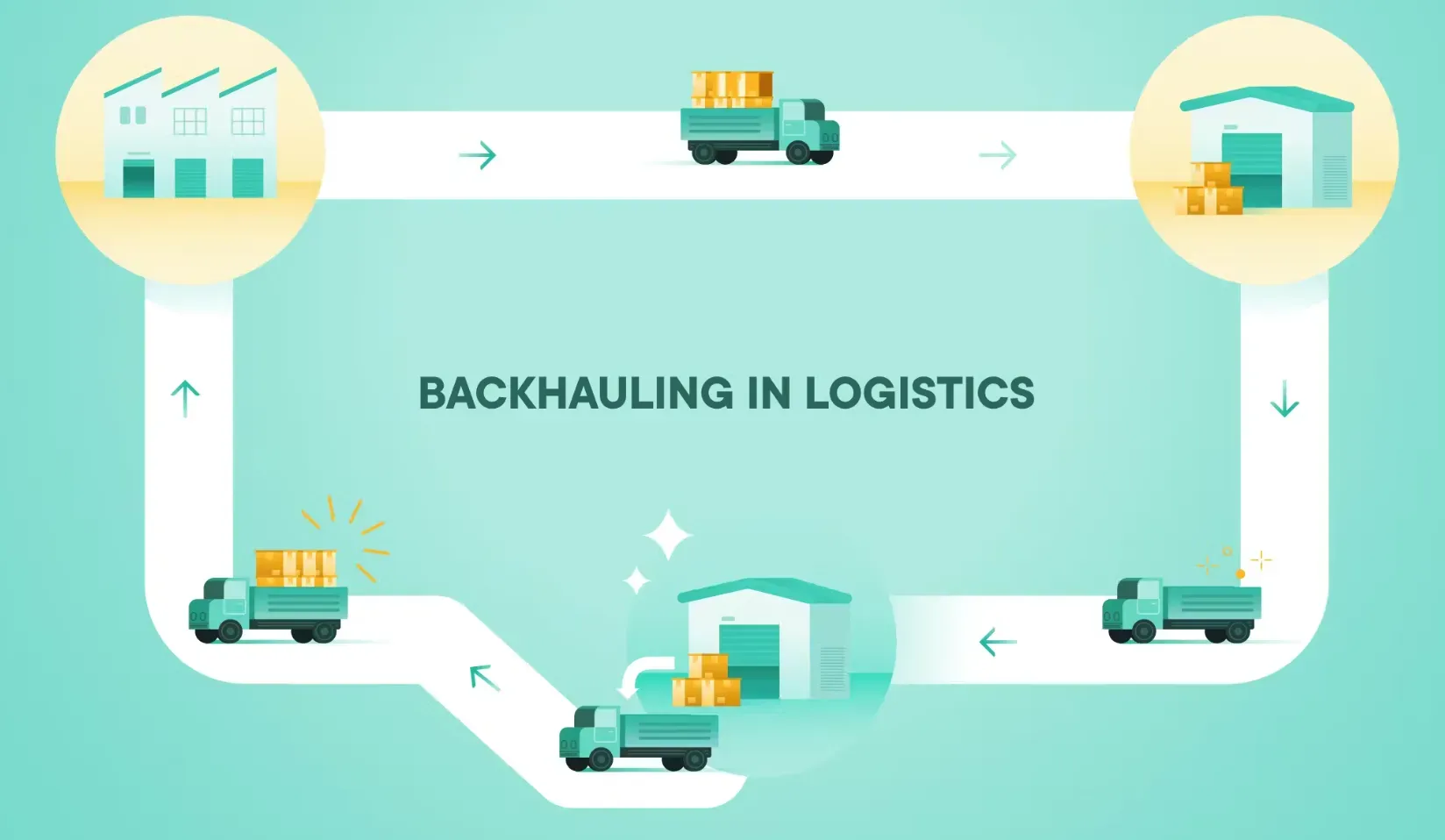
Backhaul is the return trip of a truck after it has delivered its cargo at the destination. If a unit departs from Monterrey to Mexico City with merchandise and returns empty, that return leg is the backhaul.
The problem is that this return trip is not free. The carrier incurs fuel costs, tolls, driver time, and vehicle wear — regardless of whether the unit is loaded or empty. And those costs, in one way or another, end up reflected in the rate you pay.
When a carrier does not have a secured return load, it typically offsets that cost by distributing it across the outbound trip rate. In other words: if your transportation provider does not manage backhaul well, you are paying for it without knowing it.
How much does backhaul represent in the total freight cost?
It depends on the route, but in general terms, the return trip can represent between 30% and 50% of the total cost of a long-distance transportation operation. On cross-border routes — where cargo asymmetries between Mexico and the U.S. are historically high — this percentage can be even higher.
According to data from the Bureau of Transportation Statistics, a significant proportion of trucks crossing the Mexico–U.S. border return with partial loads or empty, which raises the average cost per ton transported across the entire chain.
For the shipper, this translates into a higher rate than it should be if the operation were well optimized.
The 3 reasons why backhaul is ignored
1. The shipper does not see the return trip
From the perspective of the person hiring the freight, the operation ends when the merchandise arrives at the destination. What happens to the truck afterward is not their problem — or at least that is how it seems. In reality, the efficiency of the return trip directly affects the rate you negotiate on the next shipment.
2. It is not part of the explicit contract
Most ground transportation contracts in Mexico are structured per trip or per point-to-point rate. Backhaul is rarely mentioned. That does not mean it does not exist — it means it is hidden in the price.
3. Companies lack visibility into their own flows
To optimize backhaul, you need information: cargo volumes by route, frequencies, recurring destinations. Many companies do not have that consolidated map, making it impossible to identify optimization opportunities.
4 concrete ways to reduce backhaul cost
Consolidate routes and schedule in advance
The more predictable your operation is, the easier it is for your carrier to find a return load. If your shipments are recurring and destinations are consistent, share that information with your provider in advance. Scheduling certainty is what enables efficient backhaul structures.
Negotiate rates that include return cargo
If you have suppliers or customers at the destinations where your merchandise arrives, explore whether it is possible to coordinate return freight with them. In some cases, two companies with complementary flows can share a carrier and split the cost of the return trip — reducing the rate for both.
Work with carriers that manage cargo networks
A carrier with its own network or access to cargo boards has a greater ability to place its units on the return trip than one that operates in isolation. When evaluating transportation providers, ask directly how they manage backhaul on your main routes. The answer says a lot about the efficiency of their operation.
Evaluate the actual cost per kilometer, not just the rate per trip
A low per-trip rate can hide an inefficient backhaul that the carrier offsets in other services or in the next negotiation. Ask your provider for a breakdown of the cost per kilometer traveled — including the return — to get a more honest comparison between options.
Backhaul on cross-border routes
In Mexico–U.S. operations, backhaul has an additional layer of complexity. The volume of Mexican exports to the United States is significantly higher than the reverse flow in many product categories, creating a structural asymmetry: there are more trucks that need to return from the U.S. to Mexico than available cargo to fill them.
This has two practical implications. First, outbound rates to the U.S. tend to be higher than return rates, precisely because the carrier knows it will likely return with the unit empty or partially loaded. Second, companies that manage to structure bidirectional operations — exporting in one direction and importing in the other — have a real competitive advantage in their transportation costs.
To take advantage of this, you need a carrier with experience in foreign trade and operational knowledge on both sides of the border, not just the crossing itself.
What you should ask your carrier
Before your next rate negotiation, consider asking these questions:
How do you manage backhaul on this route? If the answer is vague or the topic is not part of their usual operation, it is a sign that the cost is being absorbed — and passed on to you.
Do you have a cargo network at the destination? A carrier with a real presence at the destinations where it operates has more tools to efficiently resolve the return trip.
Can you show me a breakdown of your rate? Transparency in costing is a sign of operational maturity. Providers that work with open rates tend to have more efficient operations.
Backhaul as a competitive advantage
Companies that understand backhaul do not just reduce costs — they also negotiate better. When you have clarity on your operation's cargo flows and know what the return trip represents in the total rate, you can identify opportunities that your competition does not see.
At Control Terrestre, we design routes considering the full operation cycle, not just the outbound trip. It is part of how we maintain competitive rates on long-haul and cross-border routes.
Want to review whether your current routes have backhaul optimization opportunities? Request a quote or subscribe to our newsletter to receive practical content on ground logistics every week.