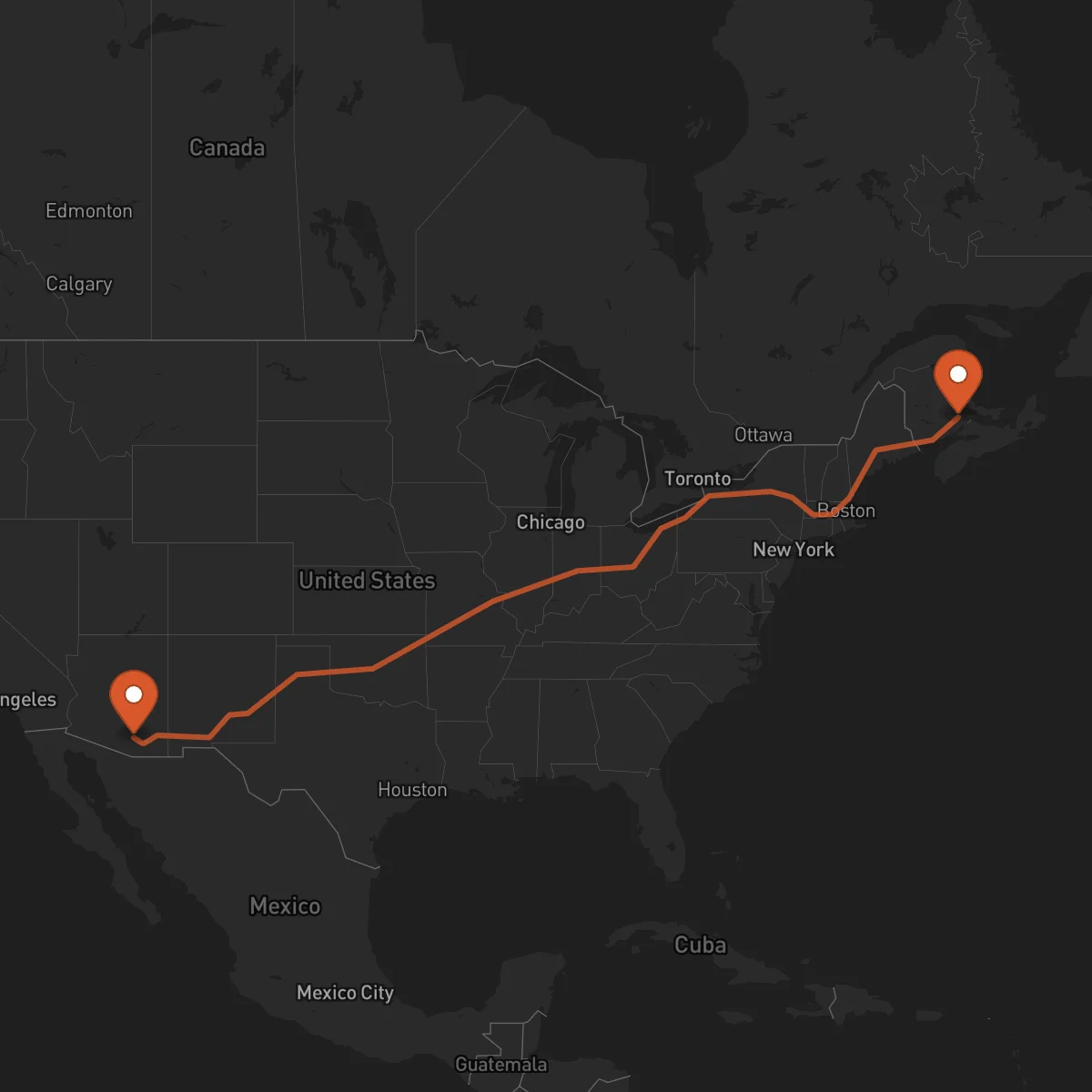
Tucson to Moncton
Moncton → TucsonFTL freight transportation service between Tucson and Moncton. Reliable logistics solutions for your business.
Route Description
Everything you need to know about the corridor Tucson - Moncton
The Tucson to Moncton corridor is a vital cross-border logistics route connecting the southwestern United States with the Atlantic provinces of Canada. This approximately 4,200 km corridor traverses diverse landscapes and crosses multiple jurisdictions, making it a strategic link for businesses operating across North America. The route primarily utilizes Interstate 10 and Interstate 25 in the United States, connecting with major Canadian highways such as the Trans-Canada Highway, ensuring efficient and reliable freight movement.
The economic significance of this corridor is substantial, facilitating trade between the industrial hubs of Arizona and the manufacturing and distribution centers of New Brunswick. Tucson, with its proximity to major Mexican trade routes, serves as a gateway for goods entering the U.S., while Moncton's strategic location in the Maritimes makes it a crucial distribution point for Atlantic Canada. This corridor supports industries such as automotive, agriculture, electronics, and consumer goods, which rely on timely and secure transportation of full truckload shipments.
Key border crossings along this route, such as those near El Paso, Texas, and Houlton, Maine, are equipped with modern customs facilities to streamline cross-border operations. Control Terrestre leverages its expertise and certifications, including C-TPAT and FAST, to ensure seamless customs clearance and compliance with all regulatory requirements. By providing dedicated FTL services, we optimize transit times and reduce handling risks, making this corridor a reliable choice for businesses seeking efficient supply chain solutions between Tucson and Moncton.
Services for this Route
Available services for the corridor Tucson - Moncton
 Origin
Tucson
Tucson, Arizona, is a strategic logistics hub in the southwestern United States, known for its proximity to the U.S.-Mexico border and its role in international trade. The city is a key entry point for goods moving between the U.S. and Mexico, supported by its robust transportation infrastructure, including Interstate 10 and the Tucson International Airport. Tucson’s economy is driven by industries such as aerospace, defense, electronics, and agriculture, making it a critical node for cross-border freight transportation. The city’s logistics ecosystem is further enhanced by its access to major rail networks and warehousing facilities, ensuring efficient distribution of goods across the region.
 Destination
Moncton
Moncton, New Brunswick, is a strategic logistics hub in Atlantic Canada, renowned for its central location and connectivity to major markets. Situated at the crossroads of the Trans-Canada Highway and the Canadian National Railway, Moncton serves as a gateway for goods moving to and from the Maritimes. The city’s economy is supported by industries such as manufacturing, logistics, and distribution, with a strong focus on serving both domestic and international markets. Moncton’s infrastructure includes the Greater Moncton Roméo LeBlanc International Airport and the Port of Belledune, providing multimodal transportation options for businesses. Its strategic position makes it an ideal destination for full truckload freight moving across North America.










