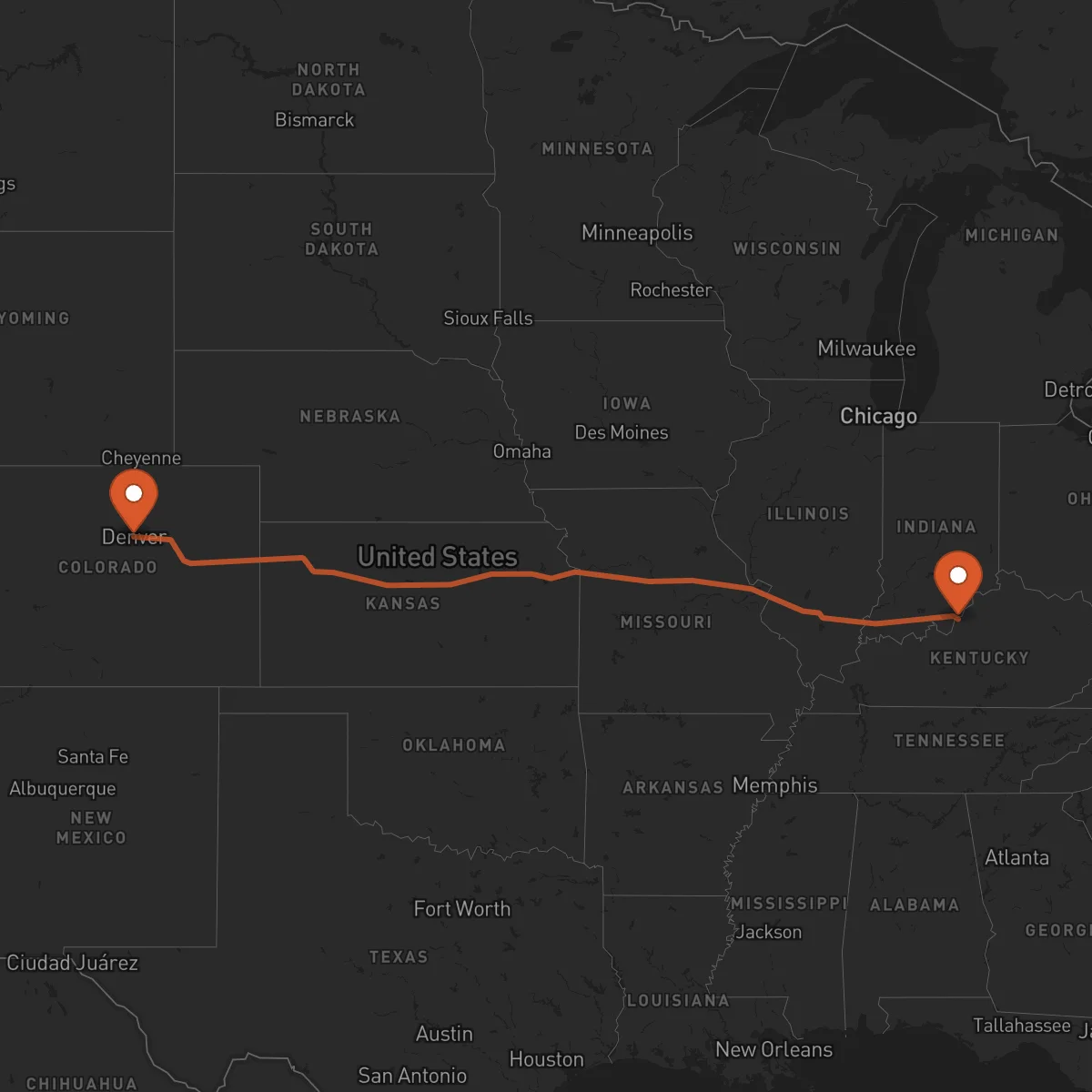
Denver to Louisville
Louisville → DenverFTL freight transportation service between Denver and Louisville. Reliable logistics solutions for your business.
Route Description
Everything you need to know about the corridor Denver - Louisville
The Denver to Louisville corridor is a vital freight transportation route connecting the dynamic economic center of Colorado with the strategic logistics hub of Kentucky. This domestic corridor spans approximately 1,666 kilometers and serves as a critical link for companies moving goods between the Mountain West and the Midwest regions of the United States.
The corridor traverses diverse terrain and crosses multiple states, including Colorado, Kansas, Missouri, Illinois, Indiana, and Kentucky. This route is essential for businesses that need to transport goods efficiently between these two major metropolitan areas. The Denver metropolitan area, known for its robust technology and energy sectors, requires reliable connections to Louisville, which has established itself as a major distribution center with the presence of UPS Worldport and numerous manufacturing facilities.
Major industries utilizing this corridor include technology products, aerospace components, agricultural goods, automotive parts, and consumer packaged goods. The route primarily follows Interstate 70, one of America's most important east-west transportation arteries, which provides excellent infrastructure for freight movement. Control Terrestre facilitates seamless operations on this corridor by leveraging our extensive network of certified transportation providers who understand the unique requirements of moving freight across this diverse landscape. Our team ensures that shipments move efficiently through all weather conditions and traffic patterns that characterize this important domestic route.
Services for this Route
Available services for the corridor Denver - Louisville
 Origin
Denver
Denver, Colorado serves as a strategic origin point for logistics operations due to its position as the largest city in the Mountain West region. The city's elevation of 5,280 feet and location at the intersection of major transportation routes makes it an ideal hub for companies serving the western United States. Denver's economy is diverse and robust, with key industries including technology, aerospace, energy (both traditional and renewable), healthcare, and financial services.
The transportation infrastructure in Denver is exceptional, featuring Denver International Airport (one of the busiest cargo airports in the world), extensive rail connections through Union Pacific and BNSF railways, and a comprehensive highway network. The city sits at the intersection of I-25, I-70, and I-76, providing excellent connectivity to both coastal regions and the central United States. Denver's strategic location allows for efficient distribution to 13 western states within a two-day truck drive, making it an ideal origin for companies looking to optimize their supply chain operations across the western and central regions of the country.
 Destination
Louisville
Louisville, Kentucky is strategically positioned as a premier logistics destination in the heart of the Midwest. The city's location at the Falls of the Ohio River has historically made it a transportation hub, and today it continues to serve as a critical distribution center for companies across the United States. Louisville's economy is anchored by major industries including logistics and distribution, manufacturing, healthcare, and bourbon production.
The city boasts world-class transportation infrastructure that makes it an ideal destination for freight operations. Louisville International Airport houses UPS Worldport, the largest fully automated package handling facility in the world, handling millions of packages daily. The city also features extensive rail connections through CSX and Norfolk Southern, along with access to the Ohio River for barge transportation. The highway network includes I-65, I-64, and I-71, providing excellent connectivity to major markets throughout the eastern and central United States. Louisville's central location allows for efficient distribution to over half of the U.S. population within a day's drive, making it an optimal destination for companies seeking to optimize their supply chain and reduce transportation costs.










