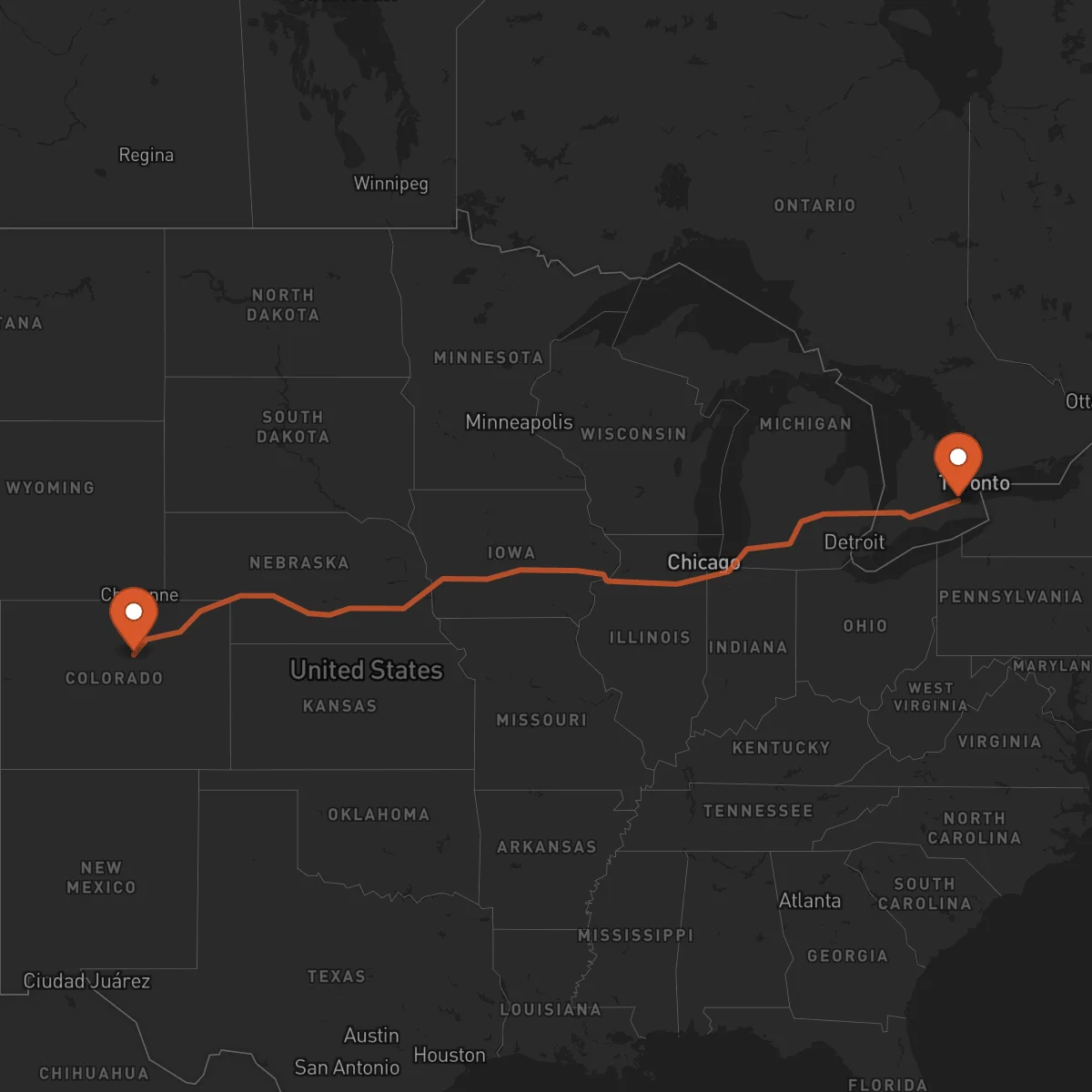
Denver to Hamilton
Hamilton → DenverFTL freight transportation service between Denver and Hamilton. Reliable logistics solutions for your business.
Route Description
Everything you need to know about the corridor Denver - Hamilton
The Denver-Hamilton corridor represents a vital trade route connecting the economic heart of Colorado with the industrial powerhouse of Ontario. This cross-border route spans approximately 2,120 kilometers, traversing diverse terrain and connecting two major North American economic regions. The corridor facilitates the movement of goods between the United States and Canada, supporting a robust trade relationship between these two nations.
The Denver metropolitan area serves as a strategic logistics hub in the Rocky Mountain region, with strong manufacturing, technology, and energy sectors. Hamilton, located on the western tip of Lake Ontario, is known as Canada's steel capital and has diversified into advanced manufacturing, healthcare, and education. This complementary economic structure creates significant freight demand along this corridor.
Key industries utilizing this route include automotive parts, steel and metal products, industrial machinery, electronics, and consumer goods. The corridor primarily uses I-76, I-80, and I-90 across the United States, transitioning to ON-401 in Canada, which is one of North America's busiest highways. The Detroit-Windsor crossing serves as the main border entry point for this route.
Control Terrestre provides seamless cross-border FTL transportation along this corridor, leveraging our C-TPAT-certified carriers and experienced team to navigate customs requirements efficiently. Our dedicated service ensures your cargo moves reliably between Denver and Hamilton, with real-time tracking and compliance with all cross-border regulations.
Services for this Route
Available services for the corridor Denver - Hamilton
 Origin
Denver
Denver, Colorado serves as a strategic logistics center in the western United States, benefiting from its central location in the Mountain Time Zone and proximity to major transportation networks. The city sits at the intersection of I-70, I-25, and I-76, providing excellent connectivity to both coasts and northern routes. Denver International Airport, one of the largest cargo airports in the country, complements the robust ground transportation infrastructure.
The Denver metropolitan area hosts diverse economic sectors including aerospace, telecommunications, healthcare, and financial services. The region is home to numerous corporate headquarters and has a strong manufacturing presence, particularly in electronics and industrial equipment. The nearby Rocky Mountains provide access to natural resources, while the city's elevation and climate make it ideal for certain specialized industries and storage requirements.
 Destination
Hamilton, Ontario stands as a major industrial and logistics center in Canada, strategically positioned on the western shore of Lake Ontario. The city benefits from its location at the intersection of major transportation routes, including the Queen Elizabeth Way (QEW) and Highway 403, providing direct access to Toronto, the U.S. border, and the Port of Hamilton. The city's port facilities on Lake Ontario offer additional intermodal transportation options.
Known historically as Canada's steel capital, Hamilton has evolved into a diversified economy with strengths in advanced manufacturing, healthcare (home to McMaster University and its medical school), education, and technology. The city's industrial base includes automotive parts manufacturing, metal fabrication, and food processing. Hamilton's relatively affordable real estate compared to Toronto has attracted numerous distribution centers and warehouses, making it a key logistics hub for the Golden Horseshoe region.










