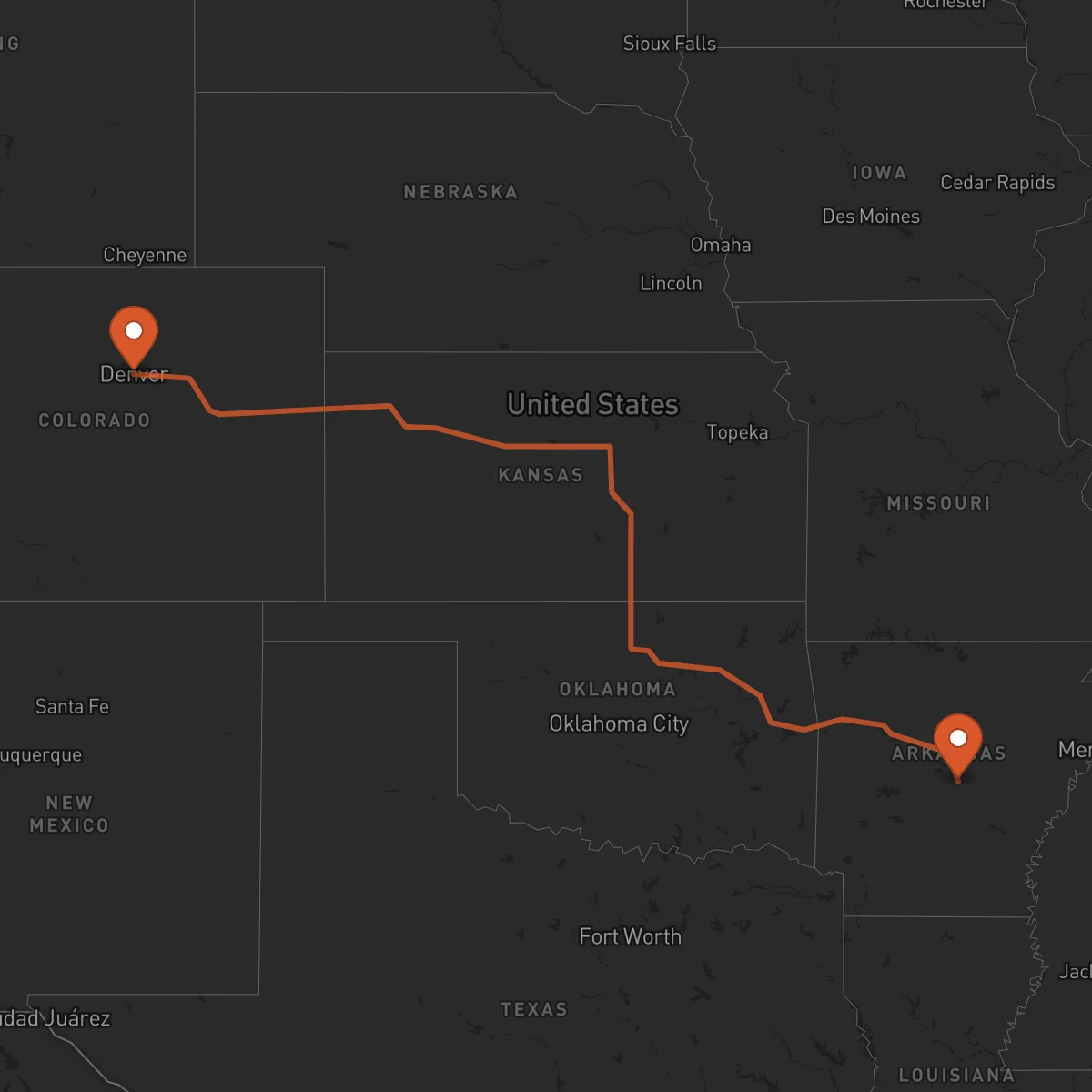
Denver to Little Rock
Little Rock → DenverFTL freight transportation service between Denver and Little Rock. Reliable logistics solutions for your business.
Route Description
Everything you need to know about the corridor Denver - Little Rock
The Denver to Little Rock corridor represents a vital logistics connection between the Rocky Mountain region and the heart of the American South. This 1253 km route links Colorado's capital, a major hub for technology and energy industries, with Arkansas' capital, a key center for manufacturing and distribution in the southeastern United States. The corridor traverses diverse terrain, crossing multiple state lines and connecting major economic zones.
The route follows Interstate 70 East from Denver, connecting with Interstate 55 South through Missouri, before transitioning to Interstate 40 East into Arkansas. This well-established interstate network provides reliable transportation infrastructure for freight movement, with multiple rest areas, truck stops, and maintenance facilities along the way. The corridor serves as a critical link for goods moving between the Mountain West and the southeastern states.
Control Terrestre leverages this strategic corridor to provide seamless full truckload transportation services. Our network of certified carriers ensures reliable capacity along the entire route, with real-time tracking and dedicated support for shipments. We understand the specific requirements of this corridor, including weight restrictions, seasonal weather considerations, and delivery scheduling in both metropolitan areas.
Services for this Route
Available services for the corridor Denver - Little Rock
 Origin
Denver
Denver, Colorado serves as a major logistics hub in the Mountain West region. Situated at the intersection of I-25, I-70, and I-76, the city provides excellent connectivity to major markets across the western United States. Denver's elevation and central location make it an ideal distribution point for companies serving both coastal and inland markets. The city's economy is driven by diverse sectors including aerospace, technology, telecommunications, and energy, with a strong presence of logistics and distribution centers.
The Denver metropolitan area features extensive transportation infrastructure including Denver International Airport, one of the largest cargo airports in the country, and a robust rail network operated by BNSF and Union Pacific. The city's strategic location at the foot of the Rocky Mountains positions it as a gateway for freight moving between the western states and the rest of the country.
 Destination
Little Rock
Little Rock, Arkansas occupies a strategic position in the southeastern United States, serving as a key logistics and distribution center. Located along the Arkansas River, the city provides access to both inland waterway transportation and major interstate highways including I-30 and I-40. Little Rock's central location in the South makes it an ideal hub for companies distributing goods throughout the southeastern states and beyond.
The city's economy is anchored by industries including healthcare, aerospace, and advanced manufacturing. Little Rock's Port of Little Rock, a major inland port facility, handles significant cargo volumes and provides intermodal transportation options. The city's logistics infrastructure includes multiple warehousing facilities, distribution centers, and a well-developed network of local and regional carriers, making it an efficient destination for freight deliveries.










