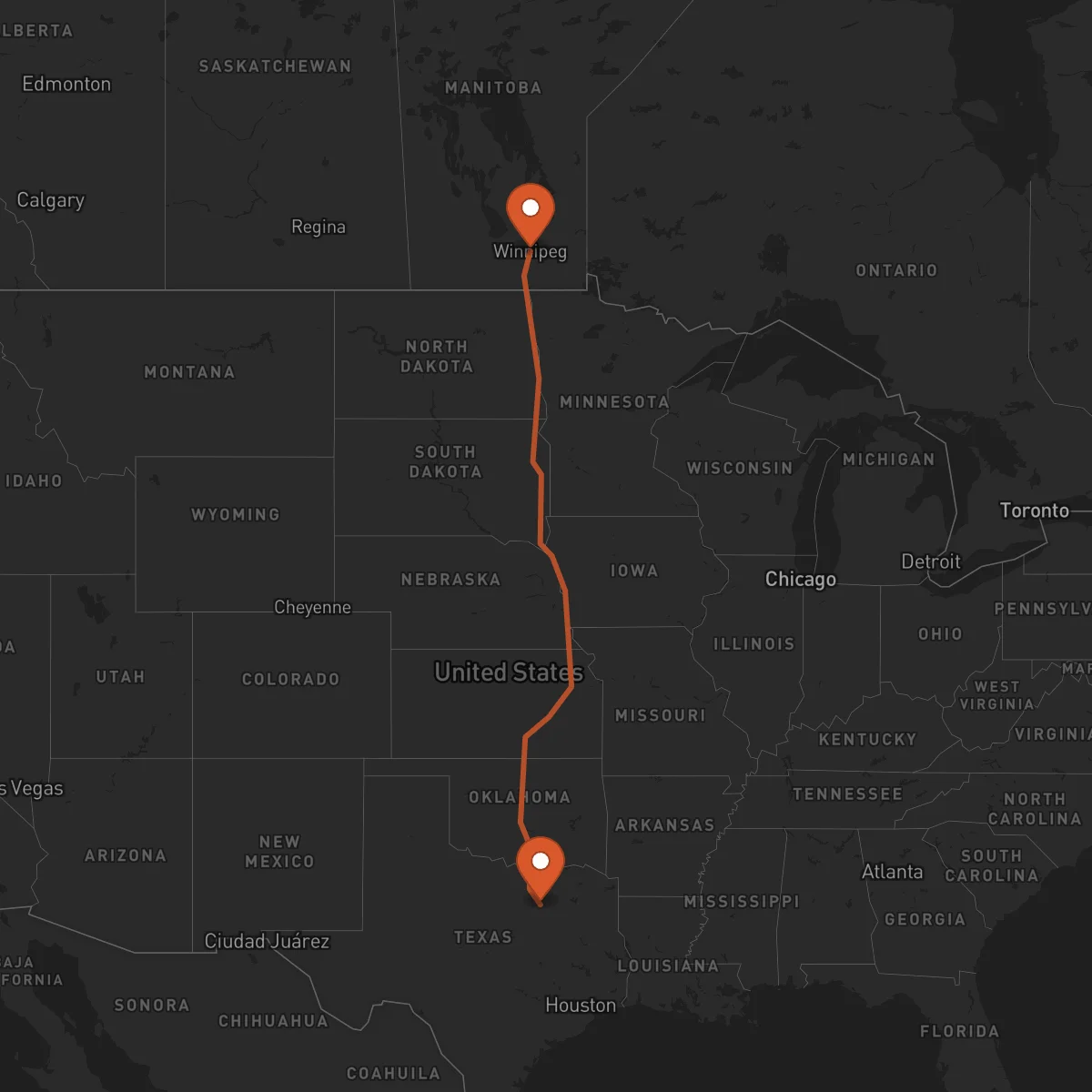
Dallas to Winnipeg
Winnipeg → DallasFTL freight transportation service between Dallas and Winnipeg. Reliable logistics solutions for your business.
Route Description
Everything you need to know about the corridor Dallas - Winnipeg
The Dallas to Winnipeg corridor represents a vital cross-border freight route connecting the heart of Texas with the capital of Manitoba. This strategic connection spans approximately 1,904 kilometers through diverse terrain and economic regions, serving as a critical link in North American supply chains. The corridor facilitates the movement of goods between major industrial centers, supporting trade relationships between the United States and Canada.
This route traverses significant transportation infrastructure, including major highways such as I-35 North from Dallas through Oklahoma and Kansas, connecting to I-29 North through the Dakotas, and finally I-29 North into Manitoba before reaching Winnipeg. The primary border crossing utilized is at Pembina, North Dakota/Emerson, Manitoba, a major commercial port of entry that processes substantial freight volume between the two nations. Control Terrestre's expertise in cross-border operations ensures seamless customs clearance and compliance with all regulatory requirements for shipments along this corridor.
The Dallas to Winnipeg corridor serves diverse industries including automotive parts, agricultural equipment, consumer goods, and industrial machinery. Dallas, as a major business hub in Texas, generates significant export volume, while Winnipeg's strategic location in central Canada makes it a key distribution point for goods throughout the Prairie provinces and beyond. Control Terrestre provides dedicated full truckload services along this route, offering reliable transportation solutions that keep goods moving efficiently between these important economic centers.
Services for this Route
Available services for the corridor Dallas - Winnipeg
 Origin
Dallas
Dallas, Texas serves as a strategic logistics hub in the southern United States, offering exceptional connectivity and infrastructure for freight transportation. Located in the Dallas-Fort Worth metroplex, the city benefits from its central position within Texas and its proximity to major transportation networks. The region's robust economy spans multiple sectors including technology, telecommunications, manufacturing, and aerospace, generating substantial freight volume for both domestic and international distribution.
The city boasts comprehensive transportation infrastructure including the Dallas/Fort Worth International Airport, one of the busiest cargo airports in the country, extensive highway networks including I-20, I-30, I-35, and I-45, and multiple rail terminals. Dallas's logistics ecosystem includes numerous warehousing facilities, distribution centers, and intermodal yards that support efficient freight operations. The city's strategic location provides excellent access to major markets throughout Texas, the southern United States, and serves as a gateway for cross-border freight to Mexico and Canada.
 Destination
Winnipeg, Manitoba stands as a strategic logistics center in central Canada, often referred to as the "Gateway to the West." Located at the confluence of the Red and Assiniboine rivers, Winnipeg's geographic position makes it a crucial distribution point for goods moving throughout the Prairie provinces and into northern Canada. The city serves as a vital link in the national supply chain, connecting eastern and western Canada while also facilitating cross-border trade with the United States.
The region's economy encompasses diverse sectors including manufacturing, agriculture, aerospace, and transportation. Winnipeg's logistics infrastructure includes the Winnipeg James Armstrong Richardson International Airport, extensive rail networks operated by Canadian National and Canadian Pacific, and major highways including the Trans-Canada Highway and Provincial Highway 75 connecting to the U.S. border. The city's warehousing and distribution sector is well-developed, with facilities strategically positioned to serve the vast Canadian market. Winnipeg's central location enables efficient distribution to major Canadian cities within a 24-hour drive, making it an ideal hub for regional logistics operations.










