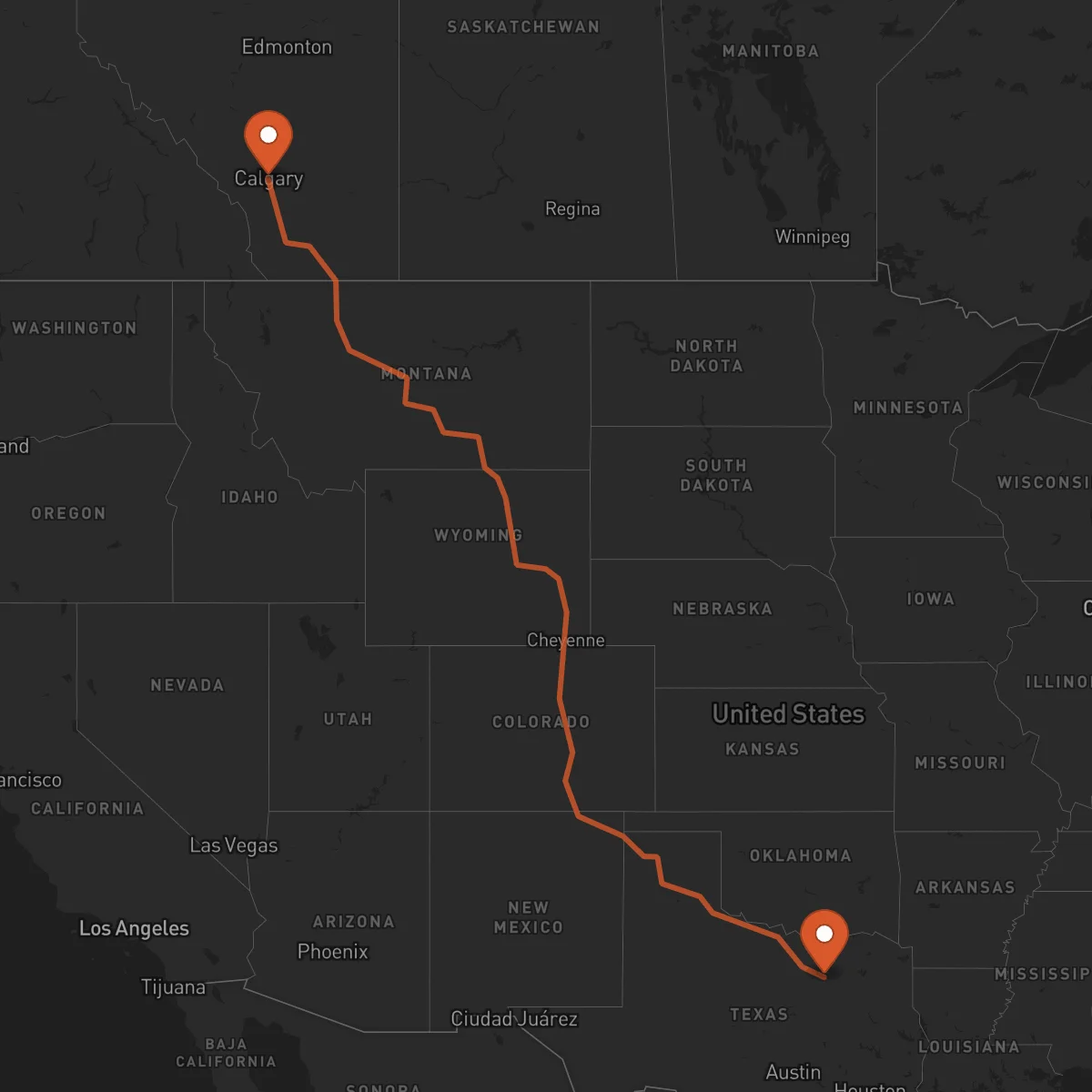
Dallas to Calgary
Calgary → DallasFTL freight transportation service between Dallas and Calgary. Reliable logistics solutions for your business.
Route Description
Everything you need to know about the corridor Dallas - Calgary
The Dallas to Calgary corridor represents a vital North American trade route connecting the economic powerhouse of Texas with Alberta's energy and industrial hub. This 2,470 km cross-border route traverses diverse landscapes and economic zones, facilitating the movement of goods between the United States and Canada. The corridor's strategic importance lies in its ability to connect major industrial centers, supporting the integrated supply chains that drive North American commerce.
The economic significance of this route extends across multiple sectors. Dallas serves as a major distribution center with strong manufacturing and technology sectors, while Calgary stands as Canada's energy capital, home to the oil and gas industry and related services. The corridor also supports agricultural trade, automotive parts distribution, and industrial equipment movement. Key industries utilizing this route include energy services, manufacturing, technology, and retail distribution.
Transportation infrastructure along this corridor relies primarily on I-35 North connecting to I-29 and I-94, providing efficient highway access between the two cities. The primary border crossing at Coutts-Sweetgrass offers streamlined customs processing for commercial freight. Control Terrestre facilitates seamless operations on this corridor through our extensive network of certified carriers, expertise in cross-border documentation, and commitment to timely delivery. Our team ensures compliance with customs regulations while maintaining the efficiency that time-sensitive freight requires.
Services for this Route
Available services for the corridor Dallas - Calgary
 Origin
Dallas
Dallas stands as a strategic logistics hub in the southern United States, offering exceptional connectivity and infrastructure for freight transportation. The city's central location in Texas provides access to major highways including I-20, I-30, and I-35, creating a robust transportation network that reaches both coasts and the Mexican border. Dallas benefits from the presence of Dallas/Fort Worth International Airport and multiple rail terminals, enhancing its multimodal capabilities.
The Dallas-Fort Worth metroplex hosts a diverse economic landscape with strong manufacturing, technology, and distribution sectors. The region is home to numerous corporate headquarters and serves as a gateway for international trade, particularly with Mexico. The area's industrial parks and warehousing facilities provide comprehensive logistics support, while the city's business-friendly environment continues to attract investment and expansion in the logistics sector.
 Destination
Calgary's strategic location in Alberta positions it as a critical logistics center for Western Canada and the broader North American market. The city serves as the primary gateway to the Canadian Rockies and provides essential connections to major transportation routes including the Trans-Canada Highway and Canadian Pacific Railway. Calgary International Airport and the Port of Vancouver access further enhance the city's multimodal transportation capabilities.
The Calgary economy is anchored by the energy sector, with Alberta's oil sands and natural gas resources driving significant industrial activity. The city also hosts growing technology, manufacturing, and logistics sectors, creating diverse freight transportation needs. Calgary's proximity to major oil and gas operations in Northern Alberta, combined with its role as a regional distribution center, makes it a crucial node in North American supply chains. The city's infrastructure supports specialized freight requirements, including oversized equipment and hazardous materials common to the energy industry.










