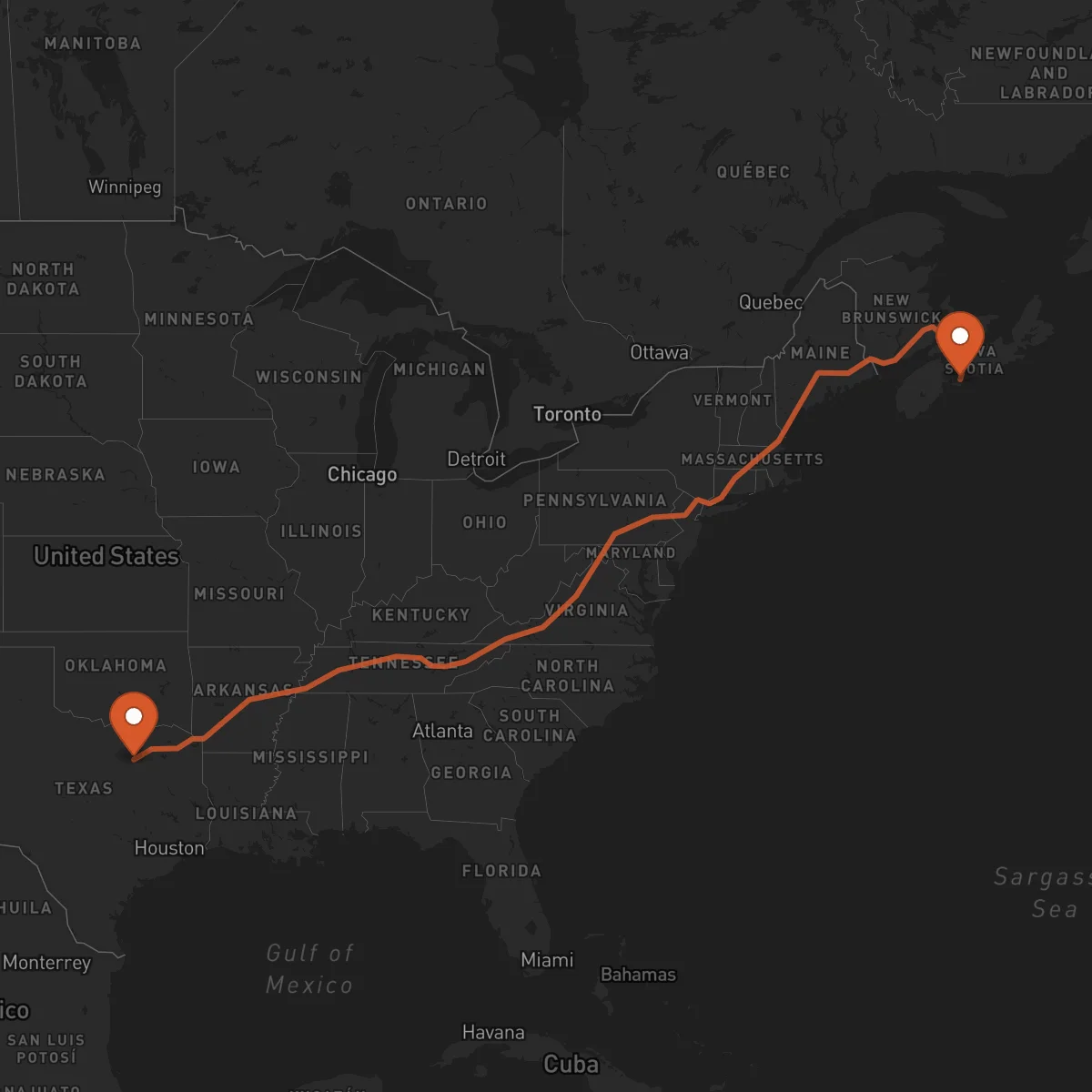
Dallas to Halifax
Halifax → DallasFTL freight transportation service between Dallas and Halifax. Reliable logistics solutions for your business.
Route Description
Everything you need to know about the corridor Dallas - Halifax
The Dallas to Halifax corridor represents a critical north-south freight transportation route connecting the industrial heart of Texas with the Atlantic port of Nova Scotia. This 3,141 km cross-border route traverses the United States and Canada, linking two major economic regions through a network of interstate highways and international trade corridors. The route serves as a vital artery for supply chain operations, facilitating the movement of goods between the central United States and the Atlantic provinces.
This corridor passes through diverse economic zones, connecting Dallas's robust manufacturing and technology sectors with Halifax's maritime and logistics industries. The route primarily utilizes I-35 North to connect with I-81 North, then transitions to Canadian highways through New Brunswick before reaching Nova Scotia. Major border crossings at locations like the Thousand Islands Bridge provide efficient customs clearance for cross-border freight movements.
Control Terrestre specializes in managing full truckload (FTL) operations along this corridor, ensuring seamless cross-border transportation. Our experienced team handles all customs documentation and compliance requirements, while our network of certified carriers provides reliable equipment options for various cargo types. We understand the unique challenges of this route, including seasonal weather conditions and varying provincial regulations, allowing us to optimize transit planning and delivery schedules for our clients.
Services for this Route
Available services for the corridor Dallas - Halifax
 Origin
Dallas
Dallas serves as a strategic logistics hub in the southern United States, offering exceptional connectivity through its central location in Texas. The Dallas-Fort Worth metropolitan area hosts numerous distribution centers, manufacturing facilities, and warehousing operations that support diverse industries including technology, aerospace, automotive, and consumer goods. The city's extensive transportation infrastructure includes multiple interstate highways (I-20, I-30, I-35, I-45), a major international airport, and direct rail connections, making it an ideal origin point for freight movements across North America.
 Destination
Halifax
Halifax functions as Atlantic Canada's primary maritime gateway, offering strategic access to international shipping routes through its deep-water port. The city serves as a crucial logistics center for Nova Scotia and surrounding provinces, with strong connections to fishing, forestry, and emerging technology sectors. Halifax's transportation infrastructure includes the Port of Halifax, Stanfield International Airport, and comprehensive highway networks connecting to mainland Canada. The city's position on the Atlantic coast makes it an essential endpoint for freight movements requiring ocean freight connections or serving the eastern Canadian market.










