Dallas to Toronto
Toronto → DallasFTL freight transportation service between Dallas and Toronto. Reliable logistics solutions for your business.
Route Description
Everything you need to know about the corridor Dallas - Toronto
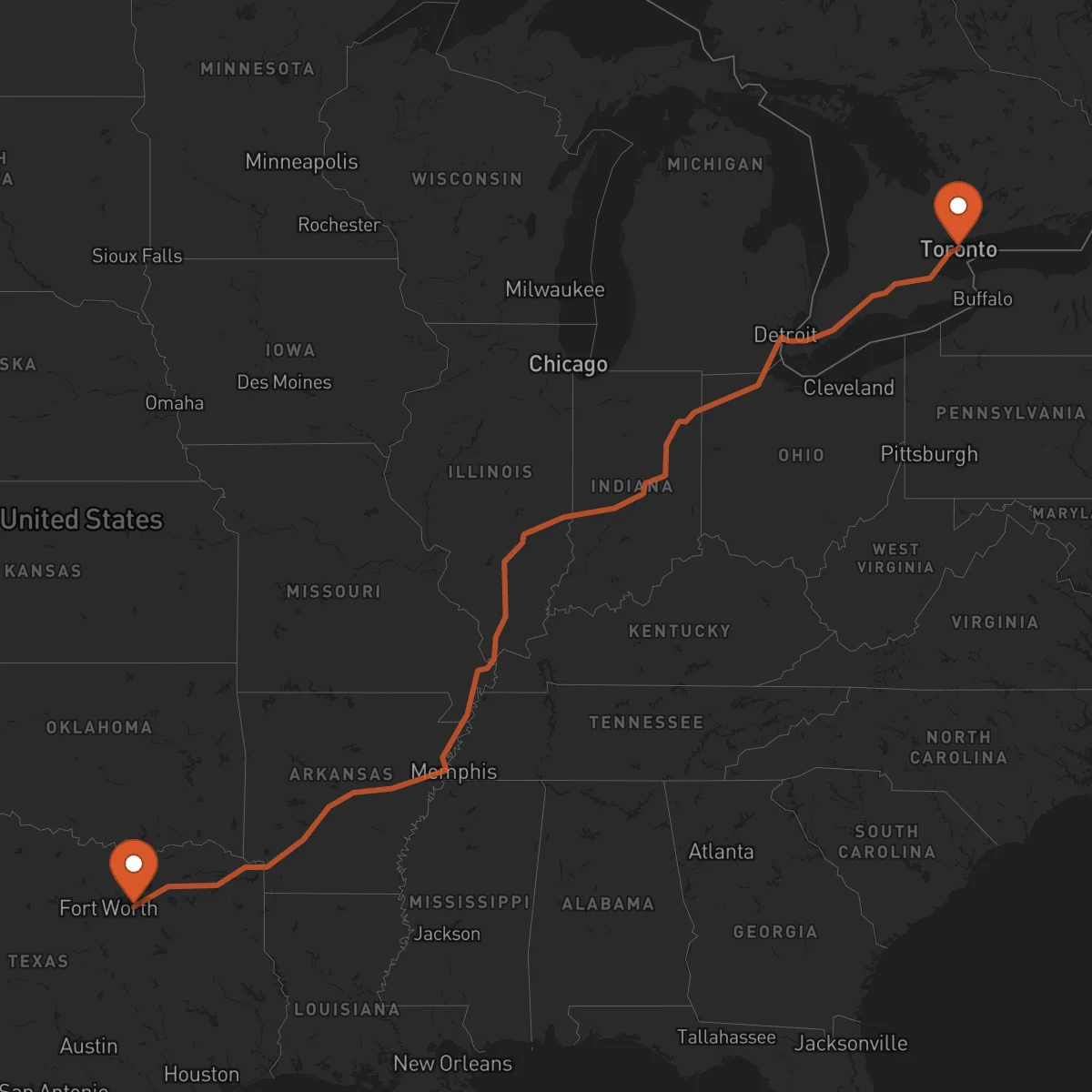
The Dallas-Toronto corridor represents one of the most critical logistics routes connecting the United States and Canada, spanning approximately 1,936 kilometers through the heart of North America. This cross-border freight route links two major economic hubs, facilitating the movement of goods between the industrial powerhouse of Texas and the manufacturing and financial center of Ontario. The corridor traverses diverse landscapes and crosses multiple state and provincial lines, requiring expert knowledge of cross-border regulations and efficient coordination to ensure seamless freight movement.
The economic significance of this route is underscored by the robust trade relationship between Texas and Ontario, with major industries including automotive manufacturing, technology, energy, and consumer goods driving freight volumes. The corridor primarily utilizes major interstate highways such as I-35 North and I-69C, connecting through key border crossings like Detroit-Windsor or Port Huron-Sarnia. These crossings are among the busiest in North America, handling billions of dollars in trade annually. Control Terrestre's expertise in cross-border logistics ensures that shipments move efficiently through customs, leveraging our C-TPAT certification and established relationships with customs brokers to minimize delays and maintain supply chain integrity.
Services for this Route
Available services for the corridor Dallas - Toronto
 Origin
Dallas
Dallas serves as a strategic logistics hub in the southern United States, offering exceptional connectivity through its extensive transportation infrastructure. The city's central location in Texas provides access to major interstate highways including I-20, I-30, and I-35, facilitating efficient distribution throughout the region and beyond. Dallas benefits from the presence of major logistics facilities, warehousing districts, and proximity to the Port of Houston for international maritime connections. The region's diverse economy encompasses technology, telecommunications, energy, healthcare, and manufacturing sectors, generating consistent freight volumes that require reliable transportation solutions. Dallas's position as a distribution center for goods moving throughout the southern United States and into Mexico makes it an ideal origin point for cross-border freight operations.
 Destination
Toronto stands as Canada's largest city and a premier logistics hub in North America, strategically positioned in the Golden Horseshoe region of Ontario. The city's extensive transportation infrastructure includes major highways such as Highway 401, which is one of the busiest in North America, and comprehensive rail networks connecting to national and international destinations. Toronto's Pearson International Airport provides air cargo capabilities, while its proximity to major manufacturing centers in southern Ontario creates a robust freight ecosystem. The region's economy is diverse, with strong automotive, technology, financial services, and consumer goods sectors driving consistent freight demand. Toronto's role as a gateway to Eastern Canada and its position as a major distribution center for goods throughout Ontario and Quebec make it a critical destination for cross-border freight operations.










