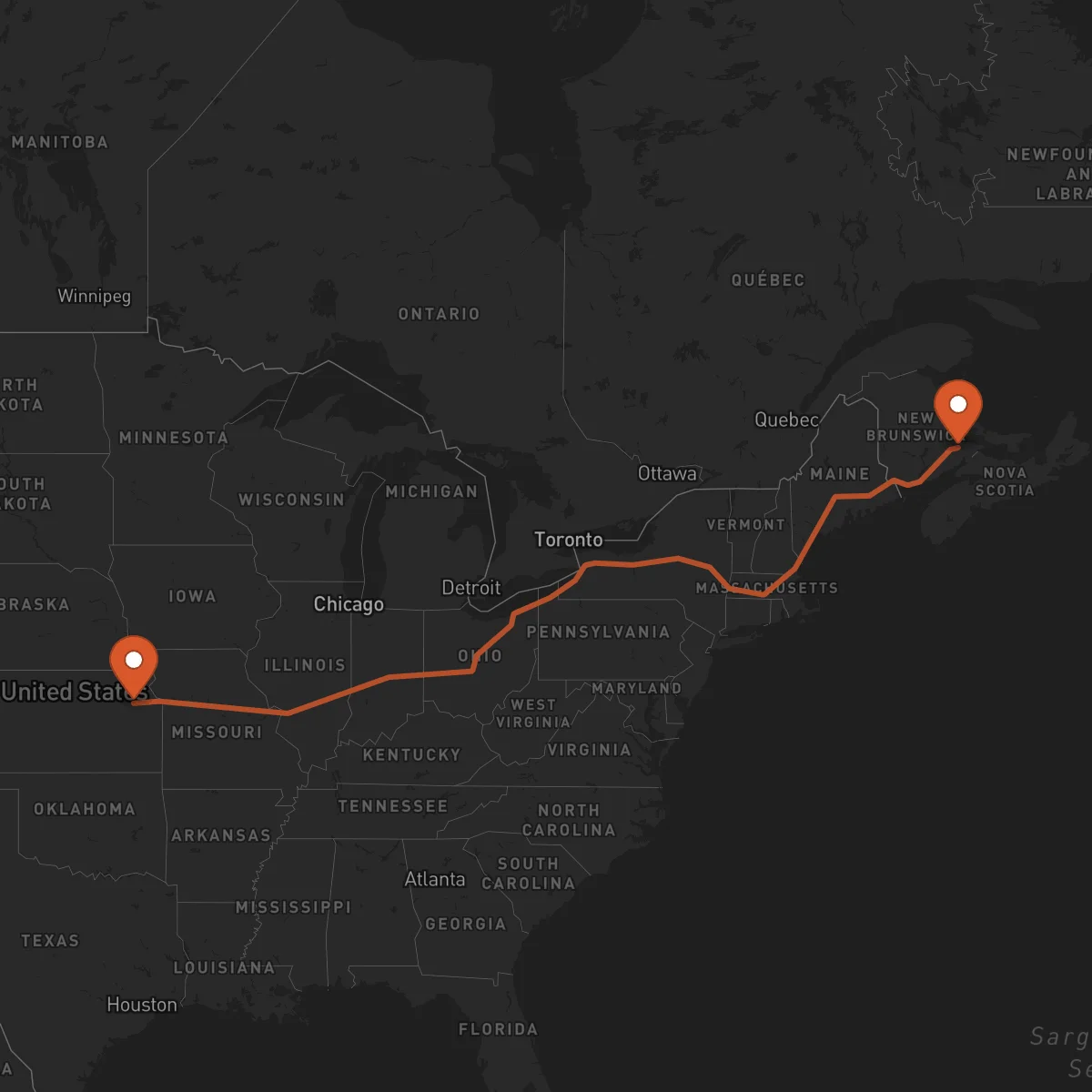
Topeka to Moncton
Moncton → TopekaFTL freight transportation service between Topeka and Moncton. Reliable logistics solutions for your business.
Route Description
Everything you need to know about the corridor Topeka - Moncton
The logistics corridor connecting Topeka, Kansas, with Moncton, New Brunswick, represents a vital cross-border freight route spanning approximately 2,630 kilometers across the United States and Canada. This strategic corridor traverses the heart of North America, linking the industrial Midwest with the Atlantic provinces, facilitating the movement of goods between major economic regions. The route primarily follows Interstate 70 eastward through Missouri, Illinois, and Indiana, connecting with Interstate 90 and Interstate 94 through the Great Lakes region, before continuing through Michigan and crossing into Canada via the Blue Water Bridge at Sarnia-Port Huron. From there, the corridor proceeds through Ontario and Quebec, utilizing the Trans-Canada Highway system before reaching New Brunswick and ultimately Moncton.
The economic significance of this corridor cannot be overstated, as it connects manufacturing hubs in the American Midwest with distribution centers and ports in Atlantic Canada. The route serves as a critical link for automotive parts, agricultural products, industrial equipment, and consumer goods moving between these regions. Major industries utilizing this corridor include automotive manufacturing, food processing, agricultural exports, and retail distribution. The presence of major manufacturing centers in Kansas, Missouri, and Michigan creates substantial northbound freight volumes, while Moncton's role as a logistics hub for Atlantic Canada generates significant southbound traffic.
Control Terrestre specializes in managing cross-border operations along this corridor, ensuring seamless freight movement across international boundaries. Our expertise in customs documentation, compliance requirements, and border procedures helps minimize delays at critical crossing points. We coordinate with trusted carriers who understand the nuances of cross-border transportation, including proper documentation for commercial invoices, certificates of origin, and compliance with both USMCA (United States-Mexico-Canada Agreement) regulations and Canadian import requirements. Our dedicated team monitors shipments throughout the journey, providing real-time visibility and proactive communication to ensure timely delivery between Topeka and Moncton.
Services for this Route
Available services for the corridor Topeka - Moncton
 Origin
Topeka
Topeka, Kansas, serves as a strategic origin point for freight transportation due to its central location within the United States and excellent transportation infrastructure. The city benefits from its position along major freight corridors, including Interstate 70, which provides direct east-west connectivity across the country. Topeka's economy is anchored by government services, as it serves as the state capital, along with manufacturing, healthcare, and education sectors. The presence of major employers such as Goodyear Tire & Rubber Company, Hill's Pet Nutrition, and various state government facilities creates consistent freight generation. The city's industrial parks and distribution centers are equipped to handle various cargo types, from automotive components to consumer goods. Topeka's transportation infrastructure includes multiple rail connections through BNSF Railway and Union Pacific, complementing the extensive highway network and providing multimodal shipping options for businesses requiring efficient freight movement to Canadian destinations.
 Destination
Moncton
Moncton, New Brunswick, stands as a crucial logistics hub in Atlantic Canada, strategically positioned to serve as a gateway to the Maritime provinces. The city's location at the geographic center of the Maritimes, combined with its bilingual workforce and business-friendly environment, has established it as a major distribution center for the region. Moncton's economy encompasses transportation, distribution, retail, and information technology sectors, with major employers including national retailers, logistics companies, and call centers. The city boasts the Moncton International Airport, which handles significant cargo volumes, and the nearby Port of Saint John provides ocean freight capabilities. The robust highway infrastructure, including the Trans-Canada Highway and connections to US Interstate systems, facilitates efficient freight movement from American origins. Moncton's role as a logistics center is further enhanced by its designation as a Foreign Trade Zone, making it an attractive destination for companies seeking to optimize their supply chain operations in Atlantic Canada.










