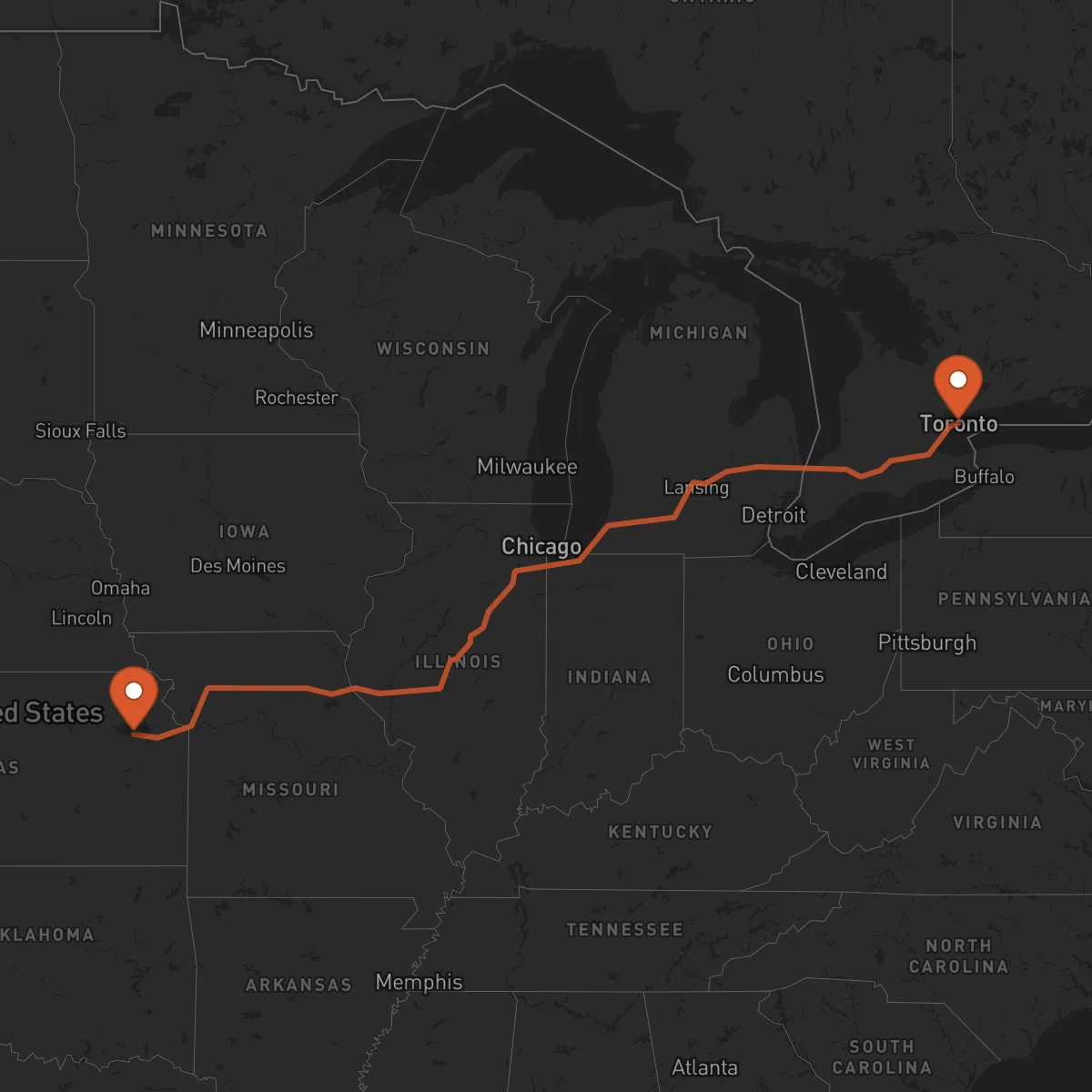
Topeka to Toronto
Toronto → TopekaFTL freight transportation service between Topeka and Toronto. Reliable logistics solutions for your business.
Route Description
Everything you need to know about the corridor Topeka - Toronto
The Topeka-Toronto corridor represents a vital cross-border freight transportation route connecting the central United States with Canada's largest economic hub. This 1450 km journey traverses the heart of North America, linking Kansas's agricultural and manufacturing base with Ontario's diverse industrial landscape. The route serves as a critical artery for businesses requiring efficient movement of goods between these two major markets.
The corridor's strategic importance stems from its connection between the American Midwest's production capabilities and Toronto's role as Canada's financial and industrial capital. Along this route, freight moves through diverse economic zones, from Kansas's agricultural processing centers to the manufacturing corridors of the Great Lakes region, before reaching Toronto's extensive distribution networks. This pathway facilitates trade in automotive parts, agricultural products, manufactured goods, and consumer products.
Transportation infrastructure along the Topeka-Toronto corridor primarily utilizes Interstate 70 East from Topeka, connecting to Interstate 90 and then Canadian highways through Windsor-Detroit. The route offers multiple border crossing options, with the Detroit-Windsor crossing being the most utilized due to its proximity and extensive processing capabilities. Control Terrestre's expertise in cross-border operations ensures seamless customs clearance and compliance with both US and Canadian regulations, providing reliable full truckload (FTL) service throughout this important trade corridor.
Services for this Route
Available services for the corridor Topeka - Toronto
 Origin
Topeka
Topeka, Kansas serves as a strategic logistics hub in the American Midwest, offering excellent connectivity through its central location. The city benefits from its position along major transportation routes, including direct access to Interstate 70, which provides east-west connectivity across the United States. Topeka's logistics infrastructure includes modern warehousing facilities, intermodal yards, and proximity to regional distribution centers that support efficient freight consolidation and distribution.
The local economy features strong agricultural processing, manufacturing, and healthcare sectors. Major employers include organizations in the food processing industry, machinery manufacturing, and technology services. The city's industrial base creates consistent freight movement, particularly in agricultural products, machinery, and manufactured goods. Topeka's central location makes it an ideal origin point for cross-country and cross-border shipments, offering cost-effective transportation solutions for businesses throughout the Midwest.
 Destination
Toronto, Ontario stands as Canada's premier logistics and economic center, offering unparalleled connectivity and infrastructure for freight transportation. The Greater Toronto Area (GTA) features an extensive network of highways, including the 400-series roads that provide efficient access to major markets across Ontario and connections to the United States. Toronto's international airport and port facilities complement its robust ground transportation network, creating multiple options for freight movement.
The city's economy is remarkably diverse, encompassing financial services, technology, manufacturing, healthcare, and retail sectors. Toronto serves as a critical distribution point for goods throughout Eastern Canada and the Northeastern United States. The region's industrial base includes automotive manufacturing, aerospace, pharmaceuticals, and food processing, generating substantial freight volume. Toronto's position as Canada's largest consumer market and its role as a gateway to other Canadian provinces make it a crucial destination for cross-border freight, requiring sophisticated logistics solutions to manage the complex supply chain demands.










