Topeka to Mississauga
Mississauga → TopekaFTL freight transportation service between Topeka and Mississauga. Reliable logistics solutions for your business.
Route Description
Everything you need to know about the corridor Topeka - Mississauga
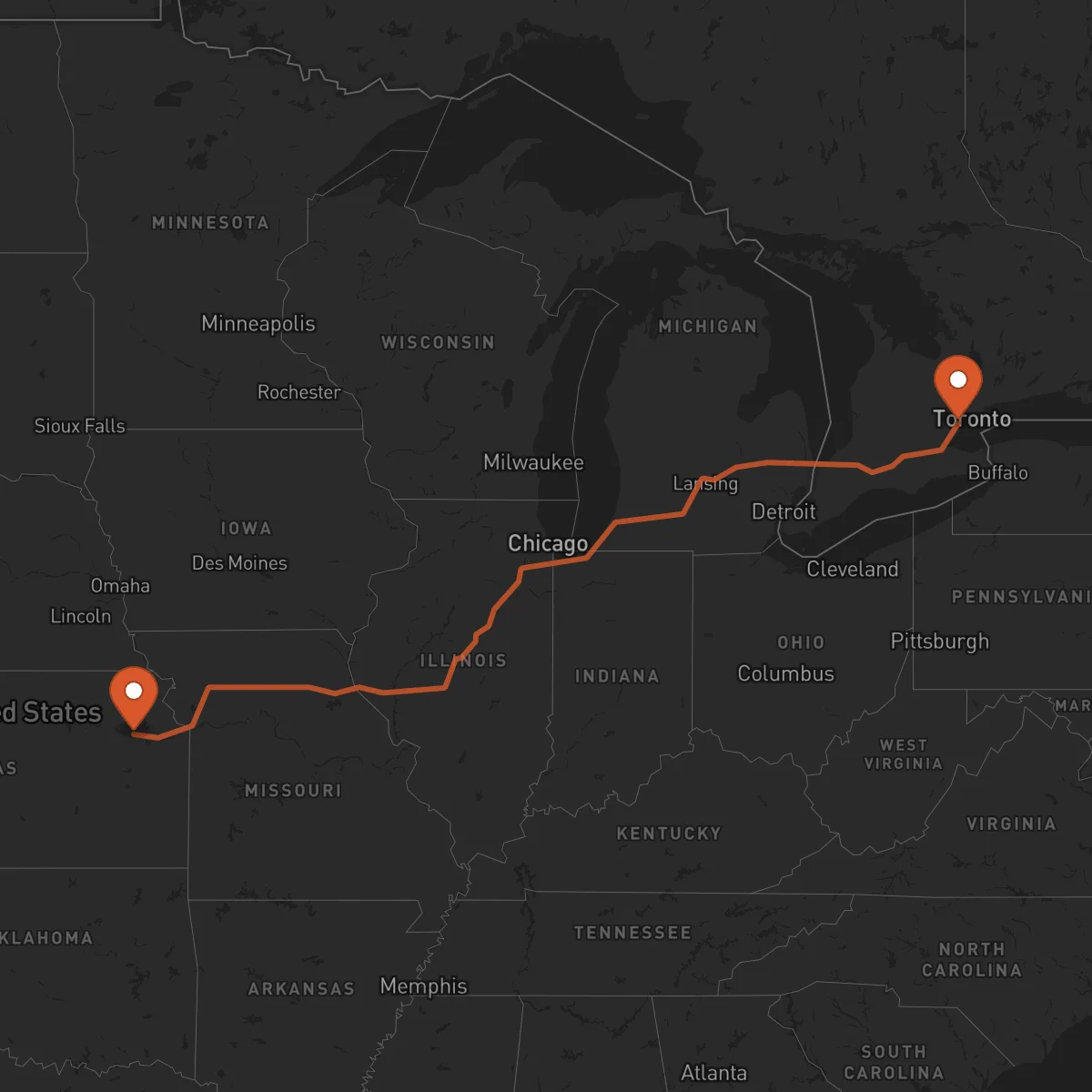
The logistics corridor connecting Topeka, Kansas, to Mississauga, Ontario, represents a vital cross-border transportation route between the United States and Canada. This 1,428-kilometer corridor facilitates the movement of goods across the North American heartland, linking the industrial Midwest with Canada's largest transportation hub. The route traverses diverse landscapes and connects major economic centers, making it essential for businesses operating in both countries.
The region along this corridor is characterized by strong manufacturing, automotive, and agricultural sectors. Topeka serves as a strategic distribution point in the central United States, while Mississauga functions as a major logistics and industrial center in the Greater Toronto Area. The corridor supports industries including automotive parts, consumer goods, electronics, and industrial equipment, with significant freight volumes moving in both directions.
Transportation infrastructure along this route includes major highways such as I-29, I-35, I-94, and the 401 Expressway in Canada. The corridor crosses at key border points including Detroit-Windsor or Sarnia-Port Huron, depending on the specific routing. Control Terrestre leverages this infrastructure to provide efficient cross-border FTL transportation, managing customs clearance and ensuring compliance with all regulations for seamless freight movement between the two countries.
Services for this Route
Available services for the corridor Topeka - Mississauga
 Origin
Topeka
Topeka, Kansas, serves as a strategic logistics hub in the central United States, offering excellent connectivity to major markets across the Midwest. The city's location provides access to an extensive network of highways, including I-70 and I-335, facilitating efficient distribution throughout the region. Topeka's transportation infrastructure includes multiple rail connections and a growing intermodal facility, making it an ideal origin point for cross-border freight operations.
The city's economy is diverse, with strong presence in manufacturing, healthcare, and education sectors. Key industries include food processing, machinery manufacturing, and agricultural equipment production. These sectors generate consistent freight volumes, particularly in full truckload shipments requiring reliable transportation to Canadian markets. Topeka's central location also provides strategic advantages for time-sensitive deliveries and just-in-time inventory management.
 Destination
Mississauga, Ontario, stands as one of Canada's most important logistics and industrial centers, located in the heart of the Greater Toronto Area. The city's strategic position provides immediate access to major transportation routes, including the 401 Expressway - North America's busiest highway - and proximity to Toronto Pearson International Airport, Canada's largest air cargo facility. Mississauga's extensive transportation infrastructure makes it an ideal destination for cross-border freight operations.
The city hosts a diverse economic landscape with strong concentrations in advanced manufacturing, pharmaceuticals, aerospace, and technology sectors. Many Fortune 500 companies maintain major operations in Mississauga, creating substantial demand for reliable freight transportation services. The area's robust industrial parks and distribution centers are specifically designed to handle high-volume cross-border shipments, making it a critical node in North American supply chains.










