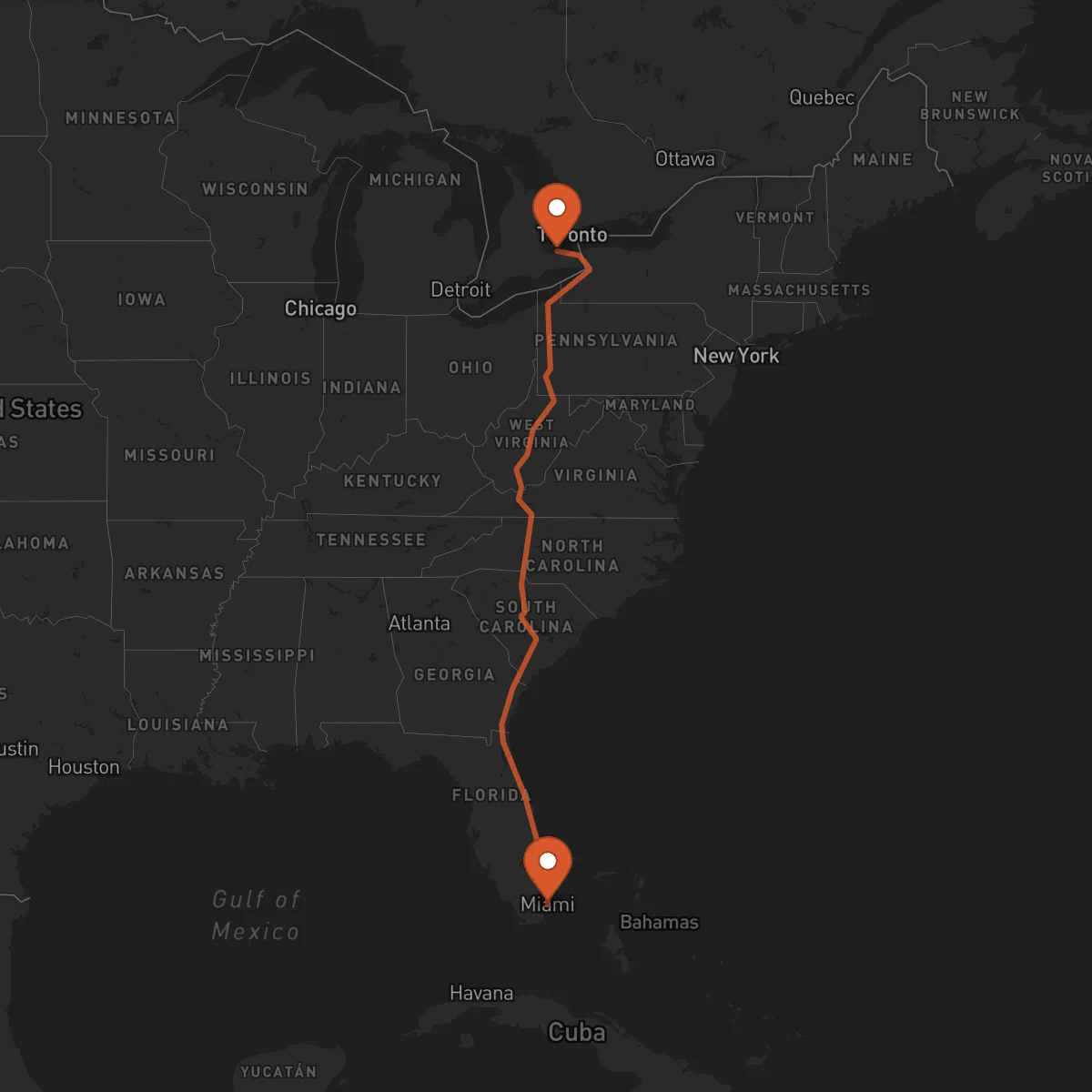
Miami to Hamilton
Hamilton → MiamiFTL freight transportation service between Miami and Hamilton. Reliable logistics solutions for your business.
Route Description
Everything you need to know about the corridor Miami - Hamilton
The Miami to Hamilton corridor is a vital cross-border freight route connecting the southeastern United States with Canada's industrial heartland. This 1,945-kilometer journey traverses diverse economic regions, linking Florida's international trade gateway with Ontario's manufacturing powerhouse. The route serves as a critical supply chain artery for industries requiring seamless North American distribution.
This corridor benefits from exceptional transportation infrastructure, primarily utilizing I-95, I-79, and I-90 highways. The route crosses at key border points including the Ambassador Bridge and Blue Water Bridge, facilitating efficient customs clearance for time-sensitive freight. Control Terrestre's expertise in cross-border operations ensures smooth navigation through customs procedures and regulatory compliance.
Major industries leveraging this corridor include automotive manufacturing, electronics, pharmaceuticals, and consumer goods. Hamilton's steel industry and Miami's diverse manufacturing sector create complementary trade flows. The route accommodates various freight types, from standard dry goods to specialized cargo requiring temperature control or handling.
Control Terrestre provides comprehensive FTL solutions for this corridor, offering dedicated equipment and experienced drivers familiar with both U.S. and Canadian regulations. Our strategic partnerships and technology-enabled tracking ensure reliable, efficient transportation from pickup in Miami to final delivery in Hamilton.
Services for this Route
Available services for the corridor Miami - Hamilton
 Origin
Miami
Miami serves as a strategic logistics hub in southeastern United States, offering unparalleled access to international trade routes. The city's location provides direct connections to Latin American markets and serves as a gateway for goods entering the U.S. market. Miami International Airport and PortMiami facilitate multimodal transportation options, while extensive highway networks connect to major U.S. markets.
The region's economy spans diverse sectors including international trade, manufacturing, technology, and healthcare. Miami's Free Trade Zone and foreign trade zones offer significant advantages for import/export operations. The city's infrastructure includes modern warehousing facilities, advanced logistics parks, and a skilled workforce supporting complex supply chain operations.
 Destination
Hamilton stands as a crucial logistics and industrial center in Ontario, Canada, strategically positioned near Toronto and the U.S. border. The city's location on Lake Ontario provides multimodal transportation capabilities through port facilities, rail connections, and highway access. Hamilton's infrastructure supports efficient distribution throughout the Great Lakes region and beyond.
The city's economy is anchored by steel manufacturing, advanced manufacturing, and a growing technology sector. Hamilton's industrial base requires reliable freight transportation for raw materials and finished goods. The region's transportation network includes the Queen Elizabeth Way, Highway 403, and direct connections to major Canadian and U.S. markets, making it an ideal destination for cross-border freight operations.










