Houston to Winnipeg
Winnipeg → HoustonFTL freight transportation service between Houston and Winnipeg. Reliable logistics solutions for your business.
Route Description
Everything you need to know about the corridor Houston - Winnipeg
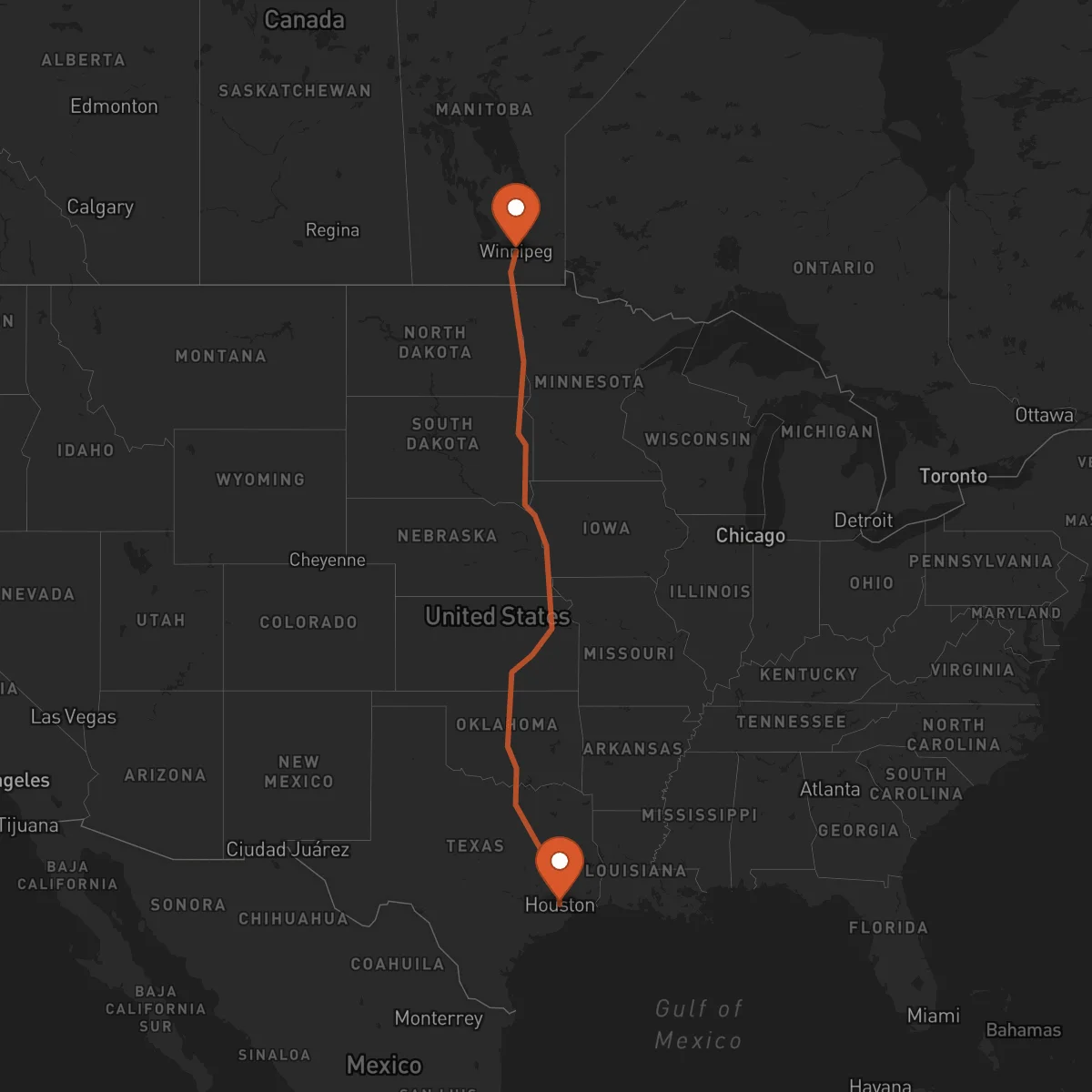
The Houston to Winnipeg corridor represents a vital cross-border freight transportation route connecting the energy and industrial hub of Texas with the agricultural and manufacturing center of Manitoba. This 2,244 km route traverses three major North American economic regions, facilitating the movement of diverse cargo between the United States, Canada, and the broader North American market.
The corridor's strategic importance stems from Houston's position as a global energy capital and Winnipeg's role as a key distribution center in central Canada. Along this route, freight moves through major transportation hubs including Dallas, Oklahoma City, Kansas City, and Minneapolis, providing multiple options for transloading and distribution. The route primarily utilizes Interstate 45, Interstate 35, Interstate 29, and Provincial Trunk Highway 75, offering reliable all-season transportation.
Key industries utilizing this corridor include energy equipment and supplies moving from Houston's petrochemical sector to Canadian oil fields, agricultural machinery and products from Winnipeg's farming region, manufacturing components for automotive and aerospace industries, and general commercial goods supporting the integrated North American supply chain. The corridor also handles significant cross-border e-commerce and retail distribution traffic.
Control Terrestre facilitates seamless operations on this corridor through our network of certified carriers and strategic partnerships. We provide comprehensive door-to-door FTL services, handling all customs documentation and compliance requirements for cross-border shipments. Our expertise in navigating both US and Canadian regulations, combined with real-time tracking capabilities, ensures your freight moves efficiently between Houston and Winnipeg, regardless of seasonal weather challenges or regulatory requirements.
Services for this Route
Available services for the corridor Houston - Winnipeg
 Origin
Houston
Houston, Texas stands as one of North America's most significant logistics hubs, strategically positioned near the Gulf of Mexico with access to major ports, airports, and an extensive highway network. The city's location at the intersection of Interstate 10, Interstate 45, and State Highway 6 provides excellent connectivity to both coastal and inland destinations. Houston's logistics infrastructure includes the Port of Houston, one of the busiest ports in the United States, George Bush Intercontinental Airport, and William P. Hobby Airport, complemented by extensive rail connections through Union Pacific and BNSF railroads.
The Houston metropolitan area is the energy capital of the world, hosting headquarters and operations for major oil, gas, and petrochemical companies. Beyond energy, Houston's economy encompasses healthcare and biomedical research, aerospace (home to NASA's Johnson Space Center), manufacturing, and technology sectors. The city's diverse industrial base creates substantial freight transportation demand, particularly for specialized equipment, hazardous materials handling, and temperature-controlled shipments. Houston's proximity to Mexico also makes it a key point for cross-border trade, further enhancing its strategic importance in North American logistics.
 Destination
Winnipeg, Manitoba serves as the geographic center of Canada and a critical logistics hub for central and western Canada. Located at the confluence of the Red and Assiniboine rivers, Winnipeg's strategic position makes it a natural distribution center for goods moving throughout the Prairie provinces and into the northern territories. The city is connected by major transportation routes including the Trans-Canada Highway, Provincial Trunk Highway 75 (which connects to the United States), and extensive rail networks operated by Canadian National and Canadian Pacific railways.
The Winnipeg logistics infrastructure includes James Armstrong Richardson International Airport, the Winnipeg James Armstrong Richardson International Airport, and the Port of Churchill via rail connection, providing multimodal transportation options. The city's location at the eastern edge of the Prairies positions it as a gateway for agricultural products, including grains, oilseeds, and livestock, as well as manufactured goods from central Canadian industrial centers. Winnipeg's economy is anchored by manufacturing, aerospace, transportation, and wholesale trade sectors, creating consistent demand for reliable freight transportation services. The city's role as a regional distribution center for Manitoba and neighboring provinces makes it an essential node in Canada's supply chain network.










