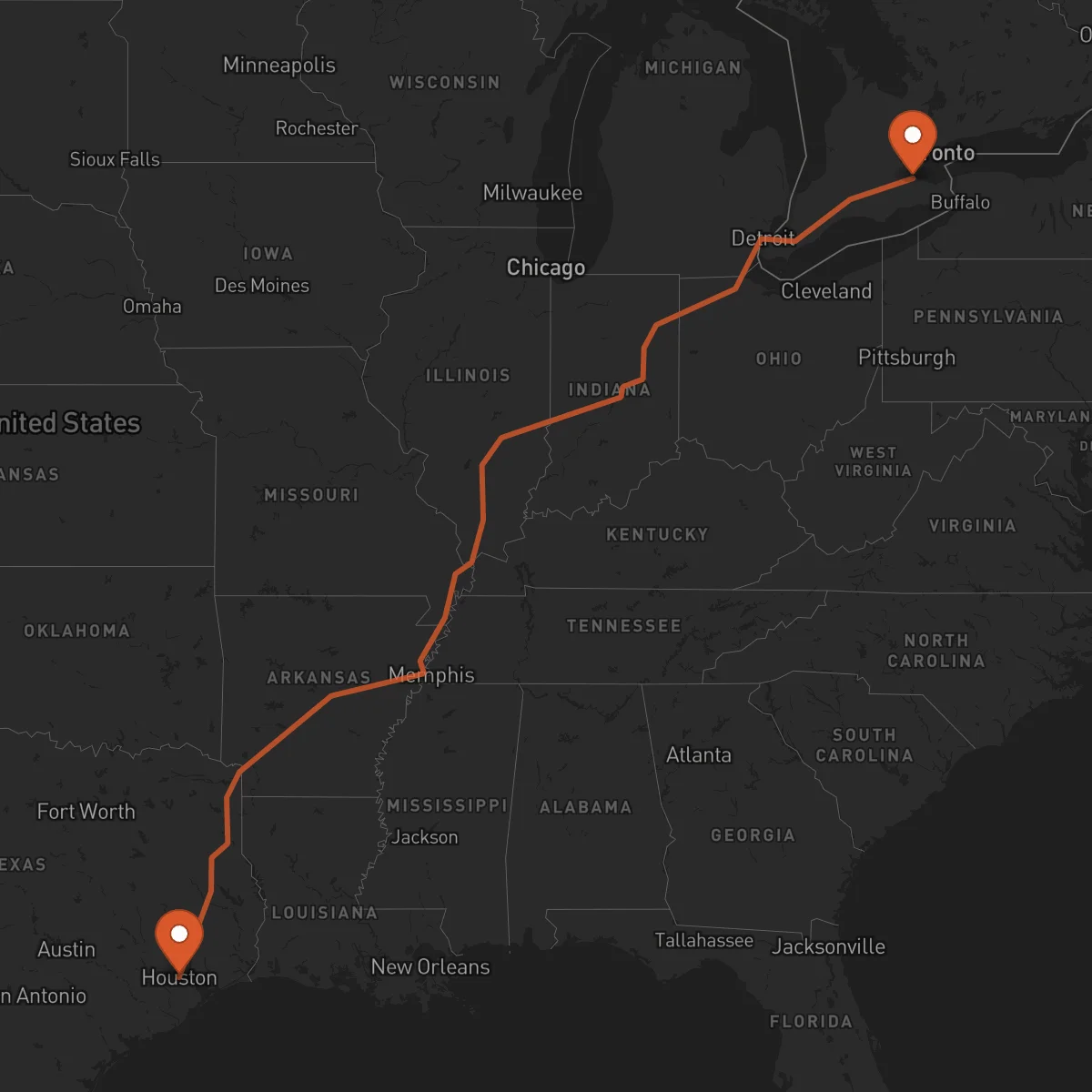
Houston to Hamilton
Hamilton → HoustonFTL freight transportation service between Houston and Hamilton. Reliable logistics solutions for your business.
Route Description
Everything you need to know about the corridor Houston - Hamilton
The Houston-Hamilton corridor represents a vital cross-border freight transportation route connecting the energy and industrial hub of Texas with Canada's manufacturing heartland. This 2,035-kilometer journey traverses the central United States and crosses into Ontario, facilitating the movement of goods between two of North America's most significant economic regions. The corridor serves as a critical link in the North American supply chain, enabling seamless trade between the United States and Canada.
This route connects Houston's diverse industrial base, including energy, chemicals, and manufacturing, with Hamilton's established steel production, automotive, and advanced manufacturing sectors. The corridor benefits from major interstate highways including I-69, I-75, and Ontario's 400-series highways, providing efficient and reliable transportation infrastructure. The primary border crossing at Detroit-Windsor offers extensive commercial processing capabilities, ensuring smooth customs clearance for cross-border shipments.
Control Terrestre specializes in managing the complexities of this cross-border corridor, offering comprehensive FTL services that ensure your cargo moves efficiently between Houston and Hamilton. Our expertise in customs documentation, border procedures, and regulatory compliance minimizes delays and ensures timely delivery. With our network of certified carriers and strategic partnerships, we provide dedicated transportation solutions that maintain the integrity of your supply chain across international borders.
Services for this Route
Available services for the corridor Houston - Hamilton
 Origin
Houston
Houston stands as a strategic logistics powerhouse in the southern United States, serving as the energy capital of North America. The city's location provides direct access to the Gulf of Mexico via the Port of Houston, one of the busiest ports in the country, while its extensive highway network connects to major freight corridors throughout Texas and beyond. Houston's economic landscape encompasses energy, petrochemicals, healthcare, and aerospace industries, creating diverse freight transportation needs.
The city boasts exceptional transportation infrastructure including George Bush Intercontinental Airport and William P. Hobby Airport for air cargo, an extensive rail network operated by major Class I railroads, and a comprehensive system of interstate highways including I-10, I-45, and I-69. This multimodal infrastructure, combined with Houston's industrial diversity, makes it an ideal origin point for freight shipments requiring reliable connectivity to both national and international destinations.
 Destination
Hamilton, Ontario, strategically positioned on the western tip of Lake Ontario, serves as a critical logistics and manufacturing center in Canada. Known historically as the "Steel Capital of Canada," Hamilton has evolved into a diversified industrial hub with strengths in advanced manufacturing, food processing, and distribution. The city's location within the Greater Toronto Area provides access to over six million consumers while maintaining more competitive operating costs than neighboring Toronto.
The city benefits from excellent transportation infrastructure including the Port of Hamilton, extensive rail connections through Canadian National and Canadian Pacific railways, and proximity to Toronto Pearson International Airport. Hamilton's highway network includes access to the Queen Elizabeth Way (QEW) and Highway 403, providing efficient connections to major Canadian markets. The city's industrial parks and logistics facilities are strategically positioned to support both domestic distribution and cross-border freight movements to the United States, making it an ideal destination for comprehensive supply chain operations.










