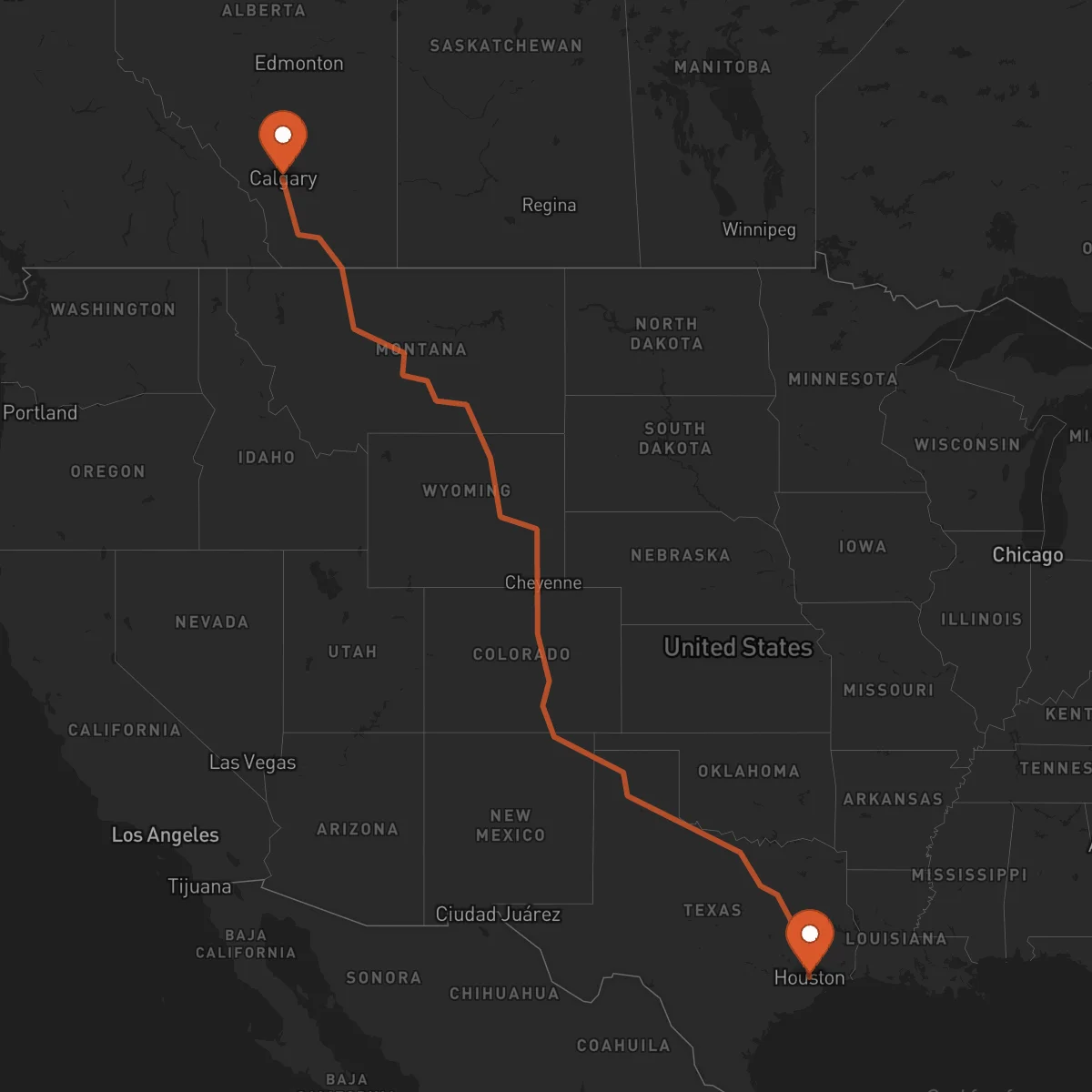
Houston to Calgary
Calgary → HoustonFTL freight transportation service between Houston and Calgary. Reliable logistics solutions for your business.
Route Description
Everything you need to know about the corridor Houston - Calgary
The Houston to Calgary corridor represents a vital cross-border freight transportation route connecting two of North America's most dynamic economic regions. This 2,830-kilometer journey traverses the United States and Canada, linking the energy and industrial powerhouse of Texas with Alberta's thriving oil and gas sector. The corridor serves as a critical supply chain artery for industries requiring reliable full truckload (FTL) transportation between these major economic centers.
The route primarily follows Interstate 45 North from Houston, transitioning to Interstate 35 North through Dallas, then continuing on Interstate 29 North through Kansas City and Omaha before connecting to Interstate 94 West through Minneapolis and Fargo. This well-established transportation infrastructure provides multiple routing options to accommodate different cargo requirements and delivery schedules. The corridor crosses the international border at multiple points, with the Pembina-Emerson crossing in North Dakota being a primary entry point for freight heading to Calgary.
This logistics corridor is particularly significant for the energy sector, manufacturing industries, and agricultural products moving between Texas and Alberta. Houston's status as an energy capital complements Calgary's position as a major Canadian energy hub, creating substantial freight volumes between these cities. The corridor also supports cross-border trade in automotive parts, industrial equipment, and specialized cargo requiring temperature-controlled transportation. Control Terrestre's expertise in cross-border operations ensures seamless customs clearance and regulatory compliance throughout this international journey, with our certified carriers maintaining C-TPAT and FAST program memberships to expedite border processing.
Services for this Route
Available services for the corridor Houston - Calgary
 Origin
Houston
Houston stands as a premier logistics hub in the southern United States, offering unparalleled access to major transportation networks and a diverse industrial base. The city's strategic location provides immediate access to the Port of Houston, one of the busiest ports in the nation, along with extensive rail connections and a comprehensive highway system. Houston's economy is anchored by the energy sector, with numerous oil and gas companies maintaining headquarters or major operations in the area, creating substantial freight transportation demand.
The city's infrastructure includes multiple interstate highways, including I-10, I-45, and I-69, providing excellent connectivity to both coastal and inland destinations. Houston's industrial parks and distribution centers are equipped to handle various cargo types, from standard freight to specialized and oversized loads. The region's manufacturing sector, including petrochemical, aerospace, and medical industries, generates consistent full truckload shipping volumes, making it an ideal origin point for cross-border freight movements to Canadian markets.
 Destination
Calgary serves as Alberta's primary logistics and economic center, strategically positioned to support both domestic Canadian and international freight movements. Located in the foothills of the Canadian Rockies, Calgary offers excellent connectivity through major highways including the Trans-Canada Highway (Highway 1) and the Queen Elizabeth II Highway (Highway 2), which provide direct access to Edmonton and other key Canadian markets. The city's proximity to the Canada-U.S. border facilitates efficient cross-border operations for freight originating from southern U.S. markets.
The Calgary region's economy is heavily influenced by the energy sector, with numerous oil and gas companies operating in the area. This industrial base creates substantial demand for specialized freight transportation, including oversized equipment and hazardous materials shipments. Calgary's logistics infrastructure includes modern warehousing facilities, intermodal terminals, and a well-maintained road network capable of handling various equipment types. The city's role as a distribution center for western Canada makes it an essential destination for full truckload freight moving from major U.S. markets, particularly for industries requiring reliable cross-border transportation services.










