Detroit to Ottawa
Ottawa → DetroitFTL freight transportation service between Detroit and Ottawa. Reliable logistics solutions for your business.
Route Description
Everything you need to know about the corridor Detroit - Ottawa
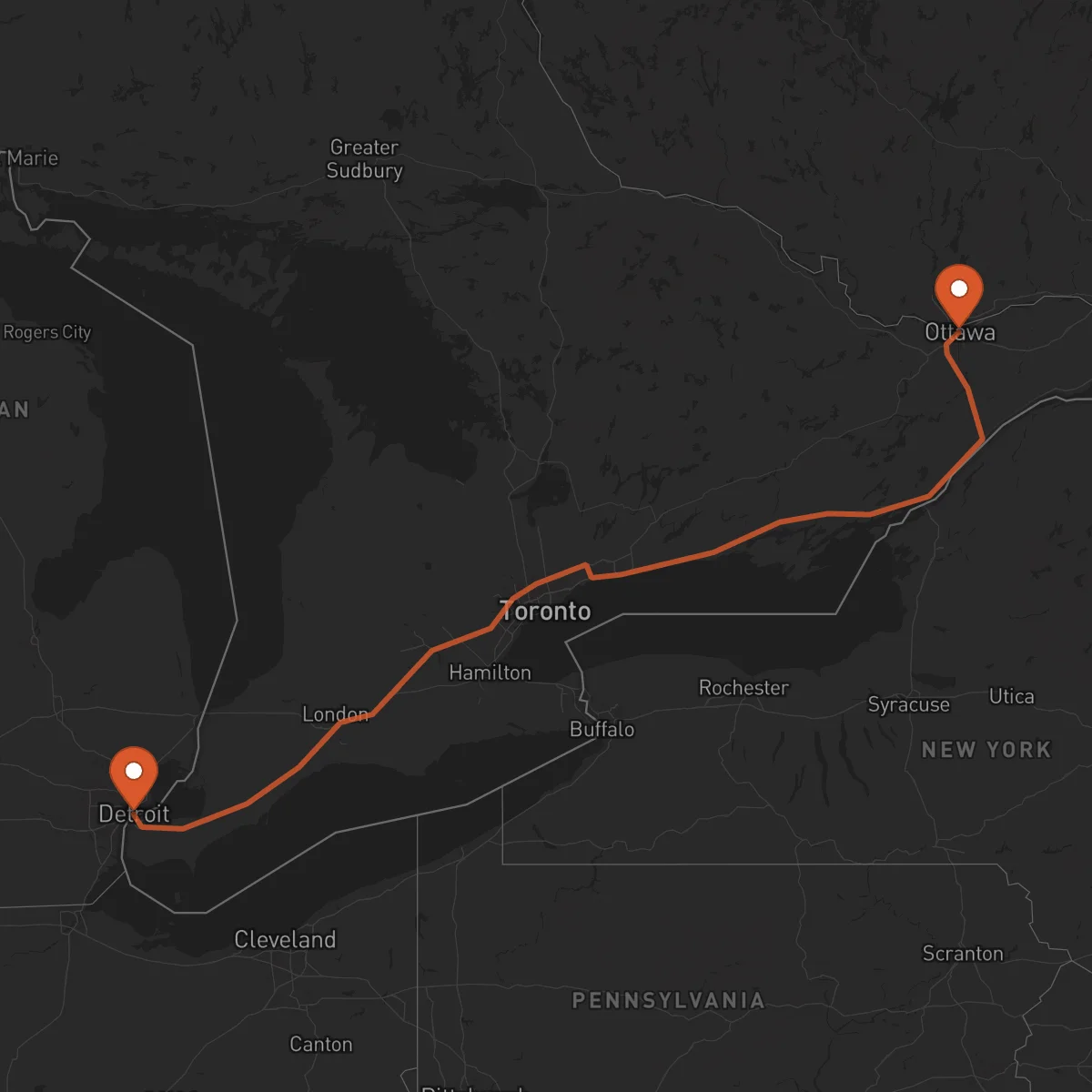
The Detroit-Ottawa corridor represents a vital cross-border logistics connection between the United States and Canada, spanning approximately 681 kilometers through the heart of North America's industrial corridor. This strategic route links Michigan's automotive manufacturing powerhouse with Canada's capital region, creating essential supply chain flows for both nations' economies.
The corridor traverses a region characterized by advanced manufacturing, technology, and government services. Detroit, known as the Motor City, serves as a global automotive hub, while Ottawa combines high-tech innovation with federal government operations. The route passes through key economic centers including London and Toronto in Ontario, connecting major industrial and commercial zones.
Transportation infrastructure along this corridor includes Interstate 75 and Ontario Highway 401, two of North America's most heavily trafficked freight routes. The Detroit-Windsor crossing at the Ambassador Bridge represents one of North America's busiest commercial border crossings, handling billions of dollars in trade annually. Control Terrestre's expertise in cross-border operations ensures seamless customs clearance and compliance with both US and Canadian regulations, facilitating efficient cargo movement between these economic powerhouses.
Our dedicated FTL services on this corridor are supported by C-TPAT and FAST certified carriers, ensuring expedited border processing and enhanced security. We understand the critical nature of just-in-time manufacturing schedules and government supply chains, providing reliable transportation solutions that maintain the integrity of your supply chain from origin to destination.
Services for this Route
Available services for the corridor Detroit - Ottawa
 Origin
Detroit
Detroit stands as a strategic logistics hub in the Great Lakes region, offering exceptional connectivity through its comprehensive transportation infrastructure. The city's location provides direct access to major interstate highways, including I-75, I-94, and I-96, creating efficient connections to both coastal ports and inland manufacturing centers. Detroit Metropolitan Airport and multiple rail terminals complement the robust road network, establishing Detroit as a multimodal logistics powerhouse.
The city's economy remains anchored in automotive manufacturing, with major facilities operated by the Big Three automakers and numerous Tier 1 and Tier 2 suppliers. Beyond automotive, Detroit hosts a growing technology sector, healthcare industry, and advanced manufacturing operations. The presence of major distribution centers and warehousing facilities, combined with Michigan's automotive supply chain concentration, creates substantial freight transportation demand that requires specialized logistics expertise.
 Destination
Ottawa serves as Canada's capital and a strategic logistics center in eastern Ontario, positioned at the confluence of major transportation routes. The city's location along the Ottawa River and proximity to major highways, including Ontario Highway 416 and 417, provides excellent connectivity to Montreal, Toronto, and the US border. Ottawa International Airport and extensive rail networks complement the road infrastructure, supporting diverse freight transportation needs.
The Ottawa economy combines government operations with a robust technology sector, earning the region the nickname 'Silicon Valley North.' The city hosts numerous federal government facilities, research institutions, and high-tech companies specializing in telecommunications, software development, and defense technology. Ottawa's growing healthcare industry, educational institutions, and professional services sector create varied freight transportation requirements, from specialized equipment to general cargo distribution.










