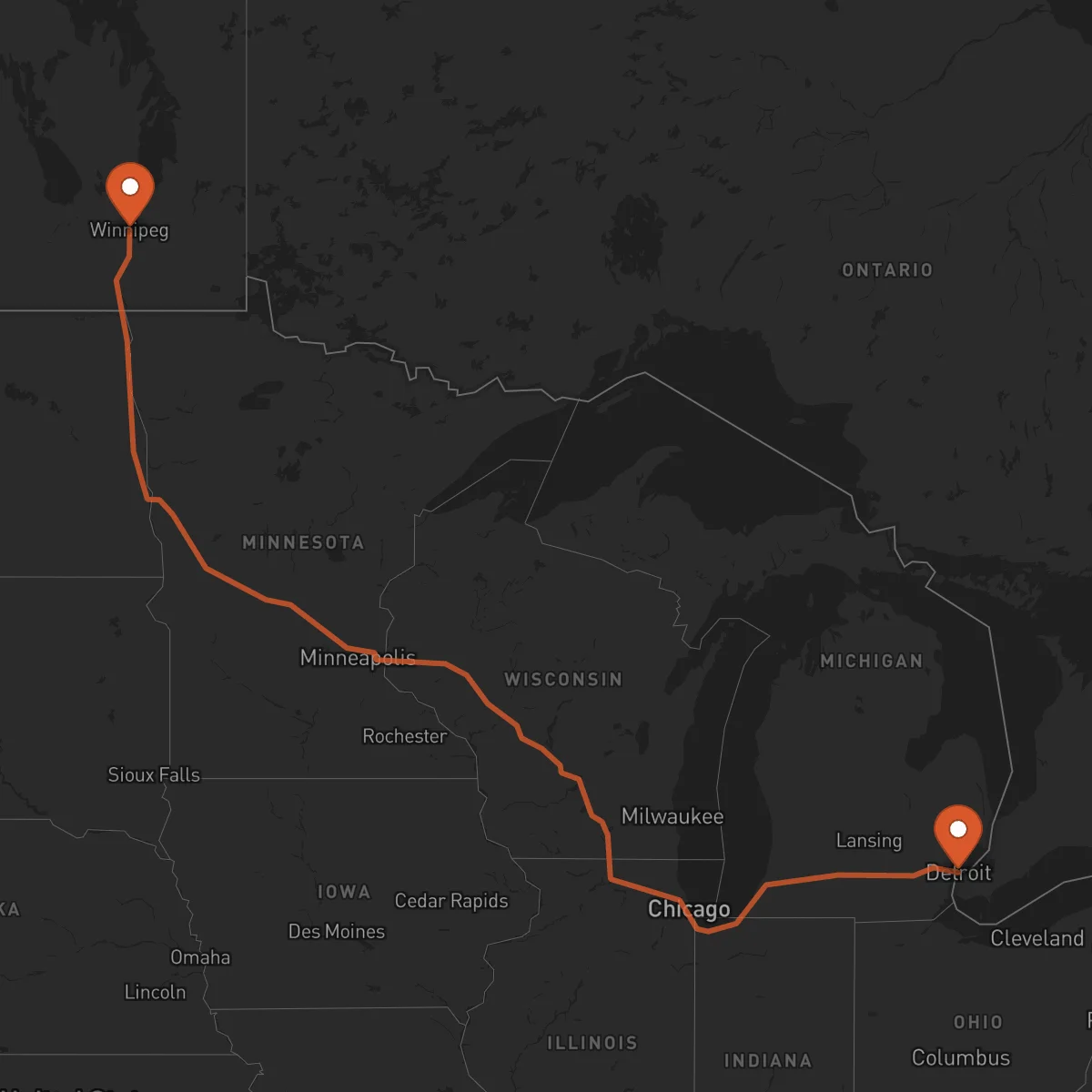
Detroit to Winnipeg
Winnipeg → DetroitFTL freight transportation service between Detroit and Winnipeg. Reliable logistics solutions for your business.
Route Description
Everything you need to know about the corridor Detroit - Winnipeg
The Detroit to Winnipeg corridor represents a vital cross-border logistics connection between the United States and Canada, spanning approximately 1,370 kilometers through the heart of North America. This strategic route links Michigan's automotive and manufacturing powerhouse with Manitoba's agricultural and resource-based economy, creating essential supply chain links for both nations. The corridor traverses the Great Lakes region and the Canadian Prairies, connecting major industrial centers with key agricultural production areas.
This transportation corridor serves critical industries including automotive manufacturing, agricultural equipment, food and beverage products, and industrial machinery. Detroit, known as the automotive capital of North America, generates significant freight volumes requiring efficient distribution to Canadian markets. Winnipeg serves as a major distribution hub for Western Canada, handling commodities, manufactured goods, and agricultural products flowing in both directions. The route accommodates diverse cargo types, from automotive parts and finished vehicles to bulk agricultural commodities and industrial equipment.
Key infrastructure along this corridor includes Interstate 94 and Highway 75, providing reliable north-south connectivity. The international border crossing at Detroit-Windsor represents one of North America's busiest commercial crossings, while alternative routes through Sarnia-Port Huron offer additional capacity. Control Terrestre's expertise in cross-border operations ensures seamless customs clearance, regulatory compliance, and efficient transit across this vital North American trade corridor.
Services for this Route
Available services for the corridor Detroit - Winnipeg
 Origin
Detroit
Detroit stands as a strategic logistics hub in the Great Lakes region, serving as the gateway between the United States and Canada. The city's location on the U.S.-Canada border provides immediate access to major North American markets, with proximity to Chicago, Toronto, and other industrial centers. Detroit's extensive transportation infrastructure includes multiple interstate highways, rail connections, and the Detroit Metropolitan Airport, creating a multimodal logistics ecosystem. The Port of Detroit on the Detroit River facilitates international maritime shipping, while the Ambassador Bridge and Detroit-Windsor Tunnel provide critical cross-border road connections.
 Destination
Winnipeg serves as the economic and logistical center of Western Canada, strategically positioned at the confluence of the Red and Assiniboine Rivers. The city's location makes it a natural distribution point for goods moving throughout the Prairie provinces and into the northern territories. Winnipeg's transportation infrastructure includes the Winnipeg James Armstrong Richardson International Airport, extensive rail networks operated by Canadian National and Canadian Pacific, and major highways including the Trans-Canada Highway and Highway 75. The city functions as a critical logistics hub for agricultural products, with extensive cold storage and warehousing facilities supporting the region's food processing industry.










