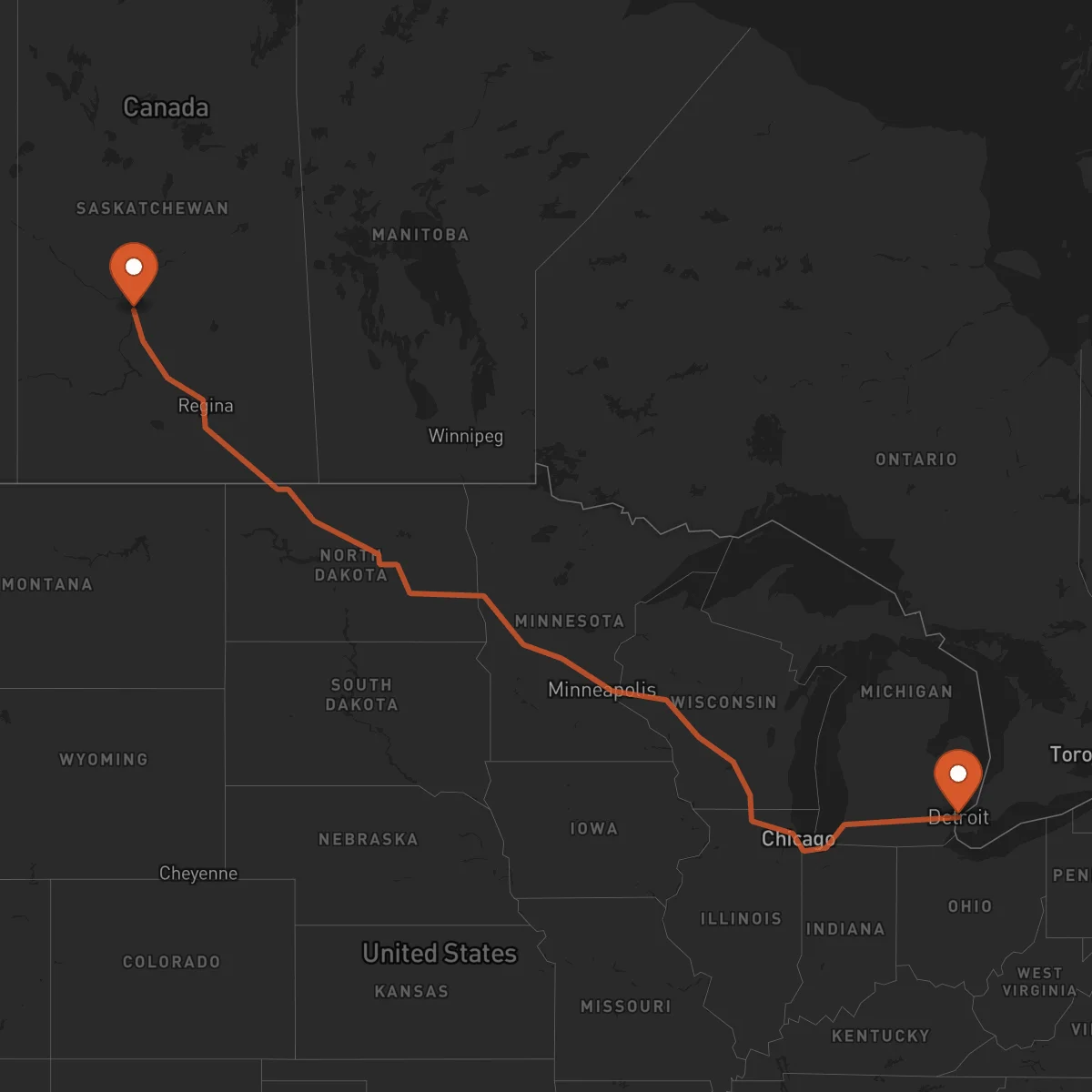
Detroit to Saskatoon
Saskatoon → DetroitFTL freight transportation service between Detroit and Saskatoon. Reliable logistics solutions for your business.
Route Description
Everything you need to know about the corridor Detroit - Saskatoon
The Detroit to Saskatoon corridor represents a vital cross-border logistics route connecting the industrial heartland of Michigan with the agricultural and resource-rich region of Saskatchewan. This 2,077 km journey traverses the Great Lakes region, the Canadian Prairies, and crosses the international border at Sarnia-Port Huron, serving as a critical link between the United States and Canada's economic powerhouses.
The corridor's strategic importance stems from its connection between Detroit's automotive manufacturing ecosystem and Saskatoon's emerging technology, agricultural, and mining sectors. Detroit, known as the Motor City, hosts major automotive assembly plants and parts manufacturers, while Saskatoon has positioned itself as a hub for agricultural biotechnology, potash mining, and sustainable energy development.
Transportation along this corridor primarily utilizes Interstate 75 and Highway 402/401 through Ontario, transitioning to the Trans-Canada Highway (Highway 17) and then north through Manitoba and Saskatchewan. The Sarnia-Port Huron Blue Water Bridge serves as the main border crossing, handling significant commercial traffic between the two nations.
Control Terrestre specializes in facilitating seamless cross-border operations along this corridor, managing customs documentation, ensuring compliance with both US and Canadian regulations, and providing dedicated FTL services that maintain cargo integrity throughout the journey. Our expertise in handling cross-border documentation and our network of certified carriers ensure reliable transportation of everything from automotive components to agricultural equipment between these two strategic locations.
Services for this Route
Available services for the corridor Detroit - Saskatoon
 Origin
Detroit
Detroit, Michigan stands as a critical logistics hub in the American Midwest, strategically positioned along the Detroit River with direct access to the Great Lakes waterway system. The city's extensive transportation infrastructure includes the Ambassador Bridge and Detroit-Windsor Tunnel connecting to Canada, multiple interstate highways (I-75, I-96, I-94), and the Detroit Metropolitan Airport. As the historic center of the US automotive industry, Detroit hosts major manufacturing facilities for Ford, General Motors, and Stellantis, along with hundreds of parts suppliers and Tier 1 manufacturers. The region's industrial base extends beyond automotive to include defense manufacturing, medical devices, and advanced materials. Detroit's location provides immediate access to the US Midwest consumer market and serves as a primary gateway for cross-border trade with Canada, handling billions of dollars in commercial traffic annually.
 Destination
Saskatoon
Saskatoon, Saskatchewan represents a strategic logistics center in central Canada, situated along the South Saskatchewan River with excellent transportation connections throughout the Prairie provinces. The city serves as the economic hub of Saskatchewan, with a diversified economy spanning agriculture, mining, technology, and research sectors. Saskatoon's location provides access to Canada's vast agricultural heartland and the province's significant potash reserves, making it a crucial node for both agricultural and mining supply chains. The city is connected via the Yellowhead Highway (Highway 16) and benefits from the John G. Diefenbaker International Airport and the Canadian National Railway network. Saskatoon has developed a reputation as a center for agricultural biotechnology and sustainable resource development, with institutions like the University of Saskatchewan driving innovation in these sectors. The region's logistics infrastructure supports the movement of bulk commodities, specialized equipment, and technology products to and from the northern Prairies.










