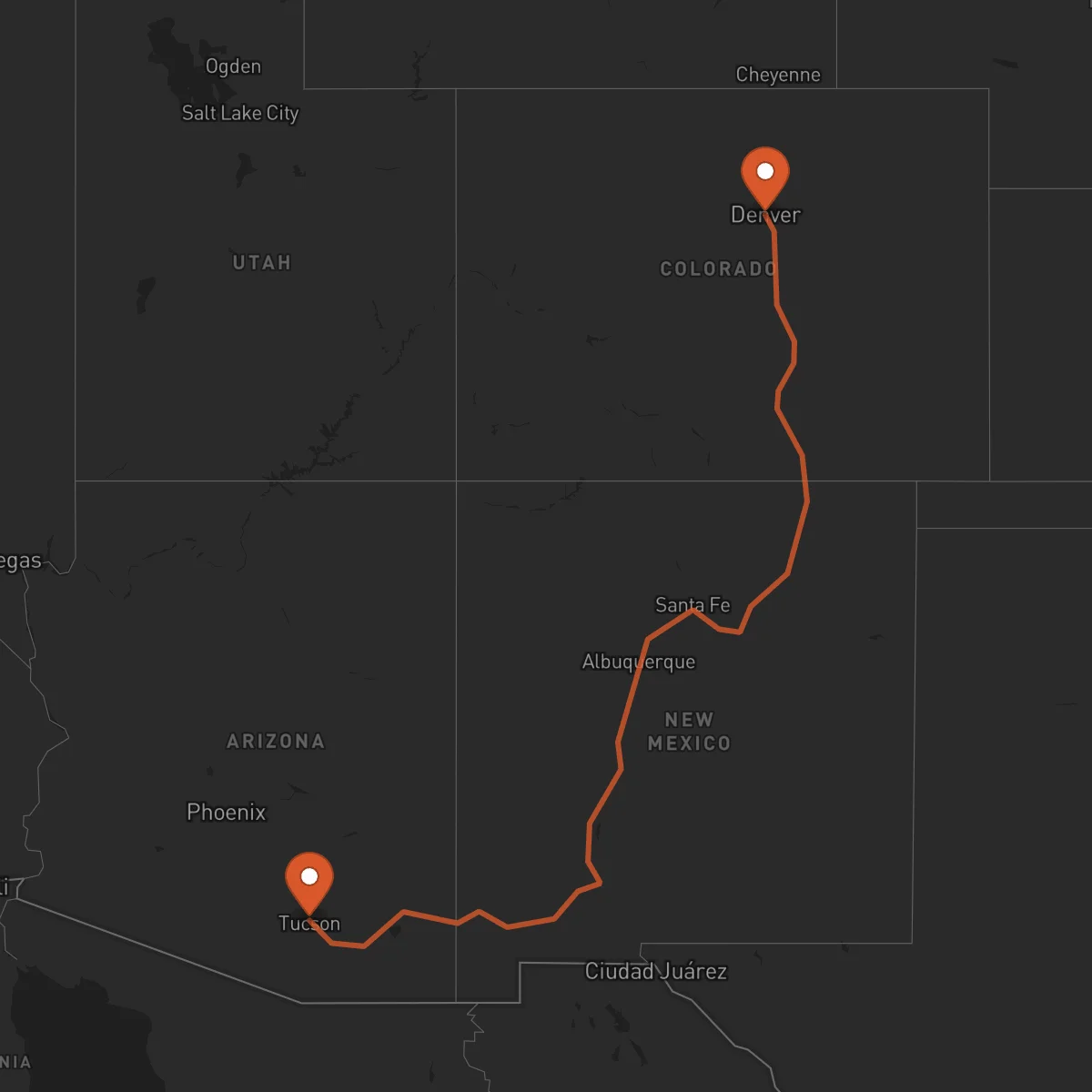
Denver to Tucson
Tucson → DenverFTL freight transportation service between Denver and Tucson. Reliable logistics solutions for your business.
Route Description
Everything you need to know about the corridor Denver - Tucson
The Denver to Tucson corridor represents a vital logistics link connecting Colorado's Front Range with Arizona's Sonoran Desert region. This approximately 991 km route traverses diverse terrain including the Rocky Mountain foothills, high desert plateaus, and eventually the Sonoran Desert, making it a crucial artery for freight movement between the Mountain West and the Southwest. The corridor serves as a bridge between two major economic regions, facilitating trade and commerce across state lines.
The economic significance of this route extends beyond simple point-to-point transportation. Denver serves as a major logistics hub for the Rocky Mountain region, while Tucson functions as a critical gateway to Mexico and a distribution center for the southwestern United States. The corridor supports numerous industries including aerospace, defense, mining, agriculture, and manufacturing, with companies relying on consistent, reliable transportation to maintain their supply chains. Major highways including I-25 south from Denver connecting to I-10 west toward Tucson provide the primary transportation infrastructure, offering multiple route options to optimize for time, cost, or specific cargo requirements.
Control Terrestre specializes in providing dedicated full truckload (FTL) services along this corridor, ensuring that your freight receives exclusive use of the equipment from origin to destination. Our experienced carriers understand the unique challenges of this route, from elevation changes to desert temperature variations, and are equipped to handle specialized cargo requirements. Whether you need standard dry van transportation, refrigerated services for temperature-sensitive goods, or specialized equipment for oversized cargo, we provide tailored solutions that keep your supply chain moving efficiently between Denver and Tucson.
Services for this Route
Available services for the corridor Denver - Tucson
 Origin
Denver
Denver, Colorado stands as a strategic logistics powerhouse in the Mountain West region. Situated at the intersection of major interstates I-70, I-25, and I-76, Denver serves as a critical distribution hub for the surrounding five-state region. The city's elevation of 1,609 meters above sea level and its proximity to the Rocky Mountains make it a natural gateway for freight moving east-west across the continental divide. Denver International Airport, one of the largest by land area in the world, complements the ground transportation network with extensive air cargo capabilities.
The Denver metropolitan area hosts a diverse industrial base including aerospace (with companies like Lockheed Martin and Ball Aerospace), technology, energy, and manufacturing. The region is also a major agricultural producer, particularly for livestock and winter wheat. Denver's central location within a day's drive of major markets like Salt Lake City, Phoenix, and Kansas City makes it an ideal origin point for regional distribution. The city's robust infrastructure includes multiple intermodal facilities, warehousing districts, and a highly developed trucking network that supports both regional and long-haul freight movements.
 Destination
Tucson
Tucson, Arizona occupies a strategic position in the southwestern United States, serving as a critical logistics node for both domestic and international trade. Located just 95 km from the Mexican border, Tucson provides direct access to cross-border freight movements and serves as a gateway for trade with Sonora, Mexico. The city's position along Interstate 10 creates a direct connection to major markets including Phoenix, Los Angeles, and El Paso, while its proximity to major ports of entry facilitates efficient international logistics operations.
The Tucson economy is anchored by aerospace and defense industries, with major employers including Raytheon Missiles & Defense and Davis-Monthan Air Force Base. The region also has significant strengths in optics and photonics, mining technology, and renewable energy. Tucson's transportation infrastructure includes the Port of Tucson, an inland port facility that provides intermodal services and connects to major rail networks. The city's warm, dry climate makes it particularly suitable for certain types of cargo storage and distribution, while its location in the Sonoran Desert requires specialized knowledge for efficient freight movement during extreme temperature conditions.










