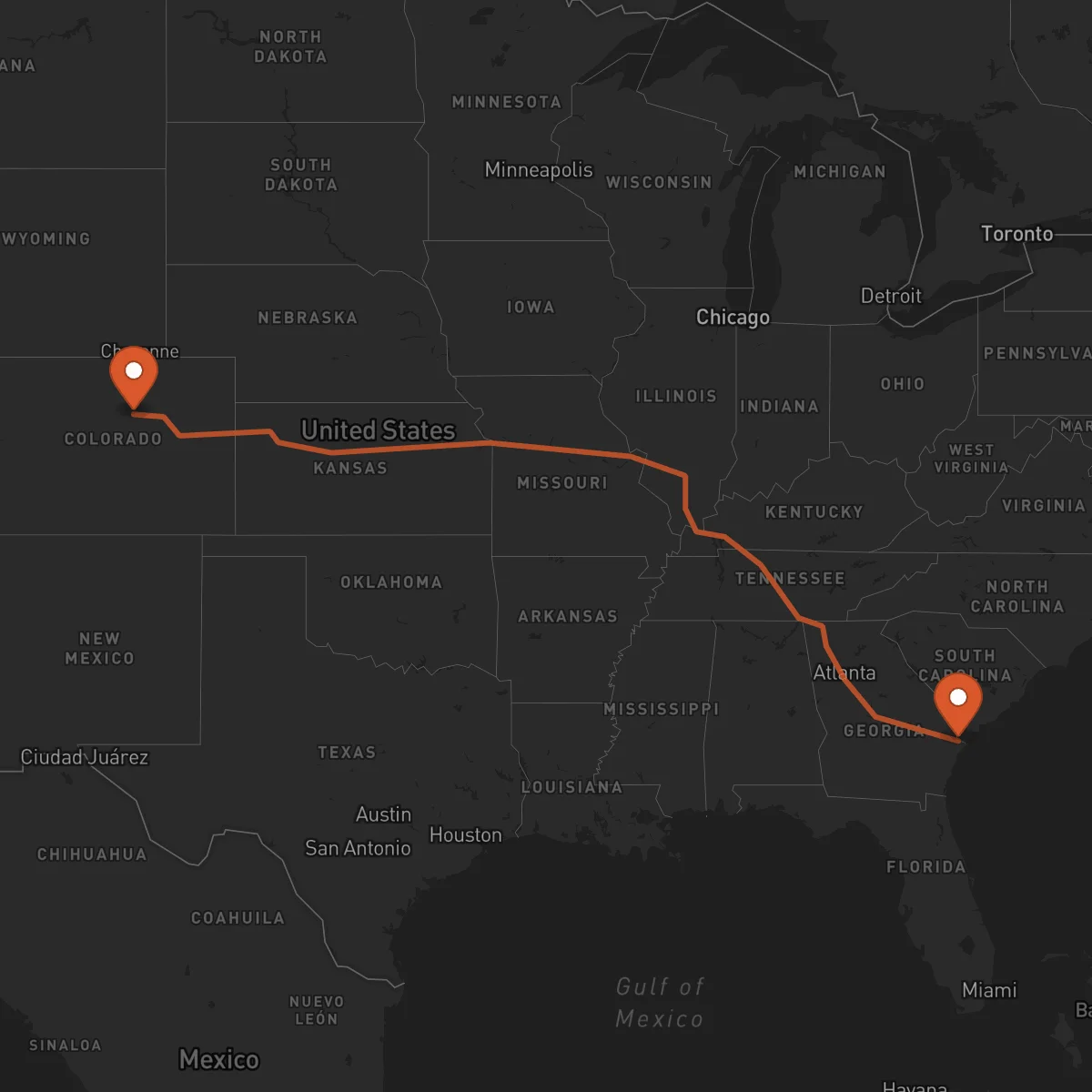
Denver to Savannah
Savannah → DenverFTL freight transportation service between Denver and Savannah. Reliable logistics solutions for your business.
Route Description
Everything you need to know about the corridor Denver - Savannah
The Denver to Savannah corridor represents a vital domestic freight transportation route connecting the Rocky Mountain region with the southeastern United States. This 2,306 km journey traverses diverse geographic and economic landscapes, facilitating the movement of goods between Colorado's industrial heartland and Georgia's strategic port city. The corridor serves as a critical link in the national supply chain, enabling businesses to efficiently transport products between the central-western United States and the Atlantic coast.
The economic significance of this route is substantial, connecting two major economic regions. Denver, as a key logistics hub in the Mountain West, serves as a gateway for goods moving to and from the western United States, while Savannah, with its deep-water port, acts as a crucial entry point for international trade. This corridor supports a wide range of industries, including manufacturing, agriculture, technology, and retail, enabling companies to optimize their supply chain operations across the country.
Major highways facilitating this route include I-70 East from Denver through Kansas and Missouri, connecting to I-64 East through Illinois, Indiana, and Kentucky, before transitioning to I-75 South through Tennessee and Georgia to reach Savannah. This interstate network provides reliable and efficient transportation infrastructure for full truckload (FTL) freight services.
Control Terrestre specializes in optimizing this corridor through our extensive network of certified carriers and strategic partnerships. We provide dedicated FTL solutions that ensure your cargo moves efficiently and securely from origin to destination, leveraging our expertise in route planning, regulatory compliance, and real-time tracking to deliver superior service for your transportation needs.
Services for this Route
Available services for the corridor Denver - Savannah
 Origin
Denver
Denver, Colorado serves as a strategic logistics hub in the Mountain West region, positioned at the intersection of major transportation routes connecting the western United States. The city's elevation and location make it a natural gateway for freight moving between the Pacific Coast, the Rocky Mountains, and the central United States. Denver's robust transportation infrastructure includes extensive highway networks, rail connections, and proximity to Denver International Airport, one of the busiest cargo airports in the country.
The Denver metropolitan area is home to diverse industries including aerospace, technology, telecommunications, healthcare, and energy. The region's strong manufacturing sector, particularly in outdoor equipment, electronics, and industrial machinery, generates significant freight volume requiring reliable transportation solutions. Additionally, Denver's role as a distribution center for goods moving to mountain states and the western United States enhances its importance in the national logistics network.
 Destination
Savannah
Savannah, Georgia represents a strategic logistics hub on the southeastern Atlantic coast, anchored by the Port of Savannah, one of the busiest container ports in North America. The city's location provides direct access to major interstate highways, including I-16, I-95, and I-75, creating efficient connections to markets throughout the southeastern United States and beyond. Savannah's transportation infrastructure is further enhanced by Class I rail service and a growing network of warehousing and distribution centers.
The Savannah region's economy is driven by international trade, manufacturing, and logistics. The presence of the port creates a strong demand for freight transportation services, while local industries including paper manufacturing, food processing, and automotive assembly generate substantial cargo volumes. The city's role as a distribution gateway for goods entering the southeastern United States makes it a critical node in the regional supply chain, requiring reliable transportation connections to inland markets.










