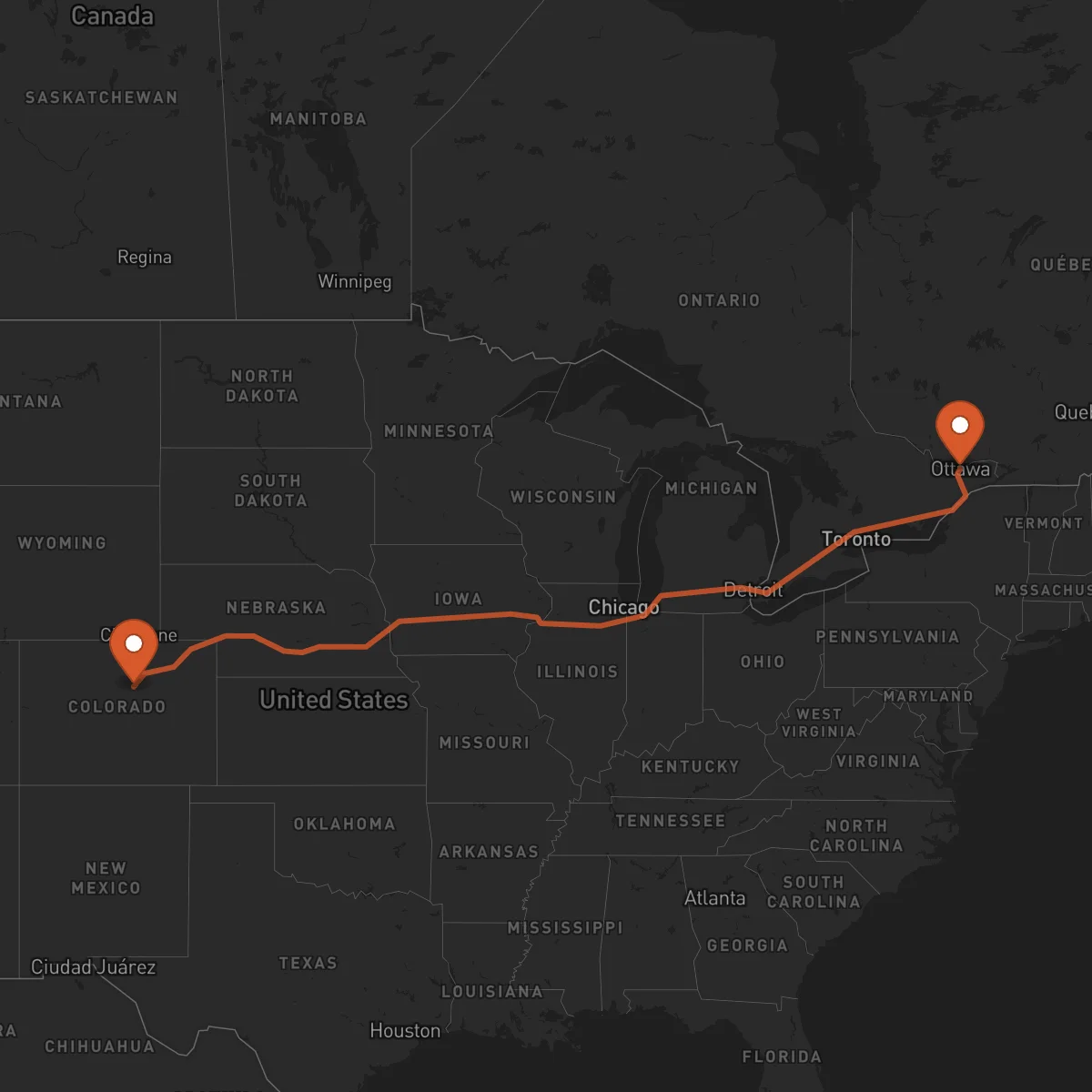
Denver to Ottawa
Ottawa → DenverFTL freight transportation service between Denver and Ottawa. Reliable logistics solutions for your business.
Route Description
Everything you need to know about the corridor Denver - Ottawa
The Denver to Ottawa corridor represents a vital cross-border freight transportation route connecting the economic heart of Colorado with Canada's capital. This strategic corridor spans approximately 2,465 kilometers through diverse terrain, linking the Rocky Mountain region with the Great Lakes industrial corridor. The route facilitates essential trade between the United States and Canada, supporting the integrated North American supply chain.
The corridor traverses major transportation hubs including Denver's extensive logistics network, the agricultural heartland of the Midwest, and the industrial centers of Ontario. Companies operating along this route benefit from Denver's position as a major distribution center and Ottawa's role as a government and technology hub. The route primarily utilizes Interstate 76, I-80, and I-90 through the United States before crossing into Canada via the Ontario 401 corridor.
Key border crossing considerations include the Ambassador Bridge in Detroit or the Blue Water Bridge in Port Huron, both requiring proper documentation for cross-border freight. Control Terrestre's expertise in navigating customs procedures and our C-TPAT certification ensures smooth border transitions. Our dedicated FTL services provide reliable, direct transportation without intermediate stops, maintaining cargo integrity throughout the journey. We understand the specific requirements for cross-border shipments, including proper documentation, customs compliance, and temperature-controlled options when needed.
Services for this Route
Available services for the corridor Denver - Ottawa
 Origin
Denver
Denver serves as a strategic logistics hub in the Mountain West region, offering exceptional connectivity for freight transportation. Located at the intersection of major interstate highways, Denver provides direct access to both coastal and inland markets. The city's elevation and central location make it an ideal distribution point for companies serving the western United States and beyond. Denver International Airport, one of the largest cargo airports in the country, complements the extensive ground transportation network.
The Denver metropolitan area hosts diverse industries including aerospace, telecommunications, healthcare, and advanced manufacturing. The region's strong energy sector, including both traditional and renewable sources, generates significant freight volume. Denver's robust logistics infrastructure includes multiple intermodal facilities, warehousing districts, and a skilled transportation workforce. The city's strategic position allows for efficient distribution to major markets across the western United States within a 24-hour drive.
 Destination
Ottawa represents a unique logistics destination as Canada's capital and a major technology center. Located in eastern Ontario along the Ottawa River, the city benefits from proximity to Montreal and Toronto while maintaining its distinct economic identity. Ottawa's strategic location provides access to the Quebec-Windsor Corridor, Canada's most densely populated and industrialized region. The city's transportation infrastructure includes major highways, rail connections, and the Ottawa International Airport.
The Ottawa economy is anchored by the public sector, with numerous federal government offices and agencies. The city has also emerged as a significant technology hub, particularly in telecommunications, software development, and clean technology. These industries generate consistent freight demand for both imports and exports. Ottawa's growing population and economic diversification continue to expand logistics opportunities, while the city's commitment to sustainable development aligns with modern freight transportation practices.










