Cheyenne to Toronto
Toronto → CheyenneFTL freight transportation service between Cheyenne and Toronto. Reliable logistics solutions for your business.
Route Description
Everything you need to know about the corridor Cheyenne - Toronto
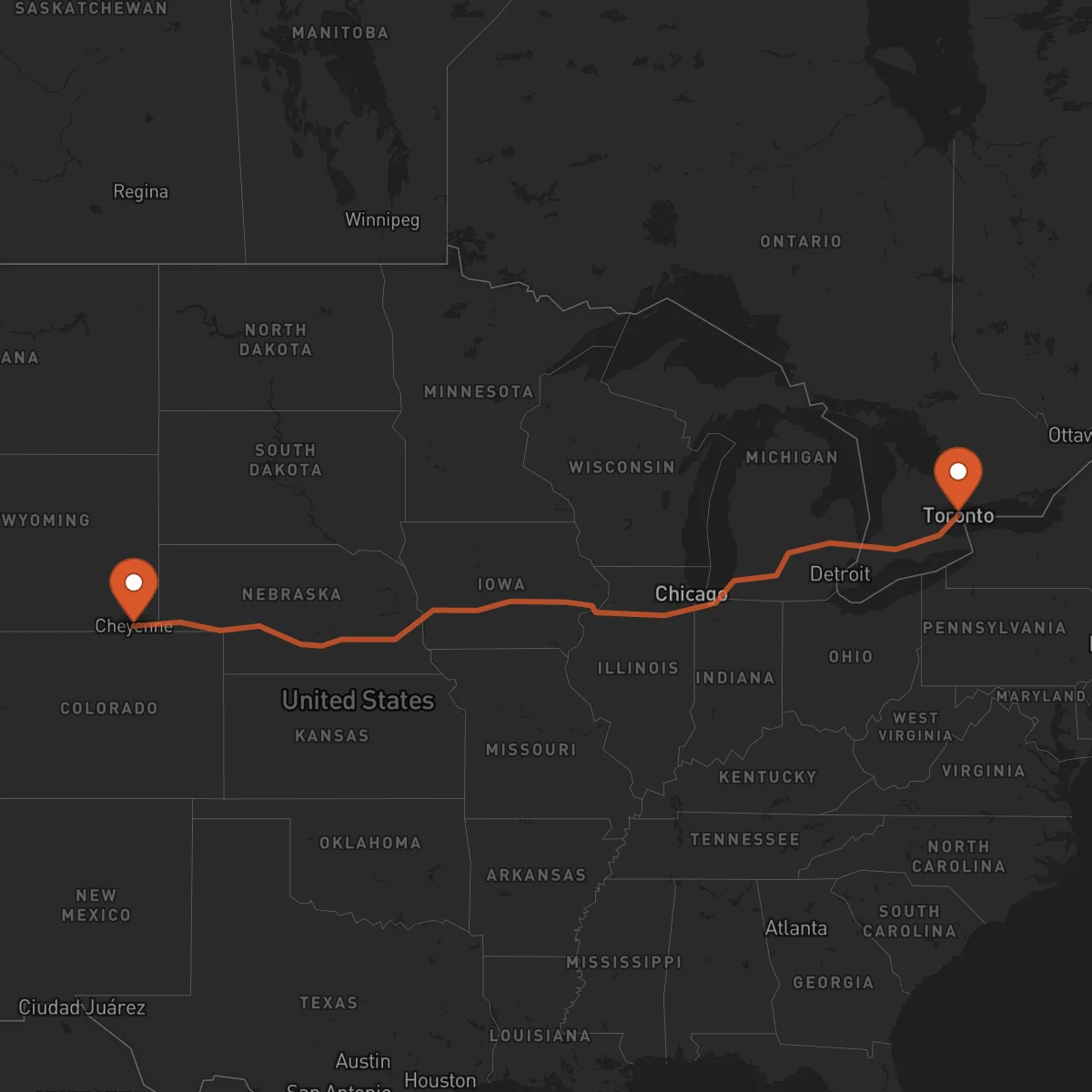
The Cheyenne to Toronto corridor represents a vital cross-border logistics connection between the United States and Canada. This route spans approximately 2,099 kilometers through the heart of North America, connecting the central United States with Canada's largest economic hub. The corridor serves as a critical link for businesses requiring reliable freight transportation between these two major markets.
The region along this corridor encompasses diverse industrial and economic activities. Cheyenne, as Wyoming's capital, serves as a key distribution point for the western United States, while Toronto stands as Canada's financial and manufacturing powerhouse. This route facilitates the movement of goods between agricultural producers, manufacturing facilities, and major urban centers on both sides of the border.
Key industries utilizing this corridor include automotive parts manufacturing, agricultural products, industrial equipment, and consumer goods. The route primarily follows major highway systems including I-80 East and I-90 North through the United States, connecting to Ontario's 401 highway system. The journey crosses the international border at various points, with Detroit-Windsor being a common crossing point for this route.
Control Terrestre provides comprehensive FTL services along this corridor, ensuring seamless cross-border operations. Our experienced team manages all customs documentation and compliance requirements, facilitating smooth passage through border crossings. We maintain a network of certified carriers who understand the specific requirements for cross-border transportation, ensuring your freight moves efficiently from origin to destination.
Services for this Route
Available services for the corridor Cheyenne - Toronto
 Origin
Cheyenne
Cheyenne, Wyoming serves as a strategic logistics hub in the western United States. Located at the intersection of major interstate highways I-80 and I-25, Cheyenne provides excellent connectivity to both coastal and inland markets. The city's position at the base of the Rocky Mountains makes it an ideal distribution point for goods moving east-west and north-south across the country.
The region's economy is driven by government services, military installations, and energy production. Cheyenne's transportation infrastructure includes multiple rail connections and proximity to Denver International Airport, complementing its highway access. The city's central location in the Mountain Time Zone allows for efficient coordination of logistics operations across multiple time zones.
 Destination
Toronto, Ontario stands as Canada's largest city and a major North American logistics center. Located on the northwestern shore of Lake Ontario, Toronto offers exceptional access to both domestic Canadian markets and international shipping routes via the Great Lakes and St. Lawrence Seaway. The city's extensive transportation network includes Pearson International Airport, one of North America's busiest cargo airports, and a comprehensive highway system.
Toronto's economy is diverse, with strong sectors in finance, technology, manufacturing, and automotive industries. The Greater Toronto Area is home to numerous distribution centers and warehouses, making it a crucial node in Canada's supply chain network. The city's proximity to the U.S. border and its position as a gateway to Central Canada make it an essential destination for cross-border freight transportation.










