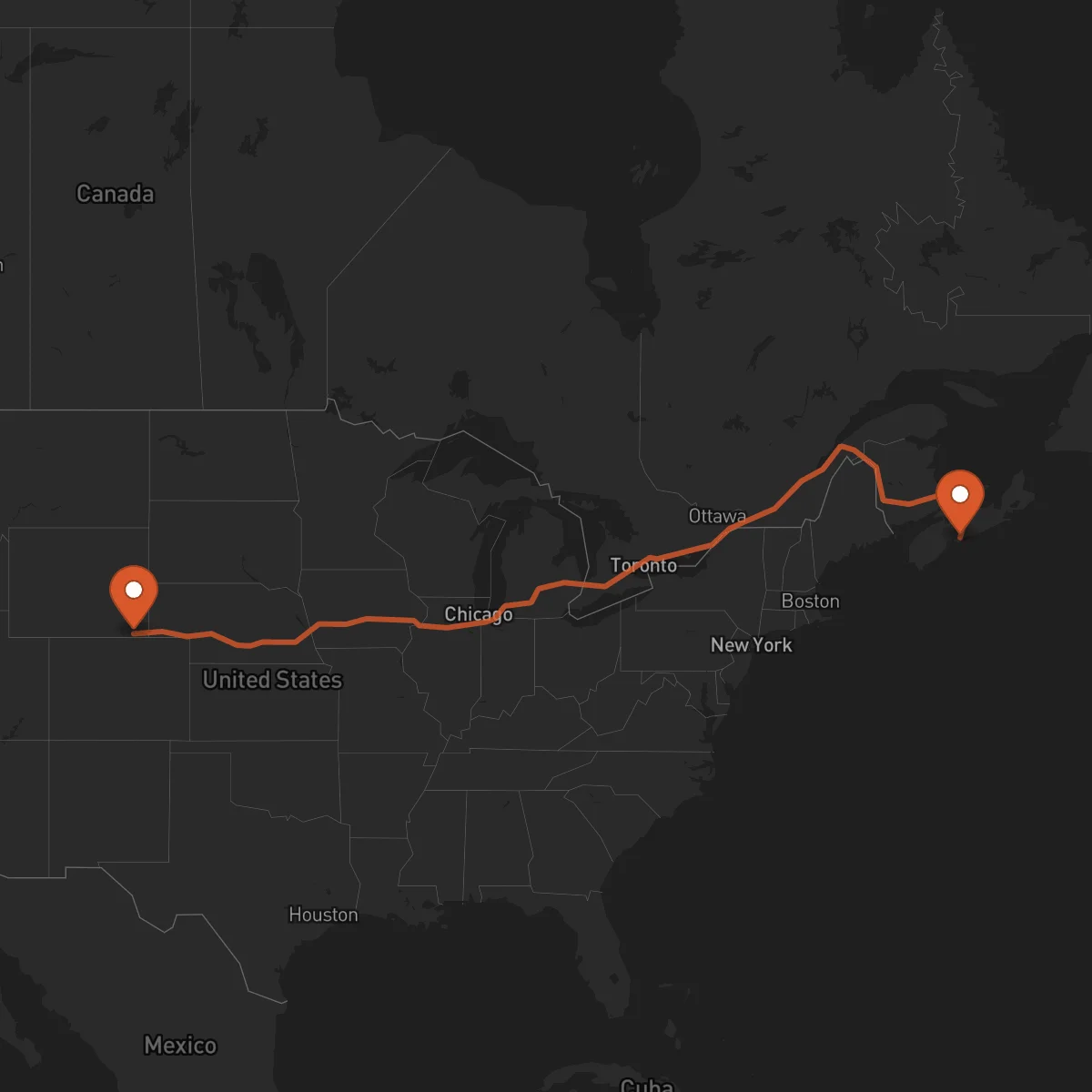
Cheyenne to Halifax
Halifax → CheyenneFTL freight transportation service between Cheyenne and Halifax. Reliable logistics solutions for your business.
Route Description
Everything you need to know about the corridor Cheyenne - Halifax
The Cheyenne to Halifax corridor represents a vital cross-border freight transportation route connecting the heart of the American West with the Atlantic port of Nova Scotia. This 3,345-kilometer journey traverses diverse landscapes and connects major industrial centers, making it a strategic artery for North American commerce. The route facilitates the movement of goods between Wyoming's energy and agricultural sectors and Atlantic Canada's manufacturing and distribution hubs, serving as a critical link in the supply chain for industries ranging from energy to consumer goods.
The transportation infrastructure along this corridor is robust, primarily utilizing Interstate 25 and Interstate 90 through the United States before connecting to Canadian highways. Key border crossings include those near Montana and North Dakota, where efficient customs processing is essential for maintaining supply chain velocity. Control Terrestre's expertise in cross-border operations ensures seamless transitions through these checkpoints, with our C-TPAT and FAST certified partners facilitating expedited clearance for qualified shipments.
This corridor serves diverse industries including energy equipment, agricultural products, manufacturing components, and retail distribution. The route's strategic importance is amplified by Halifax's status as a major Atlantic port, providing ocean freight connectivity to European and global markets. Control Terrestre's dedicated FTL services along this corridor ensure that your cargo moves efficiently and securely, with real-time tracking and our network of experienced carriers maintaining the reliability your business demands.
Services for this Route
Available services for the corridor Cheyenne - Halifax
 Origin
Cheyenne
Cheyenne, Wyoming serves as a strategic logistics hub in the American West, positioned at the intersection of major transportation routes including Interstate 25 and Interstate 80. The city's location provides excellent connectivity to both regional and national freight networks, making it an ideal origin point for cross-country shipments. Cheyenne's economy is anchored by government operations, military installations, and a growing technology sector, complemented by traditional industries such as agriculture, energy, and mining that generate substantial freight volume. The city benefits from proximity to major freight railroads and trucking corridors, with the surrounding region producing significant volumes of energy equipment, agricultural products, and industrial materials. Cheyenne's elevation and climate considerations are well-managed by experienced carriers familiar with high-plateau transportation challenges. The local infrastructure includes modern warehousing facilities and distribution centers that support efficient freight consolidation and distribution, making it an optimal starting point for shipments to Atlantic Canada and beyond.
 Destination
Halifax
Halifax, Nova Scotia stands as Atlantic Canada's premier logistics gateway, strategically positioned on the Atlantic coast with deep-water port facilities that rank among North America's busiest. The city's port serves as a critical entry point for international trade, offering direct ocean freight connections to Europe, the Mediterranean, and global markets. Halifax's strategic location makes it an ideal destination for freight originating from across North America, with its port facilities capable of handling diverse cargo types from containerized goods to bulk commodities. The region's economy is diverse, encompassing advanced manufacturing, aerospace, defense, and information technology sectors, alongside traditional industries such as fishing and forestry. Halifax's transportation infrastructure includes comprehensive highway networks, rail connections, and the port's extensive facilities, supporting efficient distribution throughout Atlantic Canada. The city's role as a logistics hub is further enhanced by its educational institutions and growing tech sector, creating consistent demand for reliable freight transportation services connecting it to major U.S. markets.










