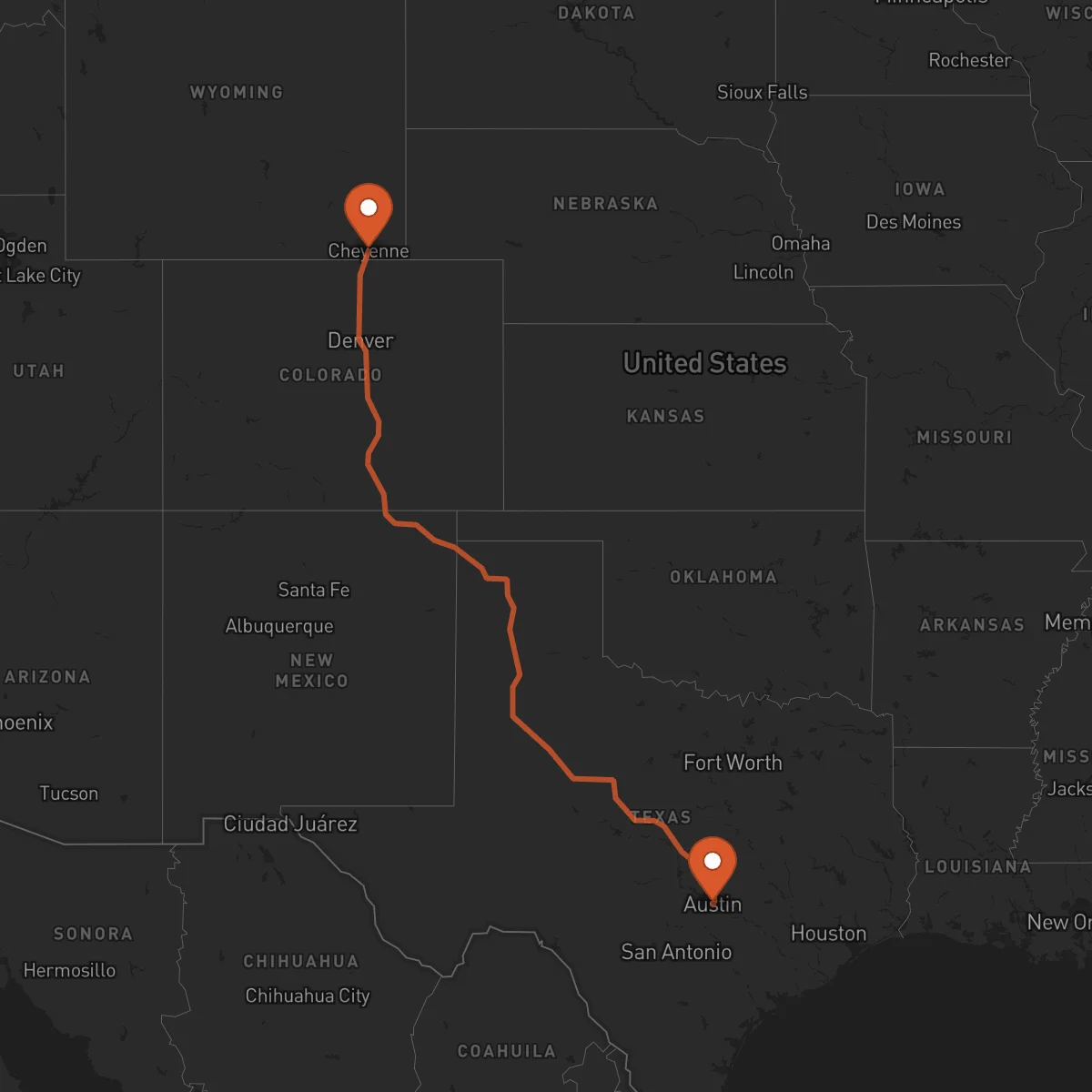
Cheyenne to Austin
Austin → CheyenneFTL freight transportation service between Cheyenne and Austin. Reliable logistics solutions for your business.
Route Description
Everything you need to know about the corridor Cheyenne - Austin
The logistics corridor between Cheyenne, Wyoming, and Austin, Texas, represents a vital transportation link connecting the central United States with the growing tech and business hub of Texas. This 1,366-kilometer domestic route traverses diverse landscapes and crosses multiple state lines, making it a strategic pathway for freight movement between the Mountain West and the Southwest. The corridor facilitates the flow of goods between Wyoming's energy and agricultural sectors and Texas's expanding industrial and technology markets, supporting economic integration across these regions.
The economic significance of this corridor is underscored by the complementary industrial profiles of both endpoints. Cheyenne serves as a key distribution center for Wyoming's energy resources, including coal, natural gas, and wind energy, as well as agricultural products from the surrounding plains. Austin, meanwhile, has emerged as a major technology and manufacturing center, with companies relocating from other parts of the country to take advantage of Texas's business-friendly environment. This creates a dynamic freight exchange where raw materials and energy products flow south while manufactured goods, electronics, and specialized equipment move north.
Transportation infrastructure along this corridor is anchored by major interstate highways, primarily I-25 and I-35, which provide reliable north-south connectivity. These routes offer multiple options for freight carriers, with alternative paths available to optimize for distance, fuel efficiency, or specific cargo requirements. The corridor also intersects with other major transportation networks, providing access to rail intermodal facilities and major airports that support multimodal logistics solutions.
Control Terrestre specializes in providing full truckload (FTL) transportation services along this corridor, offering dedicated capacity and reliable scheduling for businesses moving freight between Cheyenne and Austin. Our network of certified carriers ensures that shipments move efficiently through varying terrain and weather conditions, with real-time tracking and communication throughout the journey. Whether transporting industrial equipment, consumer goods, or specialized cargo, we provide the expertise and infrastructure needed to maintain supply chain continuity on this important domestic route.
Services for this Route
Available services for the corridor Cheyenne - Austin
 Origin
Cheyenne
Cheyenne, Wyoming, serves as a strategic logistics hub for the Mountain West region, leveraging its location at the intersection of major transportation corridors. The city's position near the junction of I-25 and I-80 provides immediate access to national freight networks, making it an ideal origin point for shipments heading in multiple directions. Cheyenne's elevation of 6,000 feet and relatively flat surrounding terrain facilitate efficient loading and unloading operations, while the nearby Warren Air Force Base and Union Pacific rail yard create a robust transportation ecosystem that supports both military and commercial freight movements.
The economic base of Cheyenne and surrounding Laramie County centers on government services, energy production, and agriculture. Wyoming's status as a leading coal producer means significant volumes of energy-related freight move through the area, while the region's agricultural output includes beef cattle, hay, and grains that require reliable transportation to distant markets. The city's relatively low industrial tax rates have also attracted warehousing and distribution centers, creating a concentration of logistics facilities that can handle various cargo types and volumes.
Transportation infrastructure in Cheyenne includes multiple freight carriers, warehousing facilities, and cross-docking operations that can accommodate diverse shipping needs. The city's municipal airport supports air freight operations, while the nearby Denver International Airport provides additional capacity for time-sensitive shipments. This multimodal accessibility, combined with Wyoming's central geographic position, makes Cheyenne an efficient origin point for freight moving to major Texas markets like Austin, particularly for companies seeking to optimize their supply chain costs and transit times.
 Destination
Austin
Austin, Texas, has rapidly evolved into one of the most dynamic logistics destinations in the southern United States, driven by its booming technology sector and strategic location within Texas's extensive transportation network. The city's position along I-35 provides direct north-south connectivity to major markets, while its proximity to other Texas economic centers creates a logistics hub that serves both the Austin metropolitan area and surrounding regions. Austin-Bergstrom International Airport supports significant air cargo operations, complementing the city's ground transportation infrastructure and enabling efficient distribution of time-sensitive goods.
The economic transformation of Austin from a state capital to a major technology and innovation center has dramatically increased freight volumes and diversified cargo types moving into the city. The presence of major tech companies, semiconductor manufacturers, and a growing healthcare sector creates demand for specialized transportation services capable of handling high-value, sensitive, or regulated cargo. Additionally, Austin's expanding population and status as a cultural destination generate substantial consumer goods traffic, while the surrounding Hill Country's agricultural and wine industries contribute to the region's freight diversity.
Austin's transportation infrastructure includes multiple freight rail lines, extensive highway networks, and a growing system of warehousing and distribution centers strategically located throughout the metropolitan area. The city's relatively flat terrain and favorable weather conditions for most of the year facilitate consistent freight operations, though summer heat requires specialized handling for temperature-sensitive cargo. This infrastructure, combined with Austin's economic growth trajectory, makes it an increasingly important destination for freight originating from points across the western and central United States, including Wyoming's energy and agricultural sectors.










