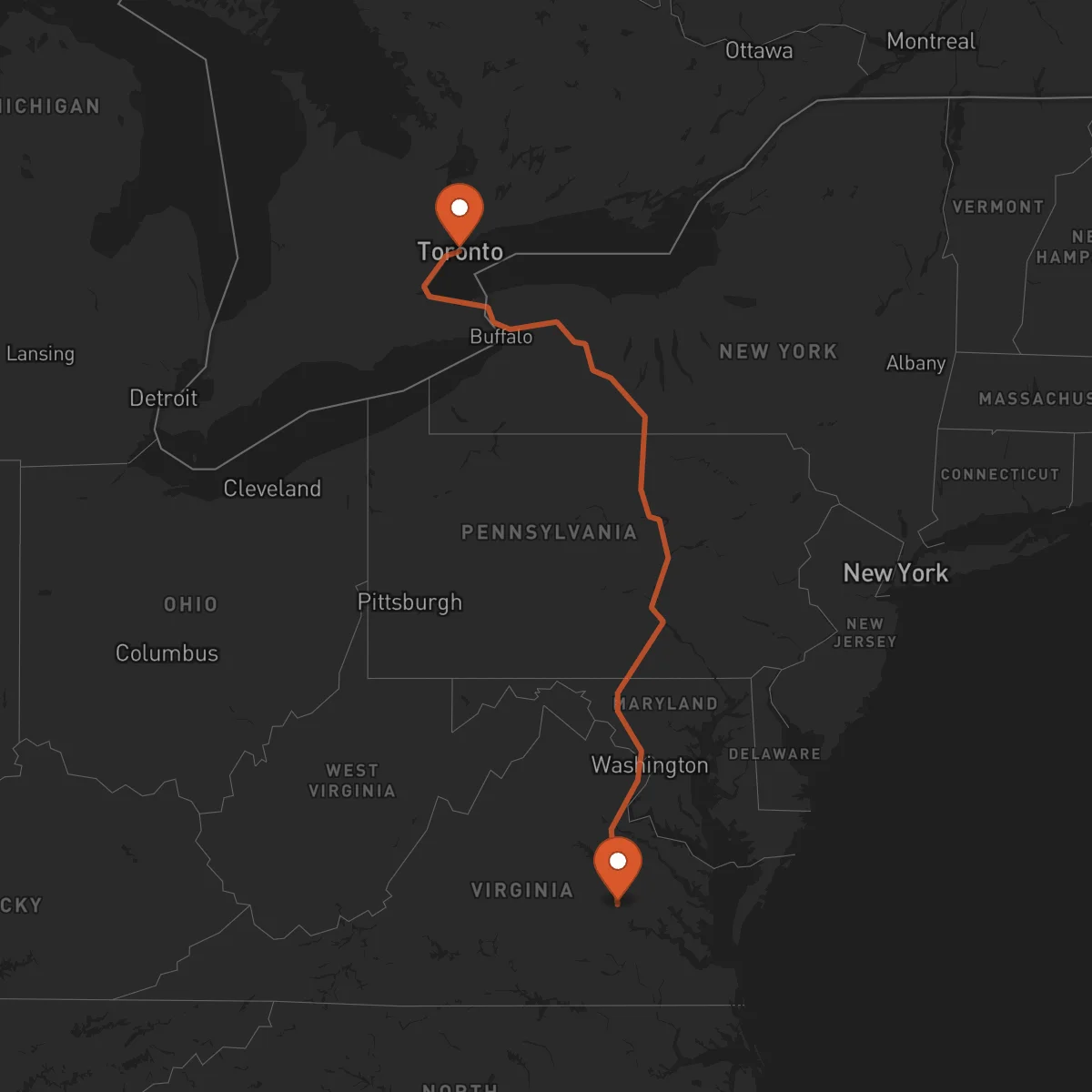
Richmond to Toronto
Toronto → RichmondFTL freight transportation service between Richmond and Toronto. Reliable logistics solutions for your business.
Route Description
Everything you need to know about the corridor Richmond - Toronto
The logistics corridor between Richmond, Virginia, and Toronto, Ontario, represents a vital cross-border connection in North America's transportation network. This strategic route spans approximately 699 kilometers and links two major economic centers, facilitating the movement of goods between the United States and Canada. The corridor serves as a critical artery for trade, connecting the Mid-Atlantic region with Canada's largest metropolitan area and economic powerhouse.
The region along this corridor encompasses diverse economic activities, from Richmond's manufacturing and technology sectors to Toronto's financial services, automotive industry, and advanced manufacturing. This route traverses through key states and provinces including Virginia, Pennsylvania, New York, and Ontario, passing through major industrial zones and distribution centers. The corridor benefits from proximity to major ports, airports, and manufacturing hubs, making it essential for companies operating in both countries.
Transportation infrastructure along this route includes major interstate highways such as I-95, I-81, and I-79 in the United States, connecting to Canadian highways like ON-401 and ON-400. The corridor features several key border crossings, including the Peace Bridge in Buffalo and the Ambassador Bridge in Detroit, though the most commonly used for this specific route would be crossings in New York state. Control Terrestre leverages this extensive infrastructure network to provide efficient full truckload (FTL) services, ensuring seamless cross-border operations with our certified transportation partners who are well-versed in customs procedures and documentation requirements.
Services for this Route
Available services for the corridor Richmond - Toronto
 Origin
Richmond
Richmond, Virginia, serves as a strategic logistics hub on the East Coast, offering excellent connectivity to major markets along the Eastern Seaboard. The city's location provides access to the Port of Virginia, one of the largest container ports on the East Coast, as well as proximity to major interstates including I-95 and I-64. Richmond's economy is diverse, with strong presence in manufacturing, technology, healthcare, and government sectors. The region hosts numerous distribution centers and warehouses, making it an ideal origin point for freight transportation. The city's transportation infrastructure includes Richmond International Airport and an extensive rail network, complementing its road transportation capabilities and providing multiple options for freight movement.
 Destination
Toronto, Ontario, stands as Canada's largest city and a major economic center, making it a crucial destination for freight transportation. The Greater Toronto Area (GTA) is home to Canada's financial district, automotive manufacturing, aerospace, and technology industries. Toronto's strategic location provides access to the Port of Toronto on Lake Ontario and Toronto Pearson International Airport, one of the busiest in North America. The city's extensive highway network, including the 400-series highways, facilitates efficient distribution throughout Southern Ontario and beyond. Toronto's robust logistics infrastructure, combined with its proximity to the U.S. border, makes it an essential hub for cross-border trade and distribution activities.










