Richmond to Edmonton
Edmonton → RichmondFTL freight transportation service between Richmond and Edmonton. Reliable logistics solutions for your business.
Route Description
Everything you need to know about the corridor Richmond - Edmonton
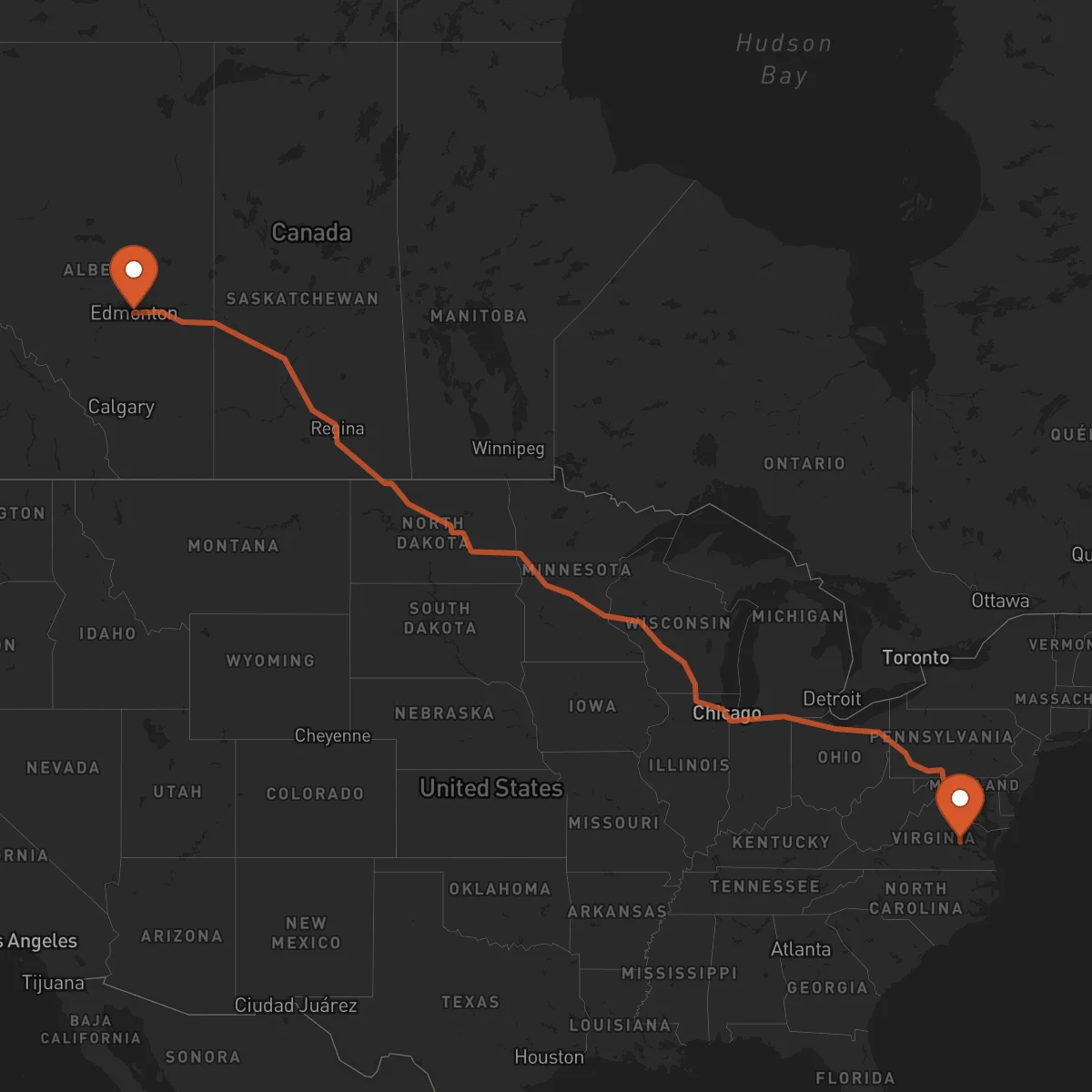
The Richmond-Edmonton corridor represents a crucial logistics connection between the eastern United States and western Canada. This 3,272-kilometer cross-border route traverses diverse terrain and multiple jurisdictions, making it essential for companies operating across North America. The corridor serves as a vital link for businesses requiring seamless freight movement between Virginia's port facilities and Alberta's energy and industrial sectors.
The economic significance of this corridor cannot be overstated. Richmond, located near the Port of Virginia, serves as a gateway for international trade, while Edmonton stands as a major distribution hub for western Canada's resource-based economy. This route facilitates the movement of goods between manufacturing centers, agricultural regions, and energy production facilities, supporting industries ranging from automotive to energy equipment.
Key industries utilizing this corridor include automotive parts manufacturing, energy equipment and supplies, agricultural products, and industrial machinery. The route primarily follows major transportation arteries including I-64, I-70, I-90, and the Trans-Canada Highway, providing reliable access through multiple states and provinces. The corridor crosses at several border points, with Detroit-Windsor and Sweetgrass-Midway being among the most frequently used for commercial freight.
Control Terrestre facilitates seamless operations on this corridor through our network of certified transportation partners. Our expertise in cross-border logistics ensures efficient customs clearance, proper documentation handling, and compliance with both US and Canadian regulations. We provide dedicated FTL services with real-time tracking capabilities, allowing our clients to maintain visibility throughout the entire journey from Richmond to Edmonton.
Services for this Route
Available services for the corridor Richmond - Edmonton
 Origin
Richmond
Richmond, Virginia serves as a strategic logistics hub in the eastern United States, offering exceptional connectivity for freight transportation. Located near the Port of Virginia, one of the East Coast's busiest ports, Richmond provides immediate access to international shipping lanes and global trade networks. The city's proximity to major East Coast markets, including Washington D.C., Baltimore, and Philadelphia, enhances its logistical significance.
The region's economy is diverse, with strong sectors in advanced manufacturing, biotechnology, and government services. Richmond's industrial base includes automotive parts production, food processing, and distribution centers for major retailers. The city's transportation infrastructure is robust, featuring multiple interstate highways (I-95, I-64, I-295), rail connections through CSX and Norfolk Southern, and proximity to Richmond International Airport for air cargo operations.
 Destination
Edmonton, Alberta stands as a critical logistics center in western Canada, strategically positioned for distribution throughout the Prairie provinces and beyond. Located at the northern end of Alberta's Industrial Heartland, Edmonton serves as the primary gateway to Canada's oil sands and northern resource development. The city's location provides optimal access to both domestic Canadian markets and cross-border opportunities with the United States.
The Edmonton economy is heavily focused on energy, with significant activity in oil and gas extraction, refining, and related equipment manufacturing. The region also hosts strong agricultural processing, technology, and construction materials sectors. Edmonton's transportation infrastructure includes extensive highway networks (Yellowhead Highway, QEII Highway), major rail connections through CN and CP Rail, and Edmonton International Airport, which handles substantial air cargo volumes. The city's position as a distribution hub makes it essential for companies serving western Canada's vast territory.










