Richmond to Hamilton
Hamilton → RichmondFTL freight transportation service between Richmond and Hamilton. Reliable logistics solutions for your business.
Route Description
Everything you need to know about the corridor Richmond - Hamilton
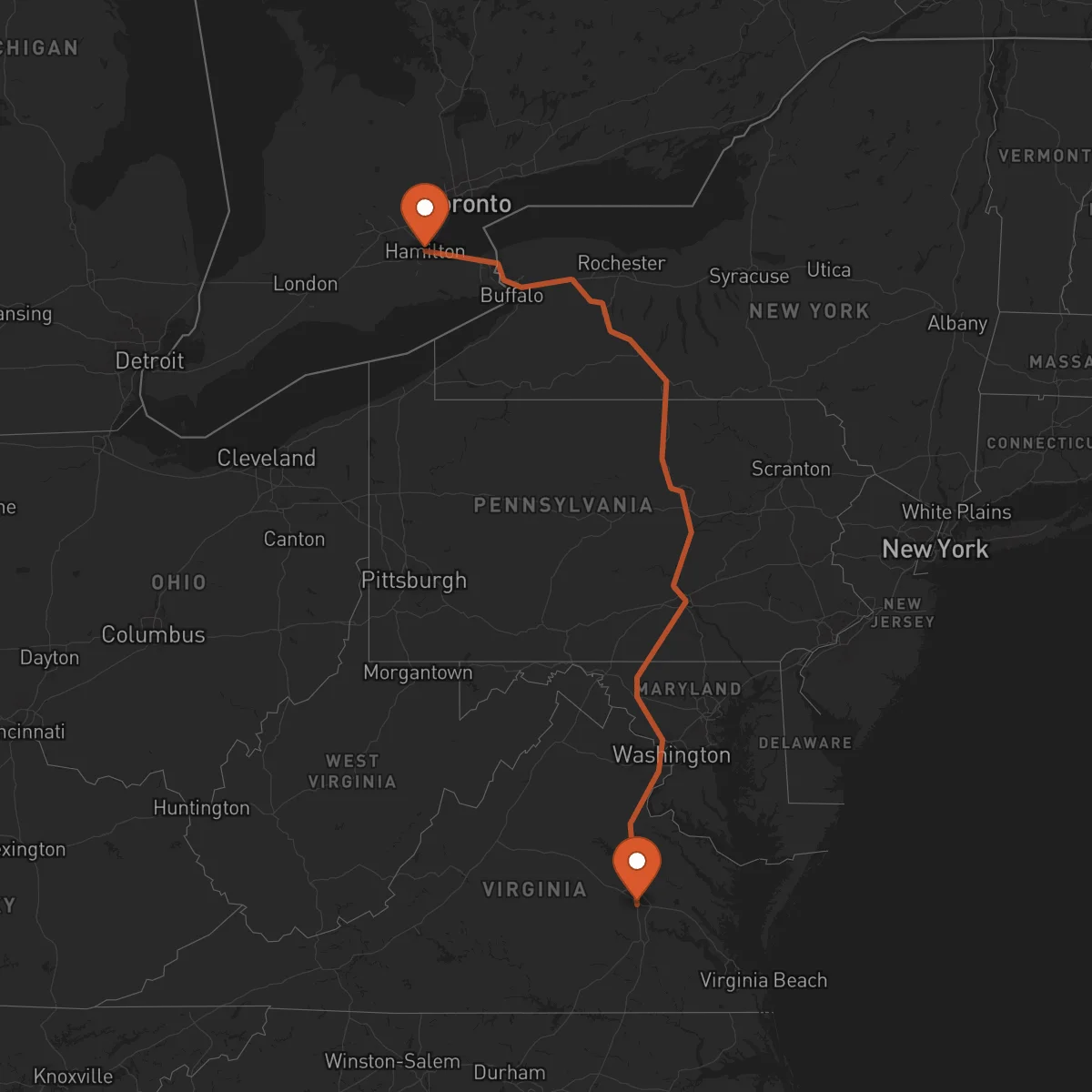
The logistics corridor connecting Richmond, Virginia to Hamilton, Ontario represents a vital cross-border freight route spanning approximately 668 kilometers through the heart of North America. This strategic corridor links two major economic centers, facilitating the movement of goods between the United States and Canada. The route traverses diverse terrain and crosses the international border at key points, making it essential for companies engaged in cross-border trade between these two nations.
The corridor serves as a critical link in the North American supply chain, connecting Richmond's industrial base with Hamilton's manufacturing and distribution hubs. This route is particularly important for industries requiring temperature-controlled transportation, specialized handling, and just-in-time delivery schedules. The economic relationship between Virginia and Ontario creates significant freight volume along this corridor, with businesses relying on efficient cross-border transportation to maintain competitive advantage.
Major highways serving this corridor include Interstate 95 and Interstate 81 in the United States, connecting to Ontario's Highway 401 and QEW (Queen Elizabeth Way). These well-maintained infrastructure networks provide reliable transportation options for freight carriers. The corridor benefits from multiple border crossing options, including the Ambassador Bridge and Peace Bridge, which help distribute traffic and reduce potential delays. Control Terrestre's expertise in cross-border operations ensures seamless customs clearance and compliance with both US and Canadian regulations, providing our clients with reliable full truckload (FTL) transportation solutions between Richmond and Hamilton.
Services for this Route
Available services for the corridor Richmond - Hamilton
 Origin
Richmond
Richmond, Virginia serves as a strategic logistics hub on the East Coast, offering excellent connectivity to major markets along the Eastern Seaboard. The city's location provides access to Interstate 95, a major north-south corridor, and Interstate 64, facilitating efficient distribution throughout the Mid-Atlantic region. Richmond's port facilities on the James River enable seamless integration of intermodal transportation, connecting ocean freight with inland distribution networks.
The region's economy is diverse, with strong presence in manufacturing, technology, healthcare, and government sectors. Richmond is home to numerous corporate headquarters and distribution centers, creating substantial freight movement. The area's manufacturing base includes food processing, tobacco products, and advanced manufacturing facilities that generate consistent freight volumes. Richmond's proximity to Washington D.C. and other major East Coast cities makes it an ideal origin point for cross-border shipments to Canada.
 Destination
Hamilton, Ontario stands as a major industrial and logistics center in Canada, strategically positioned on the western tip of Lake Ontario. The city's location provides direct access to the Greater Toronto Area while maintaining its distinct industrial character. Hamilton's port facilities on Lake Ontario facilitate international trade, while its extensive highway network connects to major Canadian and US markets.
The city has a strong manufacturing heritage, particularly in steel production, heavy machinery, and automotive components. Hamilton's economy also includes food processing, pharmaceuticals, and technology sectors, creating diverse freight generation. The presence of major distribution centers and warehouses makes Hamilton a key destination for cross-border freight. The city's infrastructure includes multiple rail connections and proximity to Toronto Pearson International Airport, providing comprehensive transportation options for businesses operating in the region.










