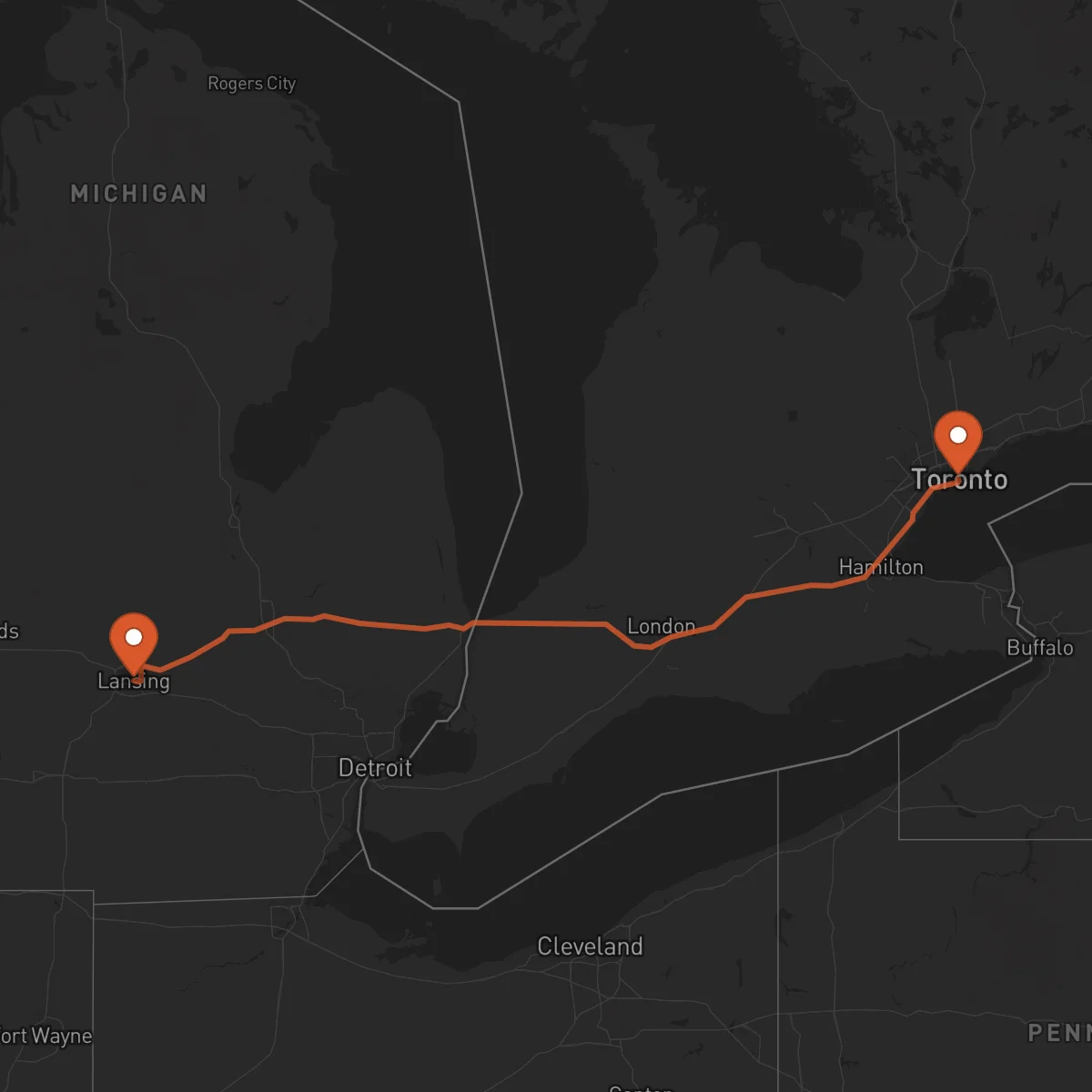
Lansing to Toronto
Toronto → LansingFTL freight transportation service between Lansing and Toronto. Reliable logistics solutions for your business.
Route Description
Everything you need to know about the corridor Lansing - Toronto
The logistics corridor between Lansing, Michigan and Toronto, Ontario represents a vital cross-border connection between two major economic centers in North America. This 431 km route links Michigan's capital region with Canada's largest financial and commercial hub, facilitating the movement of goods between the United States and Canada. The corridor traverses the Great Lakes region, connecting manufacturing and agricultural centers with major urban markets and international trade gateways.
The economic significance of this corridor is substantial, as it connects Lansing's automotive and manufacturing base with Toronto's diverse industrial and commercial sectors. This route supports the automotive supply chain, agricultural products, industrial equipment, and consumer goods moving between the two countries. The corridor benefits from the strong trade relationship between the United States and Canada, with thousands of trucks crossing the border daily to support just-in-time manufacturing and distribution networks.
Transportation infrastructure along this corridor includes major highways such as I-69, I-94, and Highway 401, providing efficient connections between the two cities. The corridor primarily utilizes the Detroit-Windsor crossing, one of North America's busiest border crossings, though alternative routes through Port Huron or Sarnia are also available. Control Terrestre's expertise in cross-border operations ensures seamless customs clearance and compliance with both US and Canadian regulations, providing our clients with reliable full truckload (FTL) transportation solutions that maintain supply chain integrity across this critical international route.
Services for this Route
Available services for the corridor Lansing - Toronto
 Origin
Lansing
Lansing, Michigan serves as a strategic logistics hub in the Great Lakes region, offering excellent connectivity for freight transportation. As Michigan's capital city, Lansing benefits from its central location within the state and proximity to major transportation networks. The city's logistics infrastructure includes access to I-96, I-69, and I-496, providing efficient connections to Detroit, Chicago, and other major Midwestern markets. Lansing's strategic position makes it an ideal origin point for cross-border shipments to Canada and coast-to-coast distribution throughout the United States.
The economic landscape of Lansing is diverse, with strong presence in automotive manufacturing, government services, and education. The city hosts several automotive suppliers and research facilities, supporting Michigan's renowned automotive industry. Additionally, Lansing's agricultural sector contributes to the movement of food products and agricultural equipment. The presence of Michigan State University also drives demand for specialized logistics services related to research materials and educational supplies.
 Destination
Toronto, Ontario stands as Canada's premier logistics and commercial center, offering unparalleled access to North American and international markets. The city's strategic location on the northwestern shore of Lake Ontario provides multimodal transportation options, including extensive highway networks, rail connections, and port facilities. Toronto's logistics infrastructure is anchored by major highways such as Highway 401, which is one of North America's busiest truck routes, and proximity to international airports and rail terminals. This comprehensive transportation network makes Toronto an ideal destination for freight consolidation and distribution across Canada and into the United States.
The economic profile of Toronto is exceptionally diverse, encompassing financial services, technology, manufacturing, and healthcare sectors. As Canada's financial capital, Toronto drives significant demand for specialized logistics services supporting the banking and insurance industries. The city's manufacturing base includes automotive parts, electronics, and food processing, while its status as a major port of entry facilitates international trade. Toronto's role as a distribution hub for Eastern Canada and the Northeastern United States makes it a critical node in North American supply chains.










