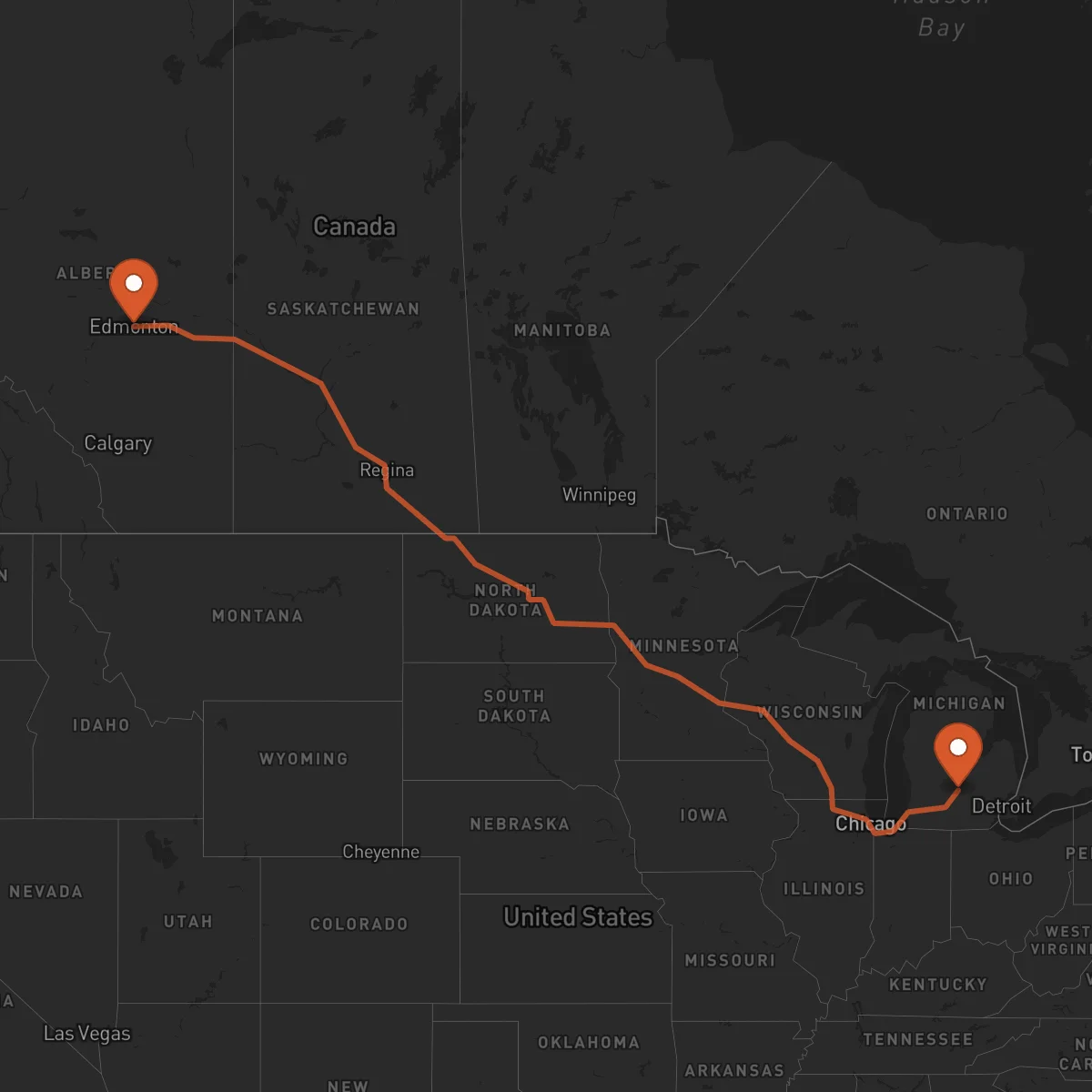
Lansing to Edmonton
Edmonton → LansingFTL freight transportation service between Lansing and Edmonton. Reliable logistics solutions for your business.
Route Description
Everything you need to know about the corridor Lansing - Edmonton
The Lansing-Edmonton corridor connects the industrial heart of Michigan with Alberta's energy and logistics hub, spanning approximately 2,437 km across the U.S.-Canada border. This critical cross-border route facilitates the movement of goods between the American Midwest and Western Canada, supporting vital economic exchanges between these two major North American markets.
The corridor traverses key industrial regions, passing through major transportation hubs in Michigan, Wisconsin, Minnesota, and the Canadian Prairies. Companies operating along this route benefit from access to both the automotive manufacturing centers of Michigan and the energy, agriculture, and logistics sectors of Alberta. The route serves as a strategic link for industries requiring efficient north-south transportation solutions across the continent.
Major transportation infrastructure includes I-96, I-94, and I-35 in the United States, transitioning to Canadian routes through Winnipeg and Saskatoon before reaching Edmonton. The corridor typically crosses at the Pembina-Emerson border crossing, one of the busiest commercial ports between the two countries. Control Terrestre's expertise in cross-border operations ensures seamless customs clearance and compliance with all regulatory requirements, providing dedicated FTL services that maintain cargo integrity throughout the journey.
Services for this Route
Available services for the corridor Lansing - Edmonton
 Origin
Lansing
Lansing, Michigan serves as a strategic logistics hub in the American Midwest, positioned advantageously for distribution throughout the Great Lakes region. The city benefits from proximity to major automotive manufacturing centers and industrial corridors, with excellent access to I-96 and I-69. Lansing's economy centers on manufacturing, automotive components, and technology sectors, creating consistent demand for reliable freight transportation services. The region's infrastructure includes multiple warehousing facilities and distribution centers, making it an ideal origin point for full truckload shipments heading north to Canada.
 Destination
Edmonton, Alberta stands as Western Canada's primary logistics and distribution center, strategically located at the crossroads of major transportation networks. As Alberta's capital, Edmonton serves as a gateway to the oil sands, agricultural regions, and northern territories. The city's economy thrives on energy, logistics, and manufacturing sectors, with the Edmonton International Airport and extensive highway systems supporting robust freight movement. Edmonton's location provides access to the Yellowhead Highway and connections to the broader Canadian Prairies, making it an essential destination for cross-border freight operations.










