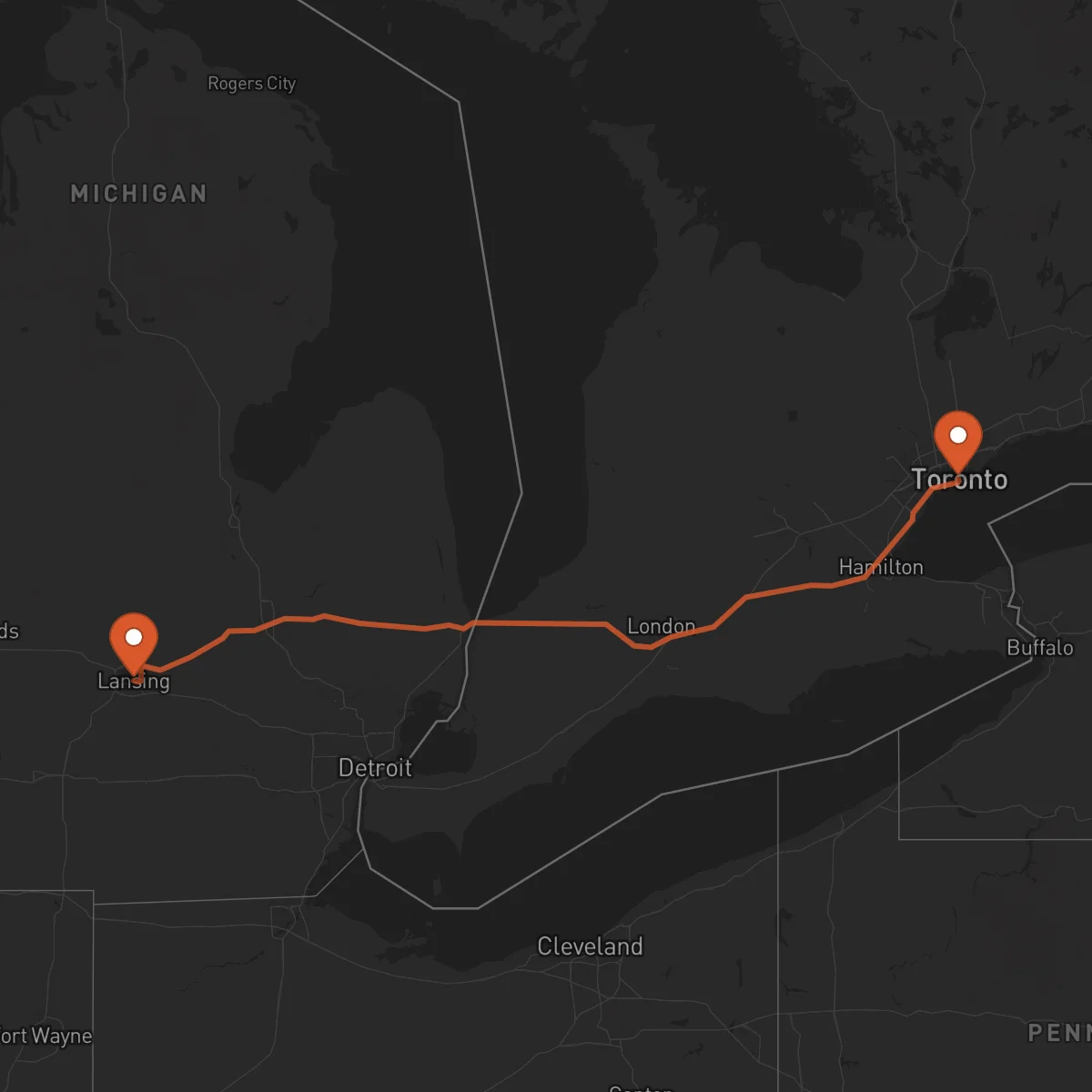
Toronto to Lansing
Lansing → TorontoFTL freight transportation service between Toronto and Lansing. Reliable logistics solutions for your business.
Route Description
Everything you need to know about the corridor Toronto - Lansing
The Toronto-Lansing corridor represents a vital cross-border logistics route connecting Canada's largest city with Michigan's capital. This 431-kilometer route facilitates the movement of goods between two major North American manufacturing and distribution hubs. The corridor leverages Ontario's robust transportation infrastructure and Michigan's industrial strength, creating a seamless supply chain link across the Great Lakes region.
The economic significance of this corridor is substantial, with Toronto serving as Canada's financial and industrial powerhouse while Lansing hosts major automotive and manufacturing operations. This route supports the continuous flow of automotive parts, industrial equipment, consumer goods, and raw materials between both regions. The corridor benefits from Canada's strategic position as a trade partner with the United States, facilitating billions in cross-border commerce annually.
Transportation along this corridor primarily utilizes Highway 401 through Ontario and I-69 through Michigan, offering efficient transit times and reliable service. The Ambassador Bridge and Blue Water Bridge serve as key border crossings, with extensive customs infrastructure to handle the high volume of commercial traffic. Control Terrestre's expertise in cross-border operations ensures smooth customs clearance and compliance with all regulatory requirements, minimizing delays and optimizing transit times for our clients' shipments.
Services for this Route
Available services for the corridor Toronto - Lansing
 Origin
Toronto stands as Canada's premier logistics hub, strategically positioned on Lake Ontario's northwestern shore. The city's extensive transportation network includes Pearson International Airport, one of North America's busiest cargo facilities, and the Port of Toronto, providing multimodal shipping capabilities. Toronto's location within the Quebec City-Windsor Corridor, Canada's most densely populated and industrialized region, makes it an ideal origin point for freight distribution across the continent.
The Greater Toronto Area hosts diverse industries including automotive manufacturing, aerospace, pharmaceuticals, and advanced technology sectors. The region's economic strength is supported by a skilled workforce and proximity to major suppliers and customers. Toronto's infrastructure includes multiple intermodal terminals, extensive highway networks, and specialized industrial parks designed for efficient freight handling and distribution operations.
 Destination
Lansing
Lansing serves as Michigan's capital city and a strategic logistics center in the Great Lakes region. The city's location provides excellent access to major Midwestern markets and connects to Detroit's extensive automotive supply chain network. Lansing's transportation infrastructure includes Capital Region International Airport and proximity to major interstate highways, facilitating efficient distribution throughout the Midwest and beyond.
The Lansing area is home to significant automotive manufacturing operations, including assembly plants and parts suppliers. The region also hosts healthcare, education, and government institutions that contribute to diverse freight movement patterns. Lansing's industrial parks and warehouse facilities are designed to accommodate various cargo types, from automotive components to general merchandise, making it a versatile destination for cross-border freight shipments.










