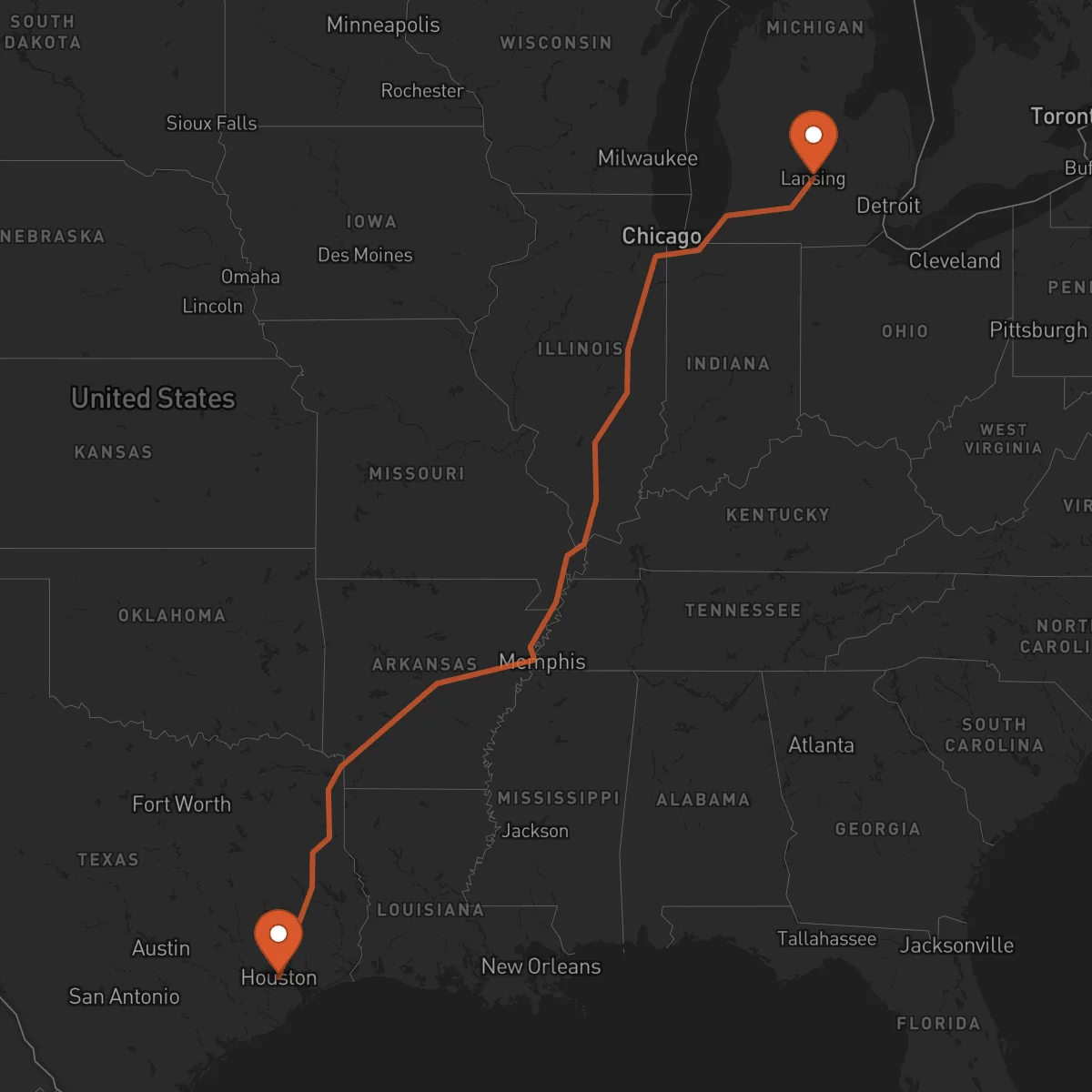
Lansing to Houston
Houston → LansingFTL freight transportation service between Lansing and Houston. Reliable logistics solutions for your business.
Route Description
Everything you need to know about the corridor Lansing - Houston
The Lansing-Houston corridor represents one of the most important freight transportation routes in the central United States, connecting Michigan's automotive and manufacturing hub with Texas's energy and petrochemical powerhouse. This 1,735 km route traverses through the heart of America's industrial corridor, facilitating the movement of critical goods between the Midwest and the Gulf Coast. The strategic importance of this corridor lies in its ability to connect major economic regions, enabling efficient supply chain operations for industries ranging from automotive to energy.
The economic synergy between Lansing and Houston creates substantial freight demand along this route. Lansing, with its strong automotive manufacturing base and industrial suppliers, generates significant outbound freight, while Houston's position as a global energy capital and major port creates inbound demand for specialized equipment and manufacturing components. This complementary relationship drives consistent freight volumes throughout the year, making it a reliable corridor for full truckload transportation services.
Major highways including I-69, I-65, I-10, and I-45 form the backbone of this corridor, providing multiple routing options for efficient freight movement. Control Terrestre leverages this extensive highway network to optimize transit times and ensure reliable delivery schedules. Our strategic partnerships with certified carriers along this route enable us to provide dedicated full truckload services, handling everything from standard freight to specialized cargo requiring specific equipment types such as refrigerated units or flatbeds.
Services for this Route
Available services for the corridor Lansing - Houston
 Origin
Lansing
Lansing, Michigan serves as a strategic logistics hub in the Great Lakes region, benefiting from its proximity to major automotive manufacturing centers and industrial corridors. The city's location provides excellent connectivity to Detroit, Chicago, and other Midwest economic centers, making it an ideal origin point for freight distribution. Lansing's economy is anchored by automotive manufacturing, with major suppliers and assembly operations creating consistent freight generation. The region also features strong healthcare, education, and technology sectors that contribute to diverse freight needs.
The transportation infrastructure in Lansing includes access to I-96, I-69, and I-496, providing direct connections to major freight corridors. Capital Region International Airport offers air cargo capabilities for time-sensitive shipments, while the nearby Port of Muskegon provides Great Lakes shipping options. The city's industrial parks and distribution centers are equipped with modern loading facilities, supporting efficient freight handling operations.
 Destination
Houston
Houston, Texas stands as one of America's most critical logistics hubs, strategically positioned near the Gulf of Mexico with access to international shipping lanes and major rail networks. The city's location makes it an ideal destination for freight from across the country, particularly from manufacturing centers in the Midwest. Houston's economy is dominated by the energy sector, with numerous refineries, petrochemical plants, and related industries creating substantial freight demand for specialized equipment and materials.
The transportation infrastructure in Houston is exceptionally robust, featuring extensive highway networks including I-10, I-45, and I-69, as well as the Port of Houston, one of the busiest ports in the United States. The city boasts multiple intermodal facilities, rail yards, and a major international airport with significant cargo capabilities. Houston's industrial districts are equipped with specialized handling facilities for hazardous materials and oversized cargo, supporting the diverse needs of the energy and manufacturing sectors.










