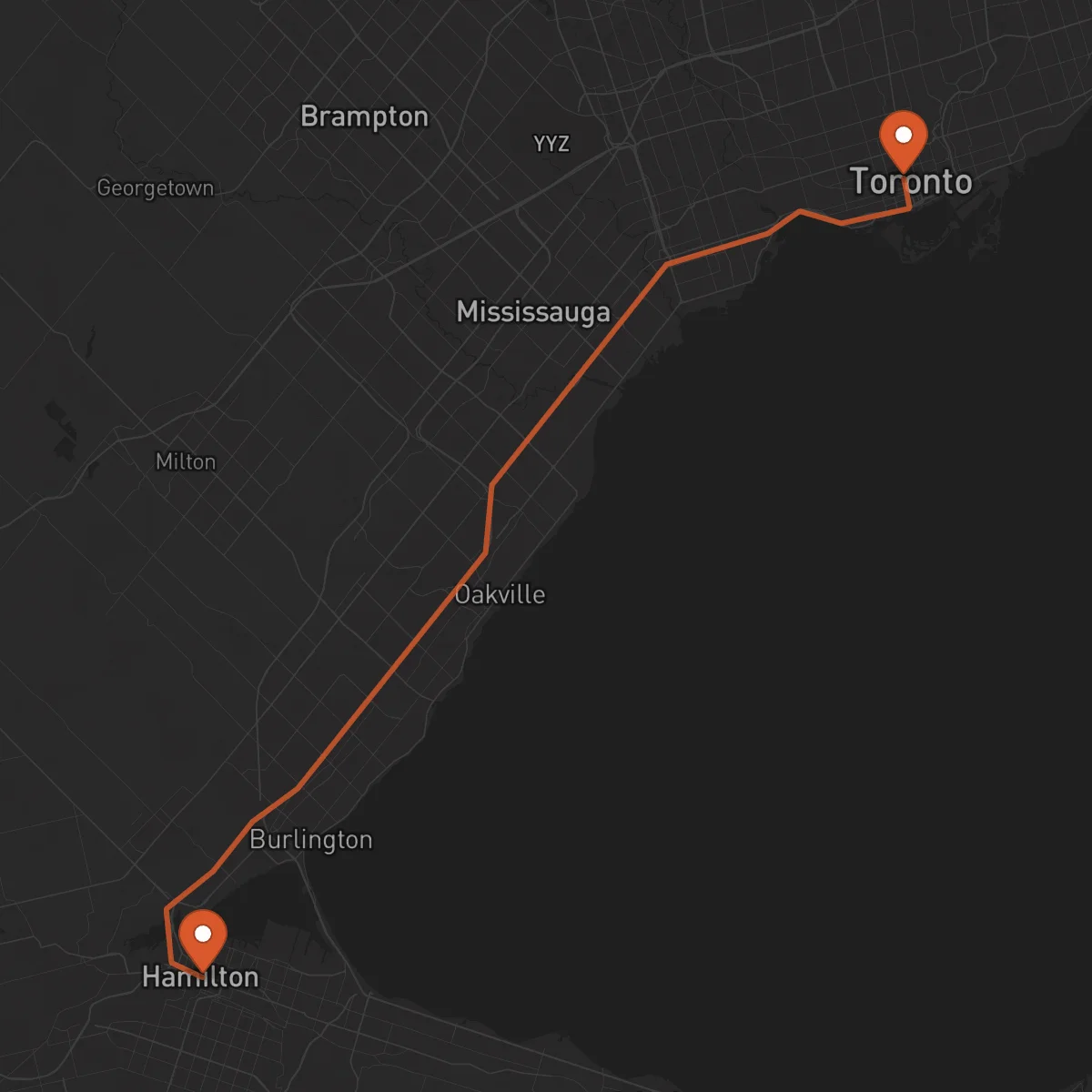
Hamilton to Toronto
Toronto → HamiltonFTL freight transportation service between Hamilton and Toronto. Reliable logistics solutions for your business.
Route Description
Everything you need to know about the corridor Hamilton - Toronto
The corridor between Hamilton and Toronto represents one of the most dynamic and strategically important freight transportation routes in Ontario. This 59-kilometer connection links two major economic centers, facilitating the continuous flow of goods that drives the region's industrial and commercial activity. The route serves as a vital artery for the Greater Toronto Area's supply chain, connecting Hamilton's industrial base with Toronto's diverse commercial and distribution networks.
The region's economic significance is underscored by its concentration of manufacturing, automotive, and technology sectors. Hamilton's steel industry and manufacturing facilities complement Toronto's role as a financial and commercial hub, creating a symbiotic relationship that demands efficient freight transportation. The corridor supports a wide range of industries, from automotive parts and heavy machinery to consumer goods and retail distribution, making it a cornerstone of Ontario's logistics infrastructure.
Transportation along this route primarily utilizes Highway 403 and the QEW (Queen Elizabeth Way), two of Ontario's most heavily trafficked freight corridors. These highways provide direct, reliable connections between the two cities, supporting the movement of full truckload (FTL) freight throughout the day. Control Terrestre leverages this infrastructure to provide seamless FTL transportation services, ensuring that your cargo moves efficiently between Hamilton's industrial parks and Toronto's distribution centers, warehouses, and commercial districts.
Services for this Route
Available services for the corridor Hamilton - Toronto
 Origin
Hamilton stands as a strategic logistics hub in Ontario, anchored by its strong industrial heritage and manufacturing capabilities. The city's location on the western tip of Lake Ontario provides excellent access to both water and land transportation networks. Hamilton's industrial sectors, particularly steel manufacturing, automotive parts production, and advanced manufacturing, create consistent demand for freight transportation services. The city's transportation infrastructure includes the Hamilton Port Authority, multiple rail connections, and direct highway access via Highway 403, making it an ideal origin point for regional and national freight movements.
 Destination
Toronto serves as Canada's largest economic center and a critical logistics destination, offering unparalleled access to markets and distribution networks. The city's diverse economy encompasses finance, technology, retail, and manufacturing sectors, all requiring reliable freight transportation. Toronto's transportation infrastructure is extensive, featuring Pearson International Airport, major rail terminals, and comprehensive highway systems including the 401, one of North America's busiest highways. The city's numerous industrial parks, warehousing districts, and commercial centers create a constant need for efficient FTL freight services to support its role as a national distribution hub.










