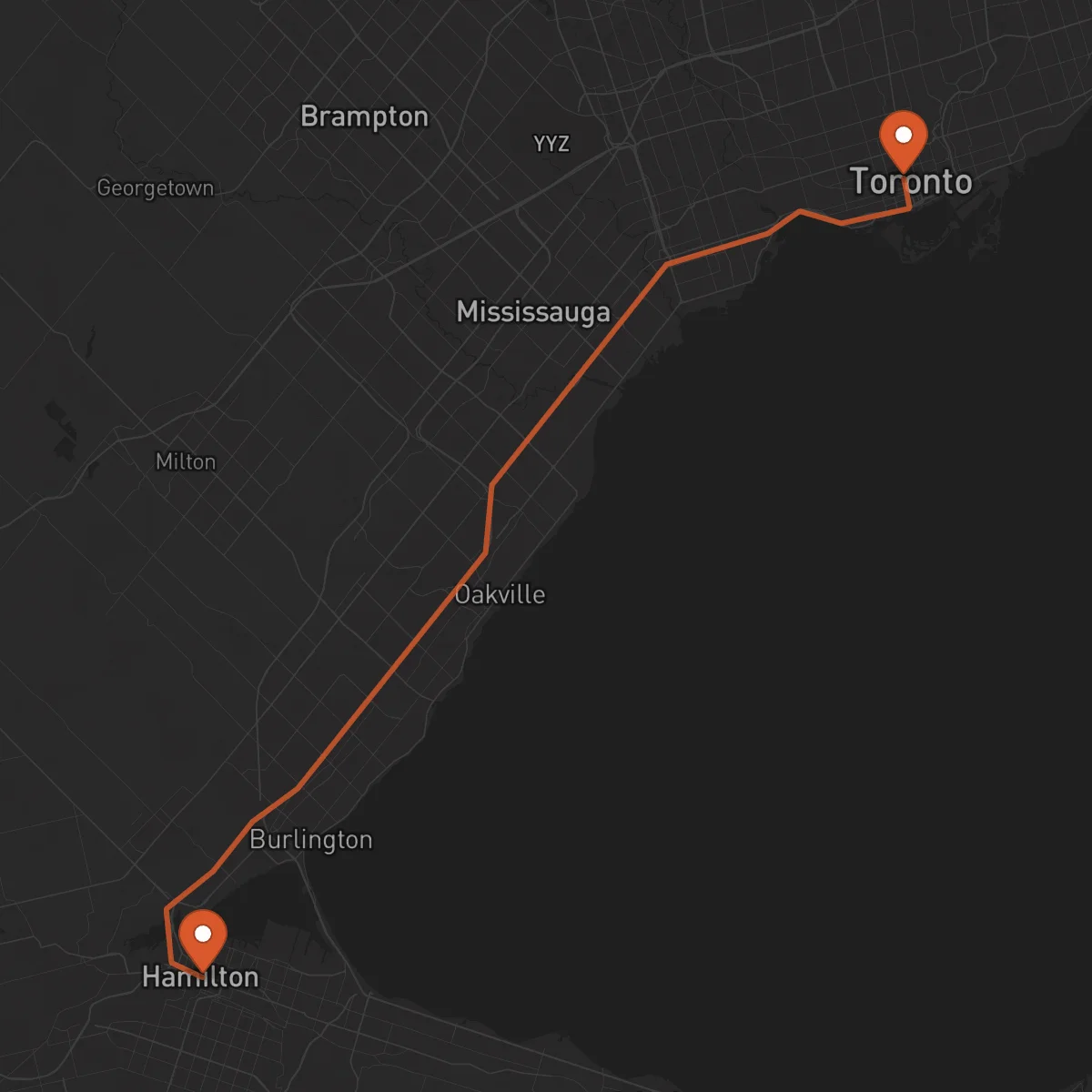
Toronto to Hamilton
Hamilton → TorontoFTL freight transportation service between Toronto and Hamilton. Reliable logistics solutions for your business.
Route Description
Everything you need to know about the corridor Toronto - Hamilton
The Toronto-Hamilton corridor represents one of the most vital logistics connections in Ontario's industrial heartland. This 59-kilometer route connects two major economic centers, facilitating the seamless movement of goods between Canada's largest city and its key manufacturing hub. The corridor's strategic importance is underscored by its role in supporting the region's integrated supply chains, where just-in-time delivery and efficient transportation are essential for maintaining competitive advantage.
The economic landscape along this corridor is dominated by advanced manufacturing, automotive production, and technology sectors. Toronto's financial and commercial center drives demand for industrial inputs, while Hamilton's steel mills, manufacturing plants, and port facilities generate substantial outbound freight volumes. This complementary relationship creates consistent freight flows in both directions, making the corridor particularly attractive for dedicated transportation solutions.
Control Terrestre leverages this corridor's infrastructure to provide specialized FTL services that meet the unique demands of these industries. Our experienced network of transportation providers ensures reliable, full truckload capacity between Toronto and Hamilton, with equipment options ranging from standard dry vans to specialized units for oversized or temperature-sensitive cargo. By focusing exclusively on dedicated freight movements, we eliminate the inefficiencies associated with consolidated shipping, providing our clients with predictable transit times and optimized supply chain performance.
Services for this Route
Available services for the corridor Toronto - Hamilton
 Origin
Toronto serves as a strategic gateway for logistics operations in Ontario, combining extensive transportation infrastructure with Canada's largest consumer market. The city's location provides access to major highways including the QEW and Highway 401, facilitating connections to both domestic and international markets. Toronto's Pearson International Airport and extensive rail networks complement its road infrastructure, creating a multimodal logistics hub that supports diverse freight requirements.
The city's economic base spans financial services, technology, advanced manufacturing, and consumer goods distribution. These sectors generate consistent demand for freight transportation, particularly for time-sensitive deliveries and specialized cargo movements. Toronto's concentration of warehousing and distribution centers, combined with its proximity to major industrial zones, makes it an ideal origin point for full truckload shipments requiring reliable, dedicated capacity.
 Destination
Hamilton's strategic position on the western tip of Lake Ontario makes it a crucial logistics node for both domestic and international freight movements. The city's well-developed transportation infrastructure includes direct access to the Queen Elizabeth Way, Highway 403, and the Hamilton Port Authority, one of Canada's busiest ports. This multimodal connectivity enables efficient distribution of goods throughout Ontario and beyond.
The city's economic foundation in steel production, heavy manufacturing, and industrial processing creates substantial demand for specialized freight services. Hamilton's port facilities handle significant volumes of bulk cargo, while its manufacturing sector requires consistent delivery of raw materials and components. The presence of industrial parks and manufacturing zones along key transportation corridors ensures that FTL services can operate efficiently, supporting the just-in-time delivery requirements of modern industrial operations.










