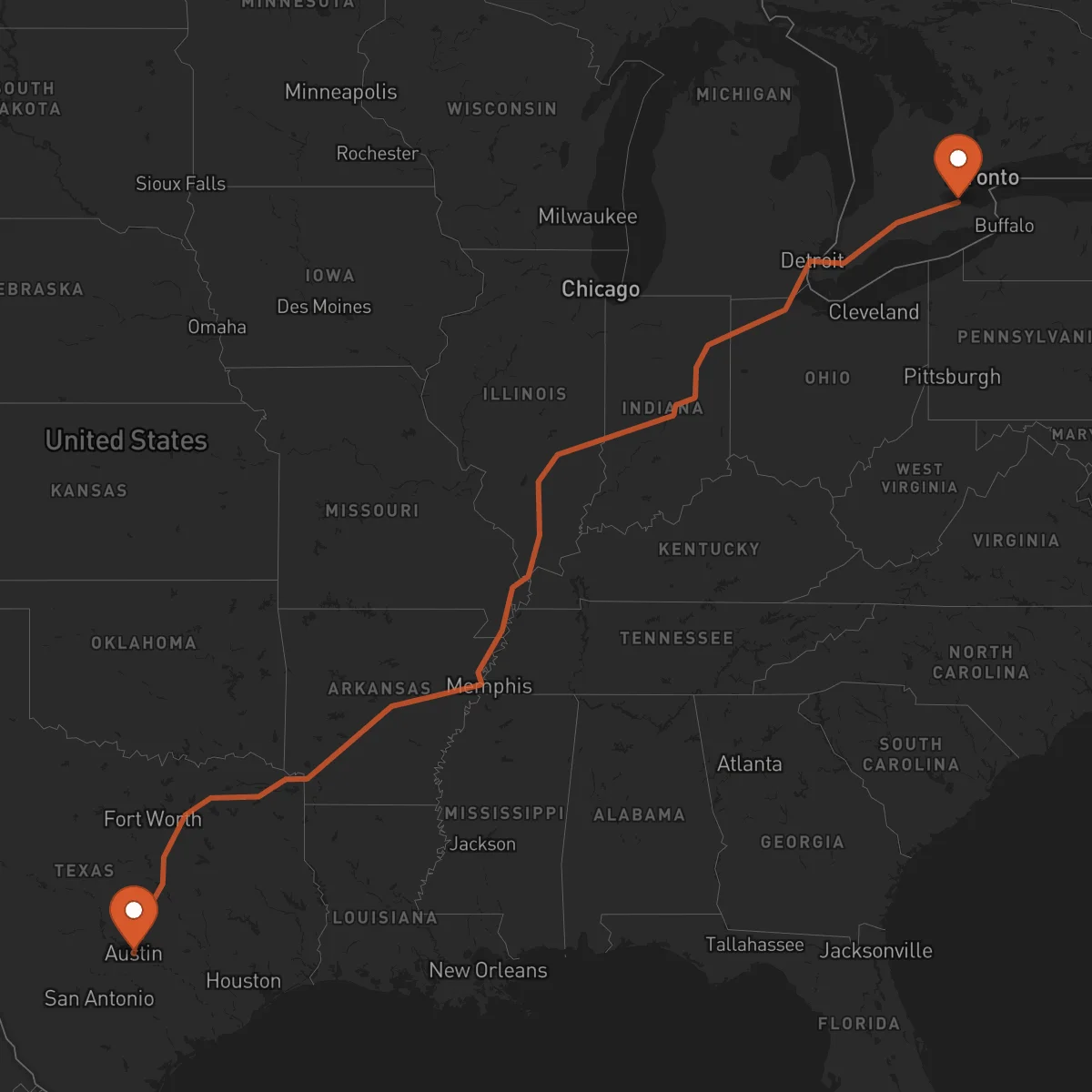
Hamilton to Austin
Austin → HamiltonFTL freight transportation service between Hamilton and Austin. Reliable logistics solutions for your business.
Route Description
Everything you need to know about the corridor Hamilton - Austin
The logistics corridor connecting Hamilton, Ontario, Canada to Austin, Texas, United States represents a vital cross-border freight transportation route spanning approximately 2,141 kilometers. This corridor serves as a critical link between Canada's industrial heartland and the dynamic business ecosystem of Central Texas. The route traverses major economic regions, connecting manufacturing centers, technology hubs, and distribution networks across two nations. Control Terrestre facilitates seamless cross-border operations along this corridor, leveraging our expertise in customs procedures, documentation requirements, and regulatory compliance for both Canadian and US jurisdictions. Our strategic partnerships with certified transportation providers ensure reliable, efficient freight movement between these key North American markets.
Services for this Route
Available services for the corridor Hamilton - Austin
 Origin
Hamilton, Ontario stands as a strategic logistics hub in Canada's Golden Horseshoe region, offering exceptional connectivity for freight transportation. The city's location on the western tip of Lake Ontario provides access to major water routes, while its proximity to the US border facilitates cross-border operations. Hamilton's industrial base includes advanced manufacturing, steel production, and automotive sectors, supported by robust transportation infrastructure including the Hamilton Port, John C. Munro International Airport, and extensive highway networks. The city's economic diversity and manufacturing strength make it an ideal origin point for freight shipments requiring reliable, full truckload transportation services to destinations across North America.
 Destination
Austin
Austin, Texas has emerged as a major logistics and distribution center in the southern United States, driven by its booming technology sector and strategic central location. The city's position in Central Texas provides excellent access to major markets throughout the southern and southwestern US. Austin-Bergstrom International Airport and the Port of Houston (approximately 3 hours away) offer multimodal transportation options, while the city's extensive highway network (including I-35 and US-290) facilitates efficient ground transportation. The region's growing industries, including technology, healthcare, and advanced manufacturing, create consistent demand for full truckload freight services connecting Austin to major Canadian markets and beyond.










