Greensboro to Tucson
Tucson → GreensboroFTL freight transportation service between Greensboro and Tucson. Reliable logistics solutions for your business.
Route Description
Everything you need to know about the corridor Greensboro - Tucson
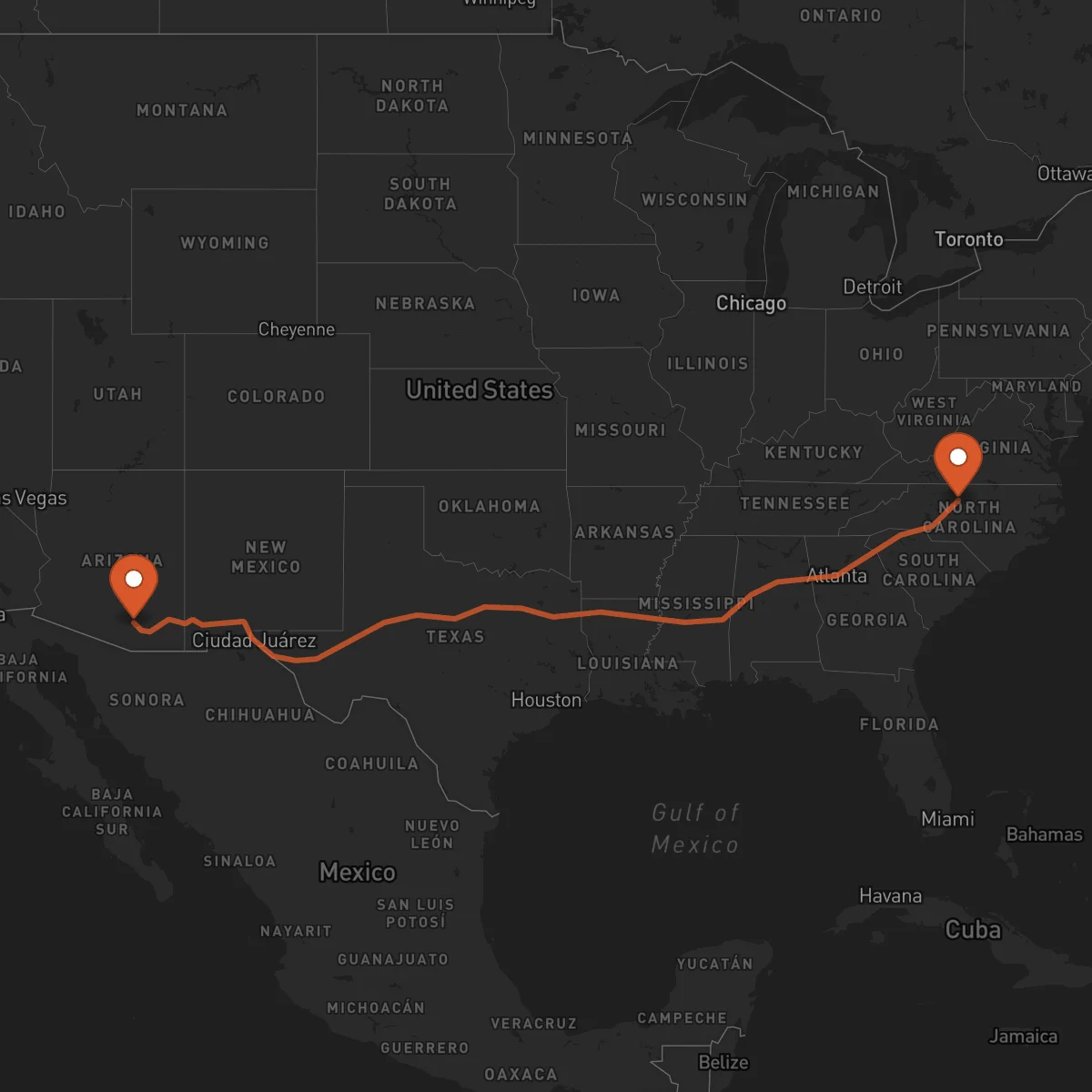
The Greensboro to Tucson corridor represents a vital freight transportation link across the United States, spanning approximately 2,888 kilometers through diverse geographic and economic regions. This east-west route connects the manufacturing and logistics hub of North Carolina's Piedmont Triad with the growing industrial center of southern Arizona, facilitating the movement of goods between the Atlantic seaboard and the southwestern United States.
The corridor traverses multiple states including North Carolina, Tennessee, Arkansas, Texas, New Mexico, and Arizona, crossing the Mississippi River and passing through major transportation nodes. This strategic route serves as a critical supply chain artery for companies requiring reliable ground transportation between the eastern and western United States, particularly for time-sensitive and high-value freight.
Control Terrestre specializes in full truckload (FTL) services along this corridor, providing dedicated transportation solutions that ensure your cargo moves efficiently without stops or transfers. Our experienced carrier network understands the complexities of this cross-country route, including optimal scheduling, fuel management, and compliance with varying state regulations. We offer flexible capacity options ranging from standard dry vans to specialized equipment for oversized or temperature-sensitive cargo, ensuring your freight arrives in Tucson exactly as it departed from Greensboro.
Services for this Route
Available services for the corridor Greensboro - Tucson
 Origin
Greensboro
Greensboro, located in North Carolina's Piedmont Triad region, serves as a strategic logistics hub with excellent transportation connectivity. The city benefits from proximity to major interstate highways including I-40, I-85, and I-73, providing direct access to regional and national freight networks. Greensboro's location within 500 miles of 40% of the U.S. population makes it an ideal origin point for nationwide distribution operations.
The region's economy is diverse, with strong manufacturing sectors including textiles, furniture, and transportation equipment. Greensboro is home to numerous warehouses, distribution centers, and third-party logistics providers, creating a robust infrastructure for freight consolidation and expedited shipping. The city's international airport and rail connections further enhance its capabilities as a logistics origin, supporting seamless multimodal transportation solutions for businesses requiring reliable outbound freight services to western destinations like Tucson.
 Destination
Tucson
Tucson, Arizona, strategically positioned in the Sonoran Desert, serves as a critical logistics gateway to the southwestern United States and Mexico. The city's location at the intersection of Interstate 10 and Interstate 19 provides excellent connectivity for freight moving between the Pacific Coast, Texas, and Mexico. Tucson's transportation infrastructure includes a major international airport, extensive rail facilities, and modern warehousing districts that support the region's growing logistics industry.
The Tucson metropolitan area has developed strong economic sectors in aerospace and defense, optics and photonics, and advanced manufacturing. The presence of major employers and distribution centers creates consistent demand for inbound freight transportation. Tucson's proximity to the U.S.-Mexico border, combined with its role as a regional distribution center for southern Arizona, makes it an important destination for companies requiring reliable ground transportation from eastern manufacturing centers. The city's infrastructure supports efficient last-mile delivery and cross-docking operations for businesses serving the broader southwestern market.










