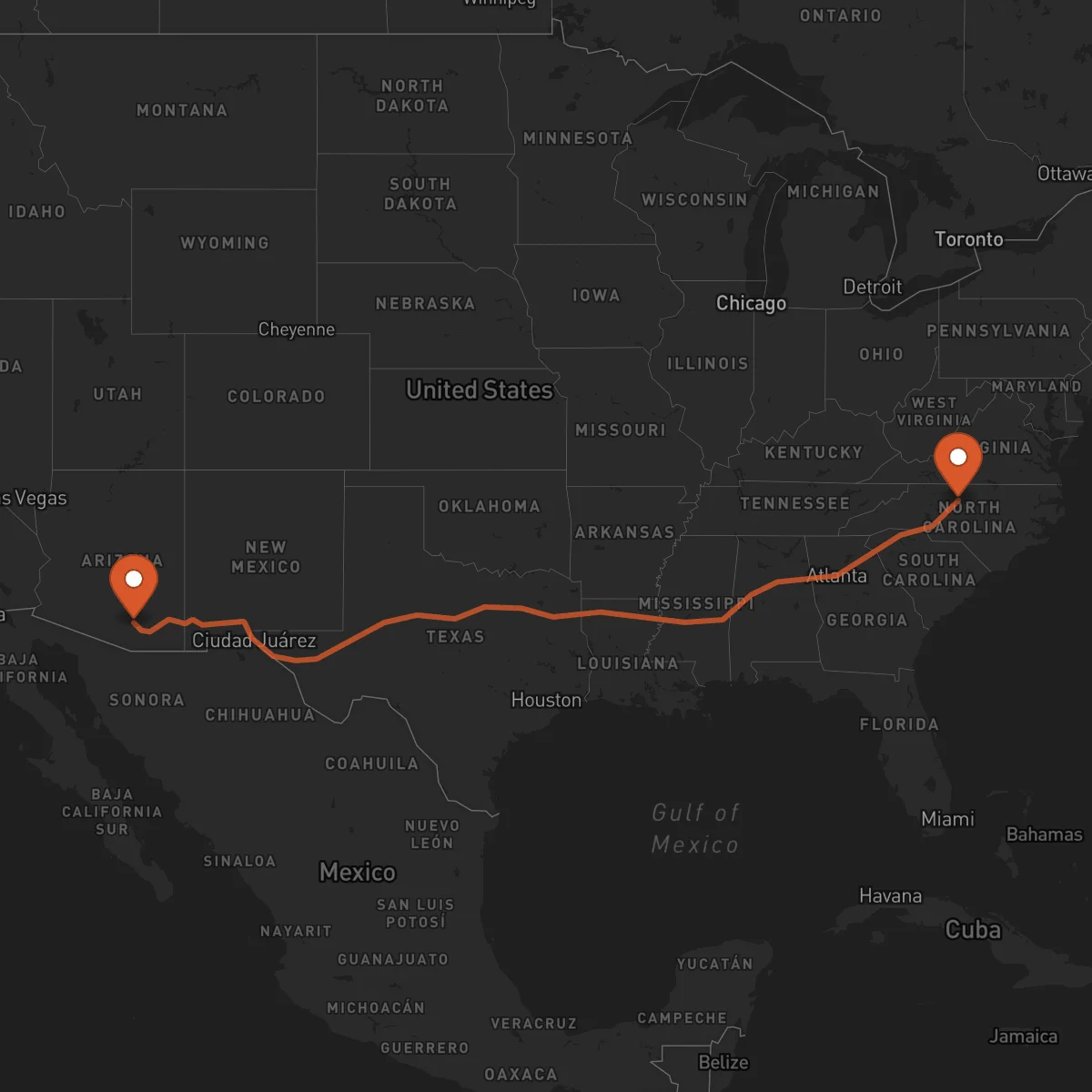
Tucson to Greensboro
Greensboro → TucsonFTL freight transportation service between Tucson and Greensboro. Reliable logistics solutions for your business.
Route Description
Everything you need to know about the corridor Tucson - Greensboro
The Tucson to Greensboro corridor represents a vital logistics connection across the United States, spanning approximately 2,888 kilometers from Arizona to North Carolina. This transcontinental route serves as a critical artery for freight movement between the Southwest and the Southeast, facilitating the flow of goods between major industrial centers. The corridor traverses diverse geographical regions and connects key economic zones, making it essential for national supply chain operations.
The economic significance of this route is underscored by the complementary industrial strengths of both regions. Tucson's growing technology and manufacturing sectors interface with Greensboro's robust textile, furniture, and transportation equipment industries. This creates a dynamic exchange of raw materials, components, and finished goods that drives economic activity across multiple sectors. The corridor particularly serves automotive parts manufacturers, electronics distributors, and consumer goods companies that require reliable transportation between these strategic markets.
Control Terrestre provides comprehensive FTL (Full Truckload) transportation services along this corridor, utilizing major interstate highways including I-10, I-20, and I-85. Our specialized fleet of 48' and 53' dry vans and refrigerated units ensures that your cargo moves efficiently and securely across the country. With our extensive network of certified carriers and real-time tracking capabilities, we offer the reliability and transparency that modern supply chains demand.
Services for this Route
Available services for the corridor Tucson - Greensboro
 Origin
Tucson
Tucson, Arizona serves as a strategic logistics hub in the Southwest, offering unique advantages for freight transportation. Located just 100 kilometers from the U.S.-Mexico border, Tucson provides seamless access to cross-border trade while maintaining strong domestic connections. The city's transportation infrastructure includes major highways such as I-10, which runs coast-to-coast, and the Union Pacific Railroad, creating multimodal shipping opportunities. Tucson's Sky Harbor International Airport and Tucson International Airport further enhance its connectivity to national and international markets.
The region's economy is diverse, with significant contributions from aerospace and defense, optics and photonics (Tucson is known as "Optics Valley"), and advanced manufacturing sectors. The University of Arizona drives innovation and technology development, supporting a growing ecosystem of tech companies and research facilities. Tucson's proximity to major copper mines and its role in renewable energy manufacturing make it a crucial node for specialized freight movements, particularly for heavy equipment and industrial components.
 Destination
Greensboro
Greensboro, North Carolina stands as a strategic logistics center in the Southeast, benefiting from its central location within the Piedmont Triad region. The city's transportation infrastructure is exceptional, featuring direct access to I-40, I-85, and I-73, which connect to major East Coast markets. Piedmont Triad International Airport provides air cargo services, while the nearby ports of Virginia and South Carolina offer ocean freight connectivity. Greensboro's extensive rail network, served by Norfolk Southern and CSX, further enhances its multimodal capabilities.
The Greensboro area is renowned for its strong manufacturing base, particularly in textiles, furniture, and transportation equipment. The region hosts numerous automotive suppliers and advanced manufacturing facilities, benefiting from North Carolina's skilled workforce and business-friendly environment. Greensboro's proximity to Research Triangle Park also supports a growing technology and biotechnology sector. The city's central location within the Eastern United States makes it an ideal distribution point, serving as a gateway to both Northeastern and Southeastern markets for companies requiring efficient freight distribution.










