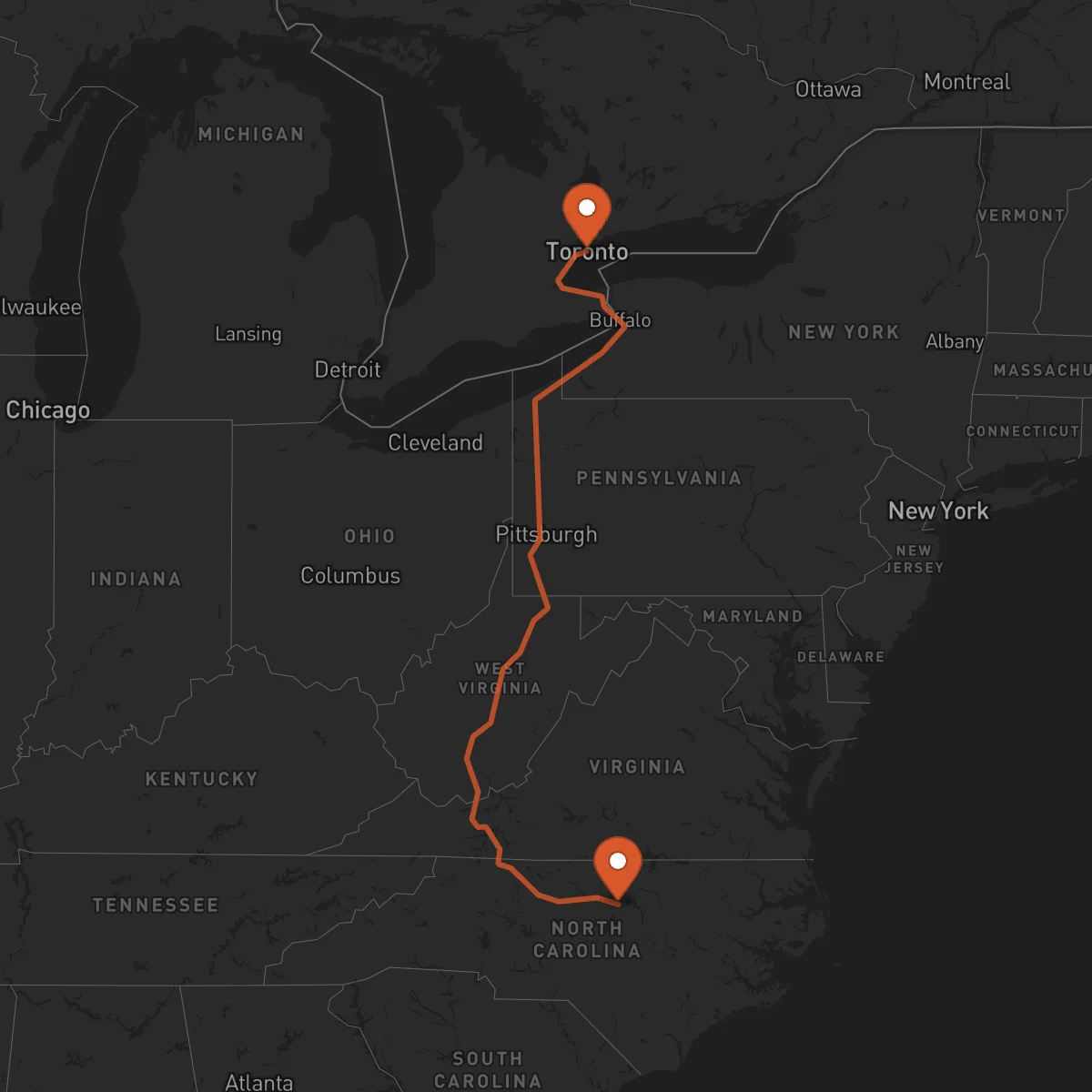
Durham to Toronto
Toronto → DurhamFTL freight transportation service between Durham and Toronto. Reliable logistics solutions for your business.
Route Description
Everything you need to know about the corridor Durham - Toronto
The Durham to Toronto corridor represents a vital cross-border logistics route connecting North Carolina's Research Triangle to Canada's largest economic hub. This 853-kilometer journey traverses diverse terrain and crosses international borders, making it essential for businesses engaged in North American trade. The corridor serves as a critical link between the southeastern United States manufacturing base and Ontario's industrial heartland.
The route passes through major transportation nodes including Richmond, Washington D.C., and Buffalo, utilizing key interstate highways such as I-85, I-95, and the QEW. These well-maintained highways provide reliable freight movement year-round, though seasonal weather patterns can affect transit times. The corridor's significance is amplified by Toronto's role as a major distribution center for Canadian and international markets.
Control Terrestre specializes in facilitating seamless cross-border operations along this corridor, handling all customs documentation and compliance requirements. Our experienced team ensures efficient border crossings at key points like the Peace Bridge or Lewiston-Queenston Bridge, minimizing delays and maintaining supply chain continuity. We understand the complexities of US-Canada trade regulations and provide dedicated support for specialized cargo requirements.
Services for this Route
Available services for the corridor Durham - Toronto
 Origin
Durham
Durham, North Carolina, serves as a strategic logistics hub within the Research Triangle, home to major pharmaceutical companies, technology firms, and research institutions. The city's proximity to Raleigh-Durham International Airport and major interstate highways (I-85, I-40) provides excellent connectivity for freight movement. Durham's growing manufacturing sector, particularly in biotechnology and advanced materials, generates significant cross-border freight volume. The region's educated workforce and research-oriented economy create demand for specialized transportation services, including temperature-controlled shipping for sensitive materials.
 Destination
Toronto, Ontario, stands as Canada's premier logistics and economic center, featuring one of North America's largest inland ports and extensive transportation infrastructure. The Greater Toronto Area hosts diverse industries including automotive manufacturing, financial services, technology, and consumer goods distribution. Toronto's strategic location provides access to major Canadian markets and serves as a gateway to the United States via multiple border crossings. The city's robust intermodal facilities, including rail yards and trucking terminals, support efficient freight consolidation and distribution operations throughout the region.










