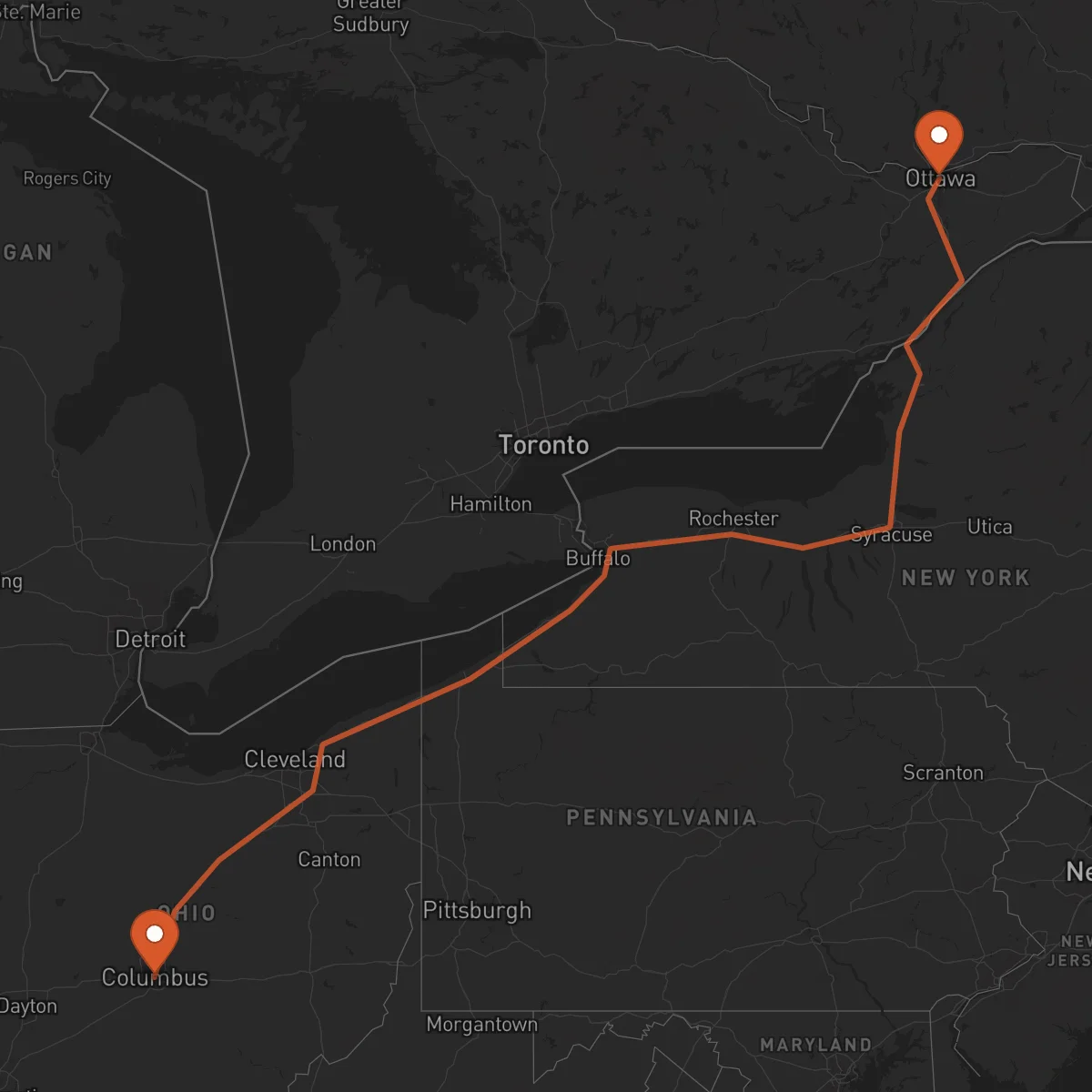
Columbus to Ottawa
Ottawa → ColumbusFTL freight transportation service between Columbus and Ottawa. Reliable logistics solutions for your business.
Route Description
Everything you need to know about the corridor Columbus - Ottawa
The logistics corridor between Columbus, Ohio and Ottawa, Ontario represents a vital cross-border freight transportation route connecting the industrial heartland of the United States with Canada's capital region. This 850-kilometer corridor facilitates the movement of goods between two major economic centers, traversing key manufacturing and distribution zones along the way. The route primarily follows Interstate 71 North through Ohio, transitioning to Ontario Highway 401 East, which serves as the main transportation artery across southern Ontario.
The corridor's strategic importance stems from its connection between Columbus's growing logistics hub and Ottawa's diverse industrial base. Major manufacturing centers, agricultural operations, and technology companies along this route depend on reliable freight transportation to maintain their supply chains. The corridor passes through significant economic regions including Cleveland, Erie, and Kingston, creating multiple opportunities for logistics operations and distribution networks.
Control Terrestre specializes in facilitating seamless cross-border operations along this corridor, leveraging our expertise in customs clearance and border documentation. Our strategic partnerships with certified carriers ensure compliance with C-TPAT and FAST program requirements, enabling expedited processing at border crossings. We provide dedicated full truckload services that maintain the integrity of shipments while optimizing transit efficiency between these two major North American cities.
Services for this Route
Available services for the corridor Columbus - Ottawa
 Origin
Columbus
Columbus, Ohio serves as a strategic logistics hub in the Midwest, offering exceptional connectivity through its central location and robust transportation infrastructure. The city's economy is anchored by diverse sectors including advanced manufacturing, healthcare, education, and technology, with major employers in these industries creating consistent freight demand. Columbus benefits from its position at the intersection of several major highways, including I-70 and I-71, providing direct access to both East Coast and Midwest markets. The city's Rickenbacker International Airport and nearby Port Columbus International Airport complement the ground transportation network, while the nearby Ohio and Erie Canal corridor provides additional logistics options.
 Destination
Ottawa, Ontario stands as Canada's capital and a major logistics center in Eastern Ontario, strategically positioned along the Quebec-Ontario border. The city's economy encompasses government operations, technology (earning it the nickname "Silicon Valley North"), healthcare, and advanced manufacturing sectors. Ottawa's location provides access to both Canadian and U.S. markets, with the Ottawa Macdonald-Cartier International Airport and extensive highway networks supporting freight movements. The city's proximity to Montreal and Toronto creates a tri-city economic region that generates substantial cross-border freight traffic. Ottawa's developed infrastructure includes multiple intermodal facilities and distribution centers that facilitate efficient cargo handling and storage.










