Columbus to Hamilton
Hamilton → ColumbusFTL freight transportation service between Columbus and Hamilton. Reliable logistics solutions for your business.
Route Description
Everything you need to know about the corridor Columbus - Hamilton
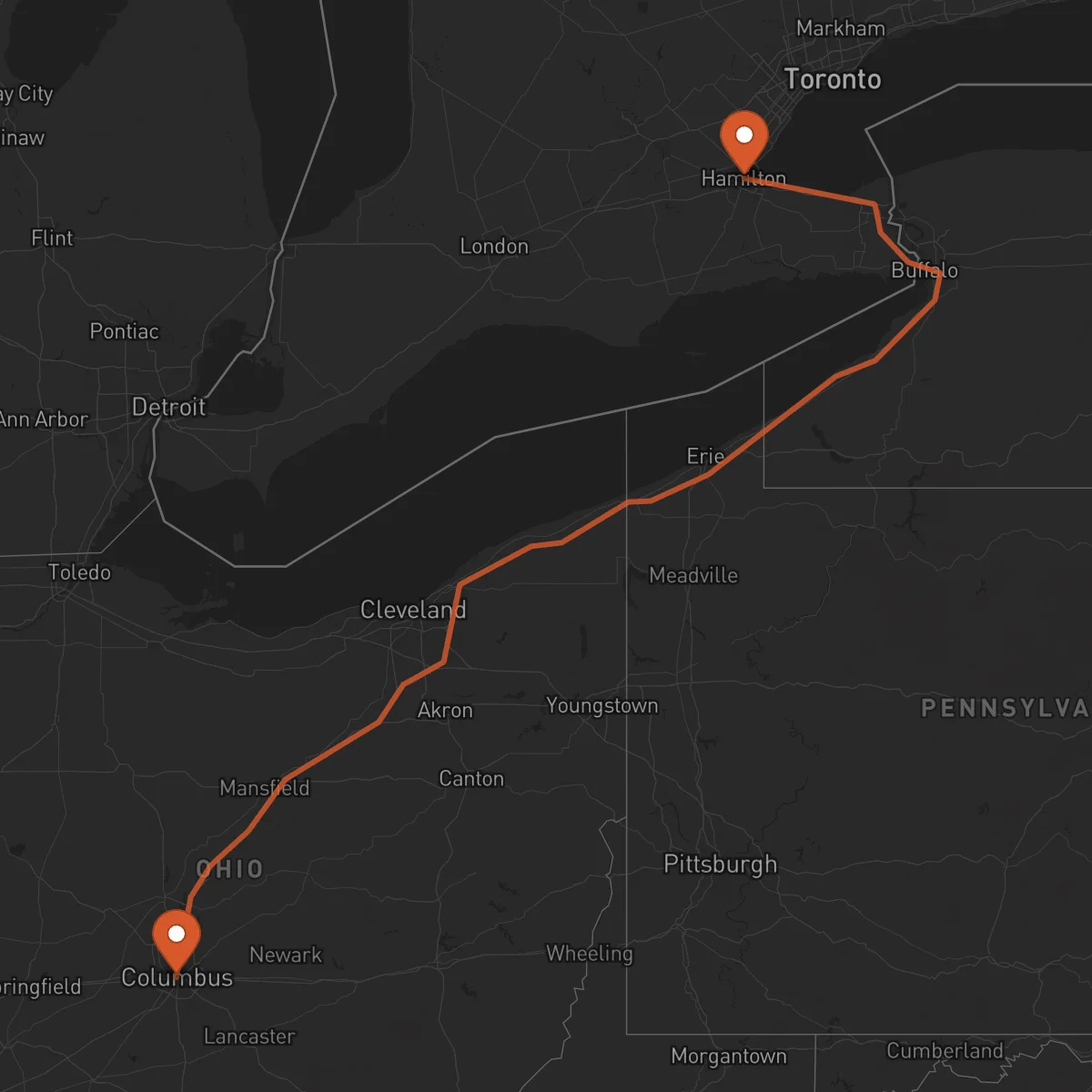
The Columbus-Hamilton corridor represents a vital cross-border logistics route connecting two major industrial centers in North America. This 449 km transportation link bridges Ohio's capital with Ontario's steel city, facilitating the movement of goods between the United States and Canada. The corridor serves as a critical artery for trade, connecting the manufacturing heartland of the Midwest with Canada's industrial corridor along Lake Ontario.
The economic significance of this route cannot be overstated, as it connects regions with complementary industrial strengths. Columbus, with its diverse economy and strategic location, serves as a distribution hub for the Midwest, while Hamilton's industrial base, particularly in steel manufacturing and advanced manufacturing, creates substantial demand for inbound raw materials and outbound finished products. The corridor benefits from the robust economic relationship between the two nations, with trade volumes continuing to grow year over year.
Transportation infrastructure along this route is well-developed, primarily utilizing Interstate 71 North from Columbus, which connects to Ontario Highway 401 via the Detroit-Windsor crossing or alternative routes through Buffalo. The Detroit-Windsor crossing remains the busiest commercial border crossing between the U.S. and Canada, handling millions of commercial vehicles annually. Control Terrestre leverages this infrastructure with our network of certified carriers, ensuring seamless cross-border operations with expertise in customs documentation, border clearance procedures, and compliance with both U.S. and Canadian regulations.
Services for this Route
Available services for the corridor Columbus - Hamilton
 Origin
Columbus
Columbus, Ohio serves as a strategic logistics hub in the Midwest, offering exceptional connectivity through its central location and robust infrastructure. The city's economy is diversified across multiple sectors including healthcare, education, technology, and advanced manufacturing. Columbus benefits from its position within a day's drive of nearly half the U.S. population, making it an ideal distribution center. The metropolitan area is served by Port Columbus International Airport, extensive highway networks including I-70 and I-71, and rail connections through CSX and Norfolk Southern. The city's growing logistics sector is supported by numerous warehousing and distribution facilities, creating a strong foundation for freight movements in all directions.
 Destination
Hamilton, Ontario stands as one of Canada's most important industrial centers, strategically located on the western tip of Lake Ontario. Known historically as the "Steel Capital of Canada," Hamilton's economy has evolved to include advanced manufacturing, healthcare, education, and technology sectors. The city's port facilities on Lake Ontario provide crucial maritime access, while its position along the Queen Elizabeth Way and Highway 403 ensures excellent ground transportation connectivity. Hamilton's industrial base creates consistent demand for both inbound raw materials and outbound finished goods, making it a key destination for freight traffic. The city's proximity to Toronto and the U.S. border further enhances its strategic importance in North American supply chains.










