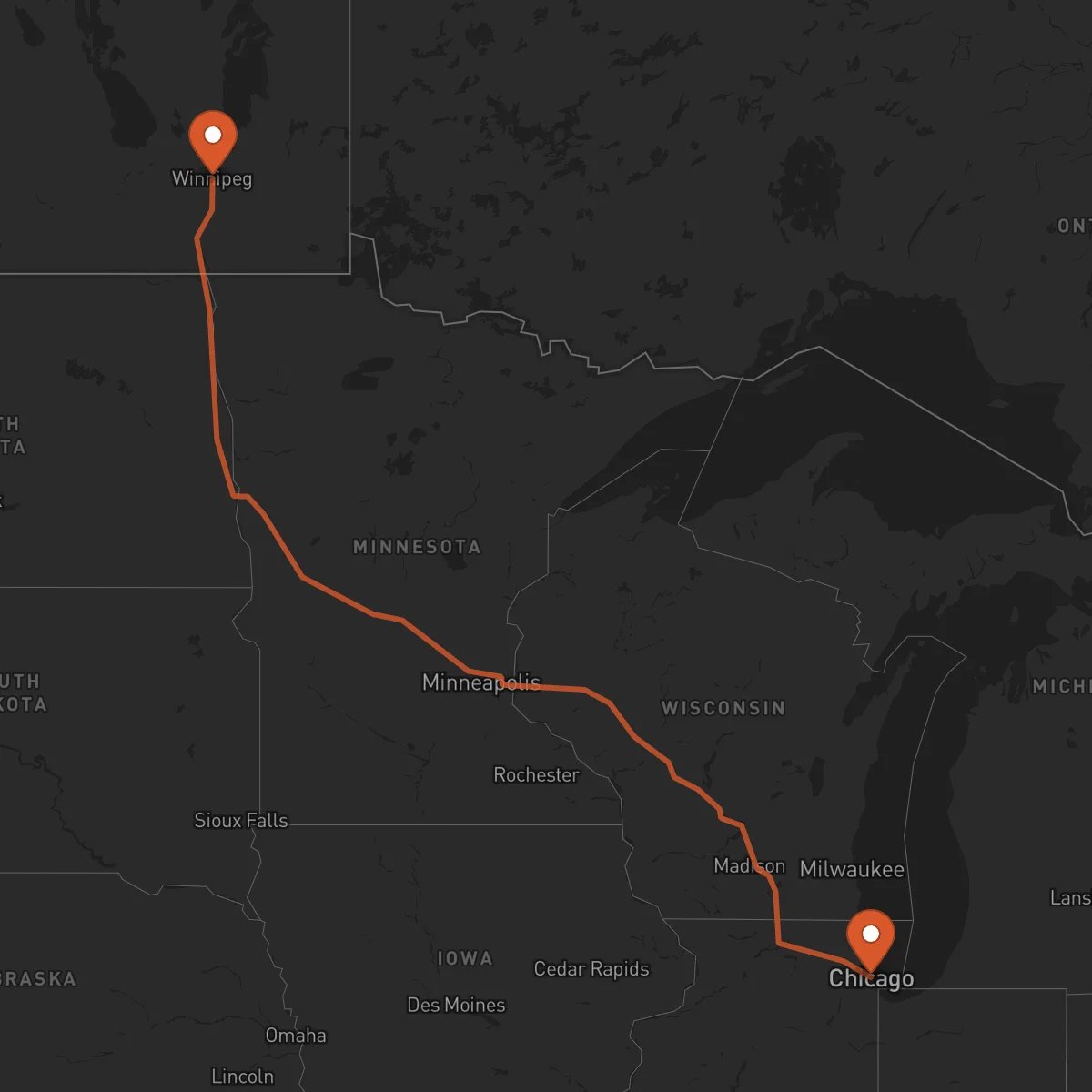
Chicago to Winnipeg
Winnipeg → ChicagoFTL freight transportation service between Chicago and Winnipeg. Reliable logistics solutions for your business.
Route Description
Everything you need to know about the corridor Chicago - Winnipeg
The Chicago-Winnipeg corridor represents a vital cross-border freight transportation route connecting the economic heart of the American Midwest with the strategic gateway to Western Canada. This 1,154 km route traverses the Great Plains, linking two major industrial and commercial centers through a well-established transportation network. The corridor facilitates the movement of goods between the United States and Canada, supporting the integrated North American supply chain and enabling businesses to optimize their distribution strategies across both countries.
This route serves as a critical artery for industries ranging from manufacturing and agriculture to retail and technology. Chicago, as a major transportation hub, processes vast quantities of goods that flow northward to Winnipeg, while Manitoba's agricultural and natural resource sectors supply products that move south to American markets. The corridor benefits from Chicago's extensive intermodal facilities and Winnipeg's position as a transportation nexus for Western Canada, creating a seamless flow of freight across the border.
Transportation along this corridor primarily utilizes Interstate 94 and Provincial Highway 75, providing reliable access through key points including Minneapolis and Fargo. The Emerson-West Lynne border crossing serves as the main port of entry, equipped with modern customs facilities to handle the significant freight volume. Control Terrestre's expertise in cross-border operations ensures smooth customs clearance, compliance with both US and Canadian regulations, and efficient transit times for full truckload shipments moving between these important economic centers.
Services for this Route
Available services for the corridor Chicago - Winnipeg
 Origin
Chicago
Chicago stands as one of North America's premier logistics hubs, strategically positioned in the heart of the Midwest with unparalleled transportation infrastructure. The city boasts six Class I railroads, two major airports (O'Hare and Midway), and extensive highway networks including I-90, I-94, and I-80. As a global intermodal center, Chicago processes billions of dollars in freight annually through its numerous rail yards and intermodal facilities. The region's economy thrives on manufacturing, food processing, printing and publishing, and financial services, creating consistent demand for freight transportation services to connect with Canadian markets and beyond.
 Destination
Winnipeg serves as the economic and transportation capital of Western Canada, strategically located at the confluence of the Red and Assiniboine rivers. The city functions as a critical distribution center for Manitoba and the surrounding prairie provinces, with major industries including agriculture, manufacturing, transportation, and wholesale trade. Winnipeg's transportation infrastructure includes the Winnipeg James Armstrong Richardson International Airport, extensive rail connections through Canadian National and Canadian Pacific railways, and major highways such as the Trans-Canada Highway and Highway 75. The city's position as a gateway to northern Canada and its role in supporting the region's resource-based economy make it an essential destination for cross-border freight movements.










