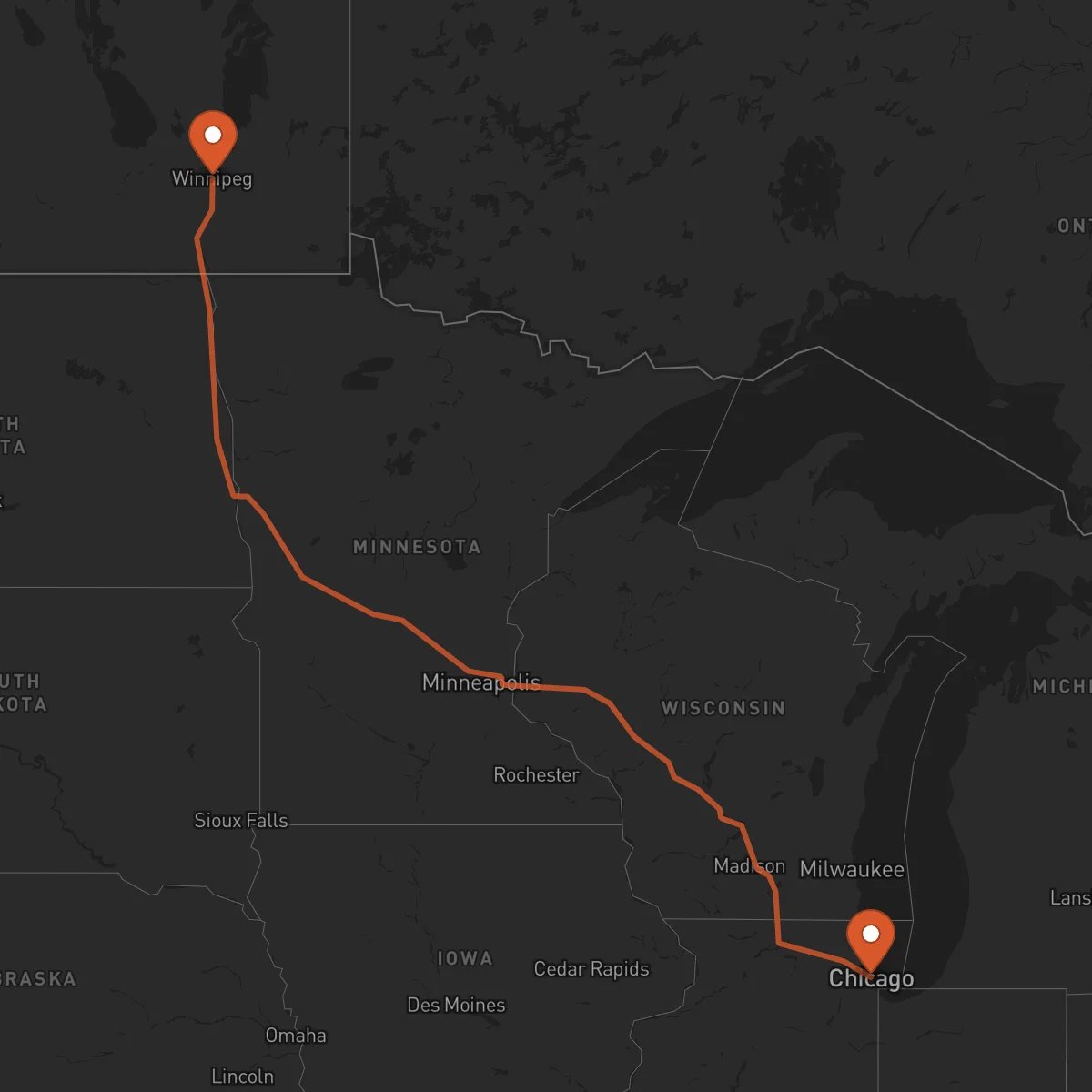
Winnipeg to Chicago
Chicago → WinnipegFTL freight transportation service between Winnipeg and Chicago. Reliable logistics solutions for your business.
Route Description
Everything you need to know about the corridor Winnipeg - Chicago
The Winnipeg-Chicago corridor represents a vital trade route connecting the Canadian Prairies with the heart of the American Midwest. This cross-border transportation link spans approximately 1,154 kilometers, facilitating the movement of goods between Manitoba's capital and Chicago, Illinois. The corridor serves as a crucial artery for North American commerce, connecting agricultural production in Western Canada with one of the United States' largest industrial and distribution centers.
The region's economic significance stems from its diverse industrial base. Winnipeg serves as a major transportation and distribution hub for Western Canada, with strong sectors in agriculture, manufacturing, and logistics. Chicago, meanwhile, stands as a global logistics powerhouse, housing one of the world's busiest airports and serving as a critical node in the North American supply chain network.
Key industries utilizing this corridor include agricultural products, manufactured goods, automotive parts, and consumer products. The route primarily follows major highways including I-90 and I-94, providing efficient access through Minnesota and Wisconsin. The Emerson-West Lynne border crossing serves as the main point of entry, offering streamlined customs processing for commercial freight.
Control Terrestre facilitates seamless operations along this corridor through our specialized cross-border expertise and certified transportation partners. Our team ensures compliance with customs regulations, provides real-time tracking, and maintains the highest standards of service delivery across this critical trade route.
Services for this Route
Available services for the corridor Winnipeg - Chicago
 Origin
Winnipeg, located in the geographic center of North America, serves as Manitoba's capital and a strategic logistics hub for Western Canada. The city's position at the confluence of the Red and Assiniboine rivers has historically made it a transportation nexus, now enhanced by modern infrastructure including the Winnipeg James Armstrong Richardson International Airport and extensive rail networks. Winnipeg's economy thrives on agriculture, manufacturing, aerospace, and information technology sectors, with the city housing major distribution centers for companies serving the Prairie provinces. The city's transportation infrastructure includes major highways such as the Trans-Canada Highway (Highway 1) and the Yellowhead Highway (Highway 16), providing efficient connections to both eastern and western markets.
 Destination
Chicago
Chicago stands as one of North America's most important logistics and transportation hubs, strategically positioned in the heart of the Midwest. The city boasts the largest inland intermodal port in the United States, with six Class I railroads converging in the metropolitan area. Chicago's economy is diverse and robust, anchored by manufacturing, finance, technology, and transportation sectors. The city processes over 40 million tons of cargo annually through its extensive network of highways, railroads, and airports, including O'Hare International Airport, one of the world's busiest cargo facilities. Chicago's central location and sophisticated infrastructure make it an ideal distribution point for goods throughout the United States and Canada, with numerous warehousing and fulfillment centers supporting e-commerce and retail operations.










