Chicago to Toronto
Toronto → ChicagoFTL freight transportation service between Chicago and Toronto. Reliable logistics solutions for your business.
Route Description
Everything you need to know about the corridor Chicago - Toronto
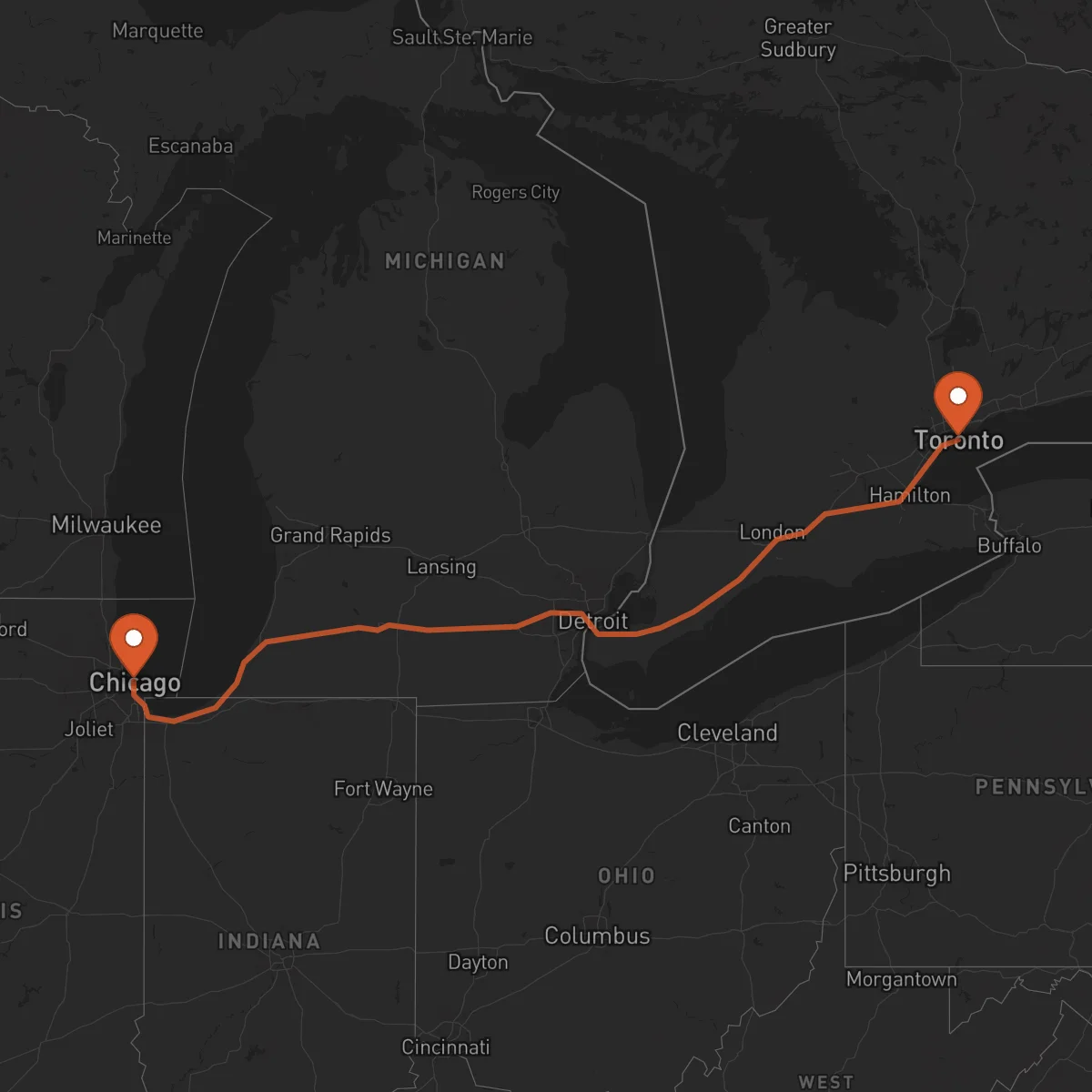
The Chicago-Toronto corridor represents one of the most critical logistics routes in North America, connecting two major economic hubs across the United States-Canada border. This 701-kilometer route facilitates the movement of goods between the Midwest's industrial powerhouse and Canada's largest metropolitan area, supporting billions in annual trade. The corridor's strategic importance stems from its role in connecting manufacturing centers, distribution networks, and consumer markets across both nations.
The economic significance of this route is underscored by the diverse industrial landscape it serves. Chicago's manufacturing base, including automotive, machinery, and food processing industries, relies on seamless connectivity to Toronto's financial services sector, technology companies, and advanced manufacturing facilities. The corridor also supports the agricultural sector, with grain and processed food products moving in both directions, alongside consumer goods, electronics, and industrial equipment.
Transportation infrastructure along this route is robust, primarily utilizing Interstate 90 and Ontario Highway 401, which form a direct connection between the two cities. The corridor crosses at the Detroit-Windsor border, one of North America's busiest commercial crossings, before continuing through Ontario's well-developed highway network. Control Terrestre's expertise in cross-border operations ensures efficient customs clearance and compliance with both US and Canadian regulations, minimizing delays and optimizing transit times for full truckload shipments.
Services for this Route
Available services for the corridor Chicago - Toronto
 Origin
Chicago
Chicago stands as a pivotal logistics hub in the United States, strategically positioned at the intersection of major transportation networks. The city's location in the Midwest provides access to a vast consumer market and serves as a gateway to the eastern United States. Chicago's extensive transportation infrastructure includes O'Hare International Airport, one of the world's busiest cargo airports, and a comprehensive rail network operated by major Class I railroads. The city's extensive highway system, including I-90, I-94, and I-80, facilitates efficient ground transportation in all directions.
 Destination
Toronto serves as Canada's primary economic engine and a crucial logistics center for the country. The city's strategic location on Lake Ontario provides access to both domestic and international markets through its port facilities and proximity to major US border crossings. Toronto's robust transportation infrastructure includes Pearson International Airport, Canada's largest and busiest airport for both passengers and cargo, and an extensive highway network centered around Highway 401, the busiest highway in North America. The city's position as a financial and technological hub drives consistent freight demand, particularly in specialized and high-value cargo categories.










